
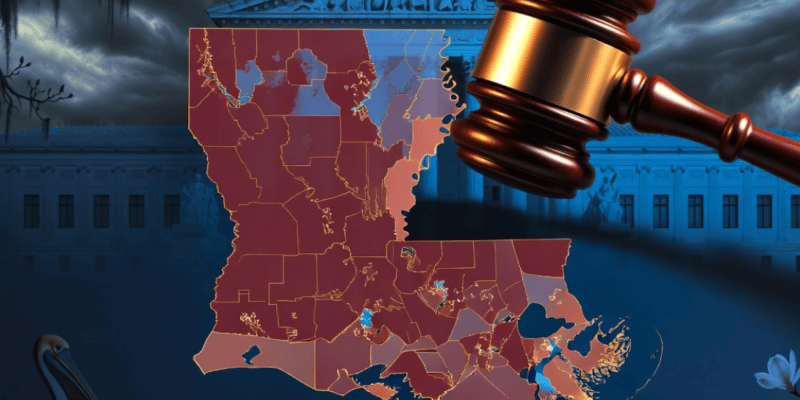
In 1986, the case of Clark v. Louisiana was filed in the U.S. District Court for the Middle District of Louisiana, seeking to restructure the election of judges in Louisiana to reflect the racial proportionality of the state’s population. This week, three district judges in East Baton Rouge Parish’s 19th Judicial District Court have moved to reopen this forty-year-old case to protect racial gerrymandering authorized under the long-closed and settled case that first authorized unconstitutional racial elections of Louisiana’s judiciary.
The Clark petitioners ultimately succeeded in restructuring Louisiana’s historically and jurisdictionally based “At Large” election system for state judgeships. More specifically, the Clark petitioners were the beneficiaries of a legal “surrender” in which then-Governor Edwin Edwards and Attorney General Richard Ieyoub voluntarily agreed that Louisiana would allocate state judgeships by race. Governor Edwards agreed to end “At Large” elections and instead implement race-based elections for district judges and circuit court of appeal judges using racially segregated white-majority and black-majority election subdistricts within the affected judicial districts. The race-based election subdistrict scheme was also implemented for Louisiana’s circuit courts of appeal. The Clark legal and constitutional surrender authorized a new, racially segregated election scheme. The new race-based scheme imposed on Louisiana voters statistically constructed subdistricts that structured judicial elections according to the proportionate racial composition of the judicial district’s underlying population. Additionally, the race-based, segregative election system required that certain people be denied their right to vote for some of their own judges based upon their race’s proportion of the population within the particular judicial district.
Until the Clark surrender, Louisiana used an “At Large” judicial election system. Every voter had the right to vote for every district judge. Louisiana has forty-one (41) legally defined district court jurisdictions. Each of Louisiana’s judicial districts was and is a combination of one or more whole, contiguous parishes. The parish or parishes included in an individual judicial district established the boundaries for two fundamental governmental and democratic functions. First, the judicial district defined the primary area of the court’s judicial jurisdiction (judicial power and authority) over the people therein and the cases and events that occur inside those parishes. Second, each individual district court judge was elected to a specific district court judgeship by all the voters in the judicial district over which the judge had primary judicial authority. Full democratic accountability was the norm.
To better understand the Clark changes, consider these details of the “At Large” system abandoned in the Clark settlement. A judicial district may have from one (1) to eighteen (18) district judges with primary judicial authority therein. Cases are randomly assigned among the individual district judges. After the assignment of a case to an individual district judge, that judge presides over the assigned case without intervention by any other district judge. In short, district judges act independently and individually to bring their assigned cases to final judgment or conclusion.
In contrast, the race-based Clark election structure now clearly and fundamentally violates the Equal Protection Clause of the 14th Amendment and the voting protections under the 15th Amendment. To be clear, today’s electoral “subdistricts” are limited areas within the judicial district (much less than the whole judicial district) in which voters elect one or more of the district judges. The sorting of voters intentionally segregates voters by race to encourage and enhance racial voting patterns. With white-majority subdistricts and black-majority subdistricts, the state has intentionally allocated judicial power at the district court level by race. That is the election system we have now in our high-population parishes.
What is historically, legally and constitutionally critical about Callais’s 2026 holding is that, since the Clark surrender to race-based elections, the application of Section 2 of the Voting Rights Act (Thornburg v. Gingles, 478 U.S. 30 (1986)), Section 5 of the Voting Rights Act (Shelby County v. Holder, 570 U.S. 529 (2013)), racial gerrymandering standards under the Equal Protection Clause of the 14th Amendment, and the right to vote under the 15th Amendment (Louisiana v. Callais, 608 U.S. ___ (2026)) have all clarified that the Clark race-based election system is not required by the Voting Rights Act and clearly violates the 14th and 15th Amendments. As declared by the Supreme Court in Callais:
“Our [the Supreme Court’s] acceptance of race-based state action has been rare for a reason.” SFFA, 600 U. S., at 208. “ ‘Distinctions between citizens solely because of their ancestry are by their very nature odious to a free people whose institutions are founded upon the doctrine of equality.’ ” Ibid. (quoting Rice v. Cayetano, 528 U.S. 495, 517 (2000)). And in redistricting, “where the State assumes from a group of voters’ race that they ‘think alike, share the same political interests, and will prefer the same candidates at the polls,’ it engages in racial stereotyping at odds with equal protection mandates.” Miller, 515 U. S., at 920 (quoting Shaw I, 509 U.S. 630, 647 (1993)).
The cases cited above, cumulatively provide the unambiguous explanation of how and why the legal standards applied by the parties and the Court in Clark were clear legal and constitutional error. Moreover, the Supreme Court in Rucho v. Common Cause, 588 U.S. 684 (2019) has made clear that our many states have their own prior constitutional power and authority to choose the election system that each state desires to implement within its boundaries (absent intentional racial discrimination).
Advertisement
With this series of constitutional decisions, Louisiana is in a position to “constitutionalize” the judicial election system applicable to all of its state judges. As to the election of district judges, the state could choose to return to the original “At Large” judicial election system. This system requires that each judge be elected by majority vote within the judge’s judicial district to serve that individualized judgeship. In this system, each voter gets to vote for each judgeship.
An alternative judicial election system would utilize “Group” elections for district judges in judicial districts with more than five district judges. With a “Group” election system, a designated group of district judges would run together. Three or four district judges are assigned to each election group. If there are three judgeships to be filled, each voter can cast three votes for one of the candidates. The results would be determined by plurality. The candidates receiving the most votes would fill the available judgeships. This “Group Plurality” system fully empowers all voters and reduces the campaign costs for judicial candidates. Finally, the “Group Plurality” system is functionally much more likely to encourage crossover voting from all communities, racial groups and partisan groups within the judicial district.
Regardless of the “At Large” system or the “Group Plurality” system adopted, all district court judges should have jurisdictional authority over all types of cases (civil, criminal, juvenile and family) that come before a district court. This full jurisdictional voting requirement guarantees that all voters’ constitutional right to vote for state officials who exercise authority over them is preserved. Also, specialization of jurisdiction should be rejected. Specialized judicial jurisdiction breeds “special interests” in the limited subject matter and the resulting election. Specialization magnifies individual influence and creates judicial fiefdoms.
It is time for the Louisiana Legislature to “constitutionalize” our judicial election system, ending racial election districts.
Paul Loy Hurd, President
Louisiana Excellence, Inc.
Email: paul@louisianaexcel.org
Non-profit Corporation dedicated to Louisiana Prosperity
Advertisement
Advertisement
