
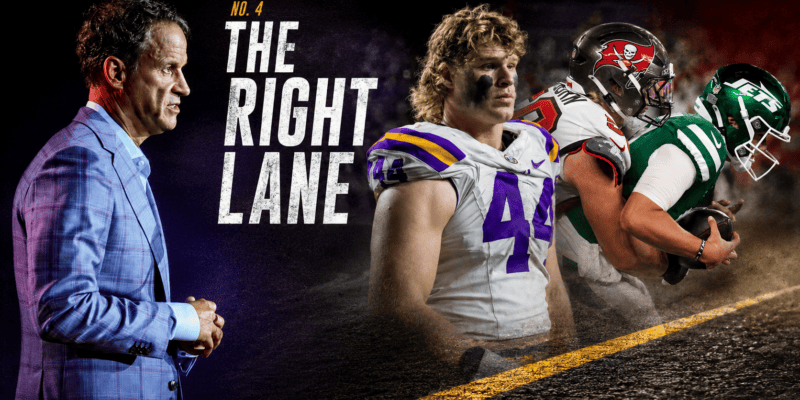
LSU head coach Lane Kiffin argued at SEC Media Days that recruits who have never played college football “should be making less.” Remembering the NFL’s old rookie-pay imbalance in relation to ten-year vets and the fix to that disorder, he added, “Our system is a little screwed up, in my opinion.”
Yeah, just a little.
And anyone could see this monster growing out of control. Back in January, a TigerDroppings poster said this….

That came months before Jack Pyburn had signed with the Buccaneers, before playing well in camp while competing for a roster spot, and before yesterday, when a Louisiana court granted a temporary restraining order against the NCAA, potentially clearing the way for Pyburn and others to receive a fifth year of eligibility and return to college football this season.
Reportedly, the lawsuit includes 33 athletes, 16 of them football players.
“Courts across the country granting relief to ineligible athletes who already had every opportunity to compete in college—sometimes without even having a hearing—are failing to appreciate the destabilizing effect their rulings are having on college sports,” said Tim Buckley, NCAA senior vice president of external affairs.
“The lawyers bringing these cases seemingly won’t be satisfied until every professional athlete can treat college sports as a fallback option, regardless of the opportunities it strips from those who will never have a chance to begin their collegiate sports experience.”
The legal history shows the slippery slope opened by the NCAA itself. In June, the NCAA adopted an age-based eligibility system capable of allowing five seasons within five years. It awarded, however, “No additional eligibility” to athletes who used their final season during 2025–26—a group that included many who began playing in 2022 and believed their college careers were finished.
Judge Charlotte Sweeney’s preliminary injunction in Wisne v. NCAA protected that class:
The Five-Year Eligibility Rule (or Rule, for short) poses a problem for Plaintiffs. It does not apply to athletes who began playing in 2022 and were deemed by the NCAA to have completed four years of competition.
Judge Sweeney’s clarification didn’t explicitly address the separate rule against players returning after signing a professional contract.
The Louisiana order does that, at least in a limited way.
It was crystal clear a long time ago, what the TigerDroppings poster said. Any fan who had been watching the sport since 2021 could see where it was all going, and many said so while more important people with microphones continued assuring everyone that the spirit of college football would never be lost, that each successive change would be limited to what was good for the student-athlete, etc etc etc.
Not all of them, but many.
With every successive story like this, the whole thing slides more and more out of control. The onset of NIL in 2021 didn’t just give players the chance to earn endorsement money. As so many knew it would, it became a pay-for-play system.
When LSU completed its NFL-style football administration in June, we noted that the building of the professionalized front office indicated that LSU was not just adding more staffers—it was building the infrastructure needed to effectively manage a paid roster.
Of course that whole system was assumed to be directed one way—from high school to college to the pros.
But this new case may seriously challenge that assumption, and may be the next chapter in battering college football unrecognizable, to reference a line from the film As Good As It Gets.
As good as it gets, indeed, for the cynic saying all along, I told you so.
The Lane Kiffin Probably Won’t Travel
Kiffin had already been asked about this developing story before the Louisiana ruling yesterday. After Sweeney’s Colorado ruling, a reporter asked whether Kiffin would consider adding fifth-year players from the 2022 class this close to the season.
“We look at everything,” Kiffin said, “so we would be prepared for that.”
Kiffin continued by noting the obvious, that such players had missed seven months in the program, that some would be returning to different coaching staffs, that other schools might already be full at their positions.
That that that that…
He seemed genuinely unable to adequately answer the question, which is not a knock against him, but perhaps the sheer insanity of the question having to be asked in the first place.
“I don’t know what that would mean,” he said. “You’ve always got to look at who they are, and will they learn your systems and all those things coming that late? They haven’t been with programs for seven months. And where some are at (like at LSU), the coaches have changed at a number of them. And there are places that don’t want them back because they’re full at that position, or there are new coaches there.”
Of course, his seeming tiptoe through the response didn’t draw the line we would like to see. He didn’t say that a student-athlete who had removed the word “student” and crossed into professional football should never be permitted to cross back. He said that a late arrival might not learn the system in time or fit the roster or like the coach. Those are football objections, and we know from following Kiffin that football objections will quickly disappear whenever the player is good enough.
Jordan Seaton, for instance. Had he gone on to the NFL, and then wanted to cross back to play for LSU, would Kiffin have turned him down?
What about Sam Leavitt?
The answer may have come, if it hadn’t already, during Monday’s press conference. When Kiffin was asked about relying on true freshmen along LSU’s defensive line, his answer was true and even good from an old-school college perspective, but also telling in light of the possibility of “old” 2022 players returning to the college gridiron.
“If you study, old teams win now,” he said. “And I just think that’s the maturity of the player, especially the fourth to fifth year player, and how they think and what’s important to them. And they’re used to playing too. They’re veterans…. The fifth year player plays different than the rookie usually. So there’s a lot of concern there.”
So yes, Kiffin understands why accepting a court-restored veteran might disrupt a roster assembled over seven months, but he also understands that fifth-year players generally perform at a more mature level than freshmen, whose mistakes become especially dangerous against LSU’s schedule. It wasn’t a direct response to the Jack Pyburn story, but his answer is telling.
Again, think Seaton and Leavitt.
The Right Lane here would have Kiffin refusing the temptation. If Pyburn or another player signs professionally, enters an NFL camp, and then becomes eligible through a court order, LSU should tell him that the line has already been crossed.
Advertisement
We, or at least I, do not believe Kiffin will do that if the player can fit quickly enough and help LSU win a national championship. He won’t accept every plaintiff who wants to come to Tiger Town, no, but his established philosophy—as sound as it is in many contexts—tells us that he will accept any Seaton or Leavitt out there who enhances the football side. His stated objections last week concern timing, the system, the staff, and roster space; but if ever there comes reason to make those obstacles go away, the reason to keep the line where it is will go away with them.
The selfish LSU fan still inside me can imagine a player, maybe not Pyburn but someone better, returning. It would be fun to follow a title as a fan again.
Deep down, though, the more upright part of me knows that something has gone terribly wrong, and recognizing that doesn’t require becoming a prudish virtue-signaler or pretending that I’m perfect or that college football was immaculate before 2021.
A man playing well enough to receive praise for two sacks in an NFL preseason game should not return to college and take the place of someone who is a legitimate student-athlete, as silly as even that label is now.
And that silliness—the professional side of college athletics that NIL brought—is what will give someone arguing against me all the ammunition he needs. He’ll say they aren’t even student-athletes anymore. That they are paid to play football and just complete their courses online or through a tutor. That there is no difference in the matter, especially if the player can return to college and make more money.
And on some level, he would be right about all of that.
Final Thoughts
Do the players have a reasonable fairness argument in this situation? Precedent had established that their college careers were finished, and then the precedent changed. And then the courts got involved. All after the fact.
Probably unfair then, yes.
Does unfairness, then, constitute reason enough to take such another leap forward on this road of insanity?
Such a sympathetic claim can open a door of no return among a myriad of doors of no return.
The Louisiana order is temporary, sure, and Pyburn may remain with the Bucs, but the loophole has been publicized. If it survives, the next lawsuit will ask why the 2022 privilege should remain confined to that particular class.
It’s a good guess that somewhere on TigerDroppings they’re mentioning that now.
It seems screwy for a judge to be involved in something like college athletics, no matter how you turn it. But one thing is worth remembering: The NCAA surrendered its authority through decades of embarrassing contradiction and hypocrisy, and it had been doing it long before the NIL era.
The Right Lane is simple enough to identify and terribly difficult for a coach paid to win: refuse the advantage. We doubt Kiffin will, and the petulant LSU fan in me may even hope he doesn’t. But that conflict, my own, is precisely why the boundary cannot depend upon the voluntary restraint of whichever coach will be punished on Saturday for observing it—because the conflict I feel strongly enough to write about is nothing compared with the one confronting a coach who will be punished on the scoreboard for following virtue. Just ask Dabo Swinney.
And that circles us back to the elephant in the room once again. We are trying, in this space, to discuss where virtue lies inside a world that is a Truman Show, a bubble where reality and the soul don’t even matter. The cynic can argue easily enough that not a shred of virtue is left to find. He can point to paid rosters, online courses, NFL-style front offices, and now professional players potentially returning to college, and there is enough evidence there to tip our cap.
Does conceding that much to the cynic mean surrendering the rest, including one of the few lines still separating college football from the NFL?
My gut says that line is long gone already.
And yet still I write so that others will think, which brings me to my final word today: If there is any shred of virtue remaining in Truman’s show, there must come a point at which college football tells a pro being praised for two sacks in an NFL preseason game that sir, we wish you the best of luck, but you are done here.
Advertisement
Advertisement
