
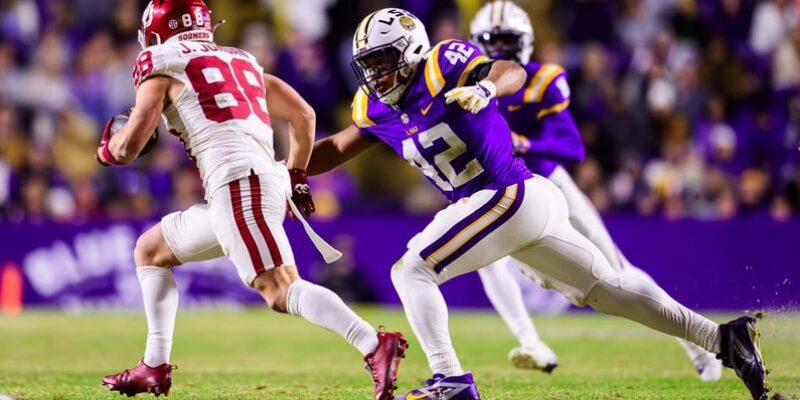
LSU linebacker Davhon Keys gave one illustration this week for something we discussed in Monday’s MIKE CHECK, concerning whether or not there were enough players from last year’s team for any sense of revenge to matter in Tiger Stadium last Saturday night.
“You’ve got to go in and play for him,” Keys said of Whit Weeks, starting linebacker and heart and soul of the Tiger defense, whose injury against Texas A&M has thrust Keys into a larger role and the spotlight. “I have to start bringing the juice.”
Whatever he means by “juice,” one thing is clear: Football players and athletes in general not only can, but so often do, find motivation in what happens to their teammates.
The importance of this reality goes well beyond A&M. It will go into this weekend and likely the entire month of October as several key players on the LSU team are recovering from injury. Weeks, Trey’Dez Green, and DaShawn Spears are the three most known, but there are other key pieces out as well.
Here’s some of the rest of Keys’ thoughts:
“The first thing is you’re devastated for him because you never like to see anyone get hurt,” Keys said. “But then you know you’ve got to flip that mindset. You’ve got to go in and play for him.
“He put his body on the line, so you’ve got to go put your body on the line, too. You’ve got to show him that you’re willing to ride for him.”
Yes, Keys is also a returning player, but inside the concept of positive peer pressure, this is not really a factor. In quite the understatement, returning players don’t forget something like injuries or what disrespect A&M showed last year in Tiger Stadium simply because new teammates are in the locker room. And those newcomers don’t have to experience the embarrassment personally to understand what it meant to the teammates beside them, particularly if the team is close, which all signs point to being the case. They practice together, suffer together, and hear one another’s peer pressures all the time. A football team or any sports team for that matter exhibits precisely how the personal investment and concern of one group can become shared with the group very quickly.
If we’re concerned about them blocking out the noise from the media, do we not think they hear the voices of their own teammates?
I have no proof of this, but it is a good guess that somewhere inside this story is yet another reminder about how readily we allow the amount of media attention on any given story to direct our opinions.
Ole Miss and Lane Kiffin received the full revenge treatment from not just Oxford, but the entire conference and nation. We heard about that emotional backdrop for almost a full year, until we knew exactly what would be said if they subject came up among our own peer groups. So it was easy for fans to gauge some mythical level of importance.
If you notice, LSU’s revenge game against A&M received considerably less attention.
Which makes the myth in this case seem not relevant.
A story doesn’t have to dominate the spectacle of the electronic screen to be important inside a football building. The absence of a weeklong media production meant to stir our emotions isn’t evidence that the motivation on the actual Tiger football team wasn’t there.
Advertisement
As we mentioned in the MIKE CHECK, Kiffin’s postgame ever so slight acknowledgment of that payback—particularly in his comments about defensive coordinator Blake Baker’s investment in stopping Marcel Reed in the off-season—gave fans reason to see the reality of the locker room beyond that electronic screen. LSU’’s preparation and execution—and a 35-6 whipping that should have been worse—might very well move the “theory” from correlation to causation.
Next opponent up is McNeese, weather permitting, and the Tigers should roar just fine.
But Lane Kiffin must strike a difficult balance now. The offense still needs meaningful reps against live competition, even if it is of the FCS variety, and depth pieces need that experience to an even greater degree.
Yet every new series also brings with it the risk for further injury, and that, before you get into what should be a challenging slate of conference games in October, before the real gauntlet in November. Nothing can guarantee an injury-free night, no, not even with more reserves seeing the field, and Kiffin more than any coach I’ve ever seen has been candid in his concerns. What he can do, however, and will do undoubtedly, is manage workloads of the top playmakers and make sure those depth pieces play most of the game.
The hope on my end is that LSU is up 21-0 by the end of the first quarter, and from there it’s all about the reserves. If that happens, I wouldn’t look for LSU to cover at -53.5, but that should be the least of Kiffin’s concerns.
And from what I’ve heard about McNeese, at least so far this year, the Tigers second and third teams might be able to cover.
The bottom line: If and when everyone plays with the respect Davhon Keys expressed toward his fallen teammate Whit Weeks, the Tigers may find themselves heading into that challenge of an October SEC slate even deeper than they were before. It has been many a championship team through sports history to find diamonds in the rough when necessity called.
Thank you for reading The Hayride!
Advertisement
Advertisement
