
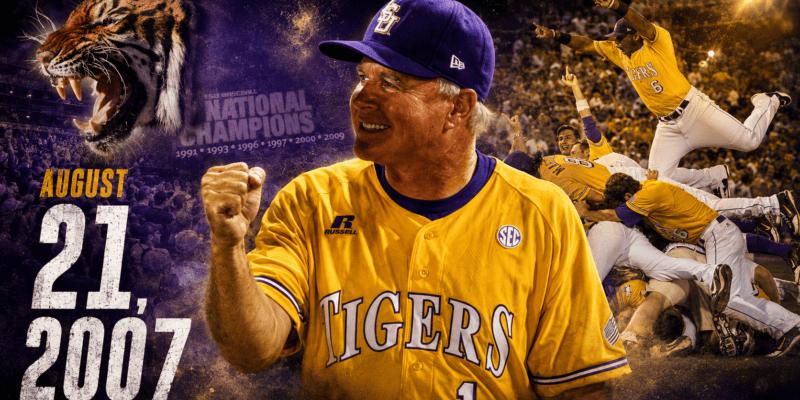
The LSU baseball program had gone up in smoke a bit when they course-adjusted and hired Paul Mainieri as its head baseball coach before the 2007 season.
That season was more of the same smoke, but the summer of the following off-season, Mainieri ended up saying something that has remained in LSU lore ever since.
“2008 will be the last time that people will take LSU baseball lightly.”
He said it on August 21, 2007, when he opened LSU’s first team meeting for the coming season.
At the time, taking LSU lightly had become less an insult and more just a matter of fact. The Tigers had finished Mainieri’s first season 29-26-1, missed the SEC Tournament, and failed to reach an NCAA regional. LSU hadn’t gone to Omaha since 2004, creating the program’s first four-year College World Series absence since 1982-85—the drought Bertman ended by taking LSU to Omaha in 1986. The old Bertman expectation that every senior class would reach Omaha remained alive, technically, but barely.
LSU baseball didn’t feel like LSU baseball under Smoke Laval, a reality that went well beyond the cartoonish uniforms. It made Mainieri’s statement either a declaration of the Tigers’ return to roar, or just more coach-speak leaving itself open for later ridicule.
The room nevertheless contained much of that roar before the games played it out. Blake Dean, Sean Ochinko, Jared Mitchell, and Ryan Schimpf were returning after receiving extensive playing time as freshmen. Mainieri had also signed the nation’s top-rated recruiting class, bringing DJ LeMahieu from Michigan, Micah Gibbs from Texas, and Leon Landry from just up the road in Baker. The official LSU retrospective of the 2008 team identifies that August 21 meeting as the beginning of the “resurgence.”
Certainly, it is convenient history now, a story that makes the piece on LSUSports that much more chilling. What wasn’t always convenient is how the statement’s truth played out in real time.
The Tigers opened 2008 by winning 10 of their first 11 games, then lost consecutive games to Stetson and Southeastern Louisiana before Tennessee swept them to begin SEC play. By April 22, LSU was 23-16-1 overall and 6-11-1 in the conference, sitting 11th in a 12-team league that would invite only eight teams to Hoover.
Tiger fans wanted Mainieri’s head.
Half of LSU’s 16 losses had come by one run. The Tigers had just lost two games to Georgia and finished the Sunday finale in a 10-10 tie after 12 innings, the game halted by the SEC’s travel rule. People outside the program saw another weekend of mediocrity if not failure inside a program once proud under Bertman.
But Mainieri kept telling his players they were one pitch, one hit, or one play from becoming what he believed they were. The eight losses by one run had borne that out.
Still, close isn’t good enough. His August promise was looking pretty ridiculous, most likely, in the minds of his players.
Or maybe it wasn’t. Maybe something about that August promise lit a fire under them.
It all started with an innocuous-enough Tuesday night at Tulane.
The Tigers trailed 4-3 entering the eighth inning. Dean doubled, Derek Helenihi singled and two quick outs threatened to strand them both. LeMahieu, the freshman whose arrival had been part of Mainieri’s plan to rebuild the roster, drove in both runners with a double. LSU won 8-4.
Mainieri sensed something different and called it the first game of a roll. Even he couldn’t have known what tidal wave the victory over the Green Wave was about to precipitate.
LSU wouldn’t lose again for more than a month, ripping off 23 consecutive wins—with a plus-118 run differential. They swept four straight SEC series, climbed from 11th place to the SEC Western Division championship, and won the SEC Tournament. They returned home and swept the Baton Rouge Regional, with the 23rd victory establishing what was then the longest winning streak in SEC history.
Only then did Mainieri return publicly to the statement he’d given them that day long ago in August.
Advertisement
The winning streak ended with an 11-5 loss to UC Irvine in the first game of the Super Regional in Baton Rouge, creating one more occasion for failure by LSU’s standards, for the season to once again collapse before Omaha. The Anteaters were scrappy, and just flat-out good. They were a bunch of “baseball players,” as the saying goes, and maybe only those who have played the game know exactly what that seemingly generic expression means.
The Tigers’ claws were definitely being tested.
Game 2 was more of the same. Things—everything—looked bleak. LSU trailed 7-2 entering the eighth inning. Six outs away from elimination and the permanent closing of the old Box.
But the Tigers scored twice in the eighth and five times in the ninth, winning 9-7 and forcing one last game, winner-take-all game for Omaha.
It was unthinkable that LSU should lose that Monday game—the definitive last game in a stadium that had seen so many wild and cherished memories.
There was no comeback in this one—because it wasn’t needed. LSU belted seven home runs and beat Irvine by the football tally of 21-7 before 8,173 fans, the largest actual crowd in the history of the old Alex Box Stadium. Michael Hollander, the only four-year senior position player, drove in the final run in his last home at-bat, perhaps one of those chilling nods to the coincidences only sports can bring.
The Tigers had preserved Bertman’s expectation after all, sending Hollander’s class to Omaha and giving the stadium one final electrifying dogpile.
As any Tiger fan knows, the remarkable run didn’t end with a championship. LSU lost its first game in Omaha to North Carolina, then trailed Rice 5-2 in the bottom of the ninth of an elimination game. Dean’s bases-loaded double produced a 6-5 victory, LSU’s first at the College World Series since the 2000 national championship. North Carolina eliminated the Tigers three days later, however, when a ninth-inning grand slam broke a 2-2 tie.
Mainieri said afterward that LSU had run out of miracles.
What it hadn’t run out of was players formed by them. More than 30 members of that team returned with the experience of the streak, the Super Regional comeback, and the solid showing in Omaha. Louis Coleman returned for his senior season after surrendering the grand slam that ended 2008. Dean, Ochinko, Mitchell, Schimpf, LeMahieu, Gibbs, and Landry were all still there.
When LSU opened the new Alex Box Stadium in February 2009, opponents were no longer taking the program lightly. The Tigers began the season ranked No. 1 and ended it there, finishing a sparkling 56-17 record, winning both the SEC regular-season and tournament championships, and ripping off a 10-1 record in the NCAA Tournament. On June 24, LSU defeated Texas 11-4 in the deciding game of the College World Series championship final, winning the program’s sixth national title and its first since 2000. Mainieri had returned LSU to the summit in just his third season.
And came out looking like a prophet to boot.
On August 21, 2007, it could’ve just been something inspiring to say to a team in a meeting room.
But by June 2009, it had become yet another baseball on the billboard.
Thank you for reading The Hayride!
Advertisement
Advertisement
