
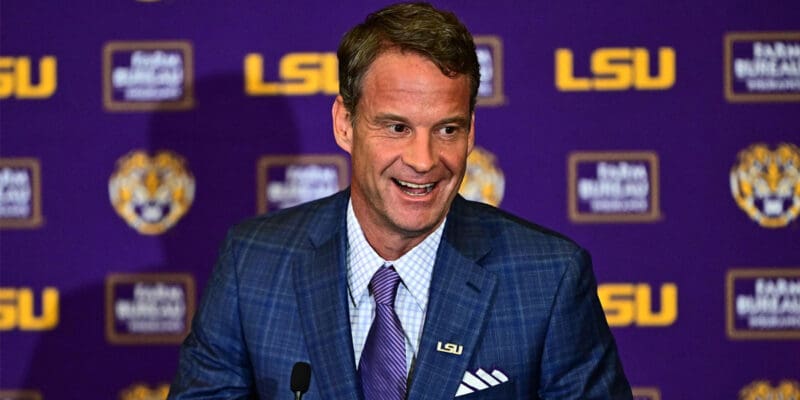
Three things have happened over the past few days which have the sports media throwing a fit about LSU’s athletic program – in a way which won’t damage the university’s desirability in the slightest.
Playing the villain is often an excellent brand to have. And LSU’s brand, even with the Jayden Daniels mess from a couple of weeks ago, has never been stronger.
The first development is one which has been coming for some time. Namely, former St. John’s superstar forward R.J. Luis, a 6-8 inside-outside threat who can do a little of everything, got an injunction in a Baton Rouge courtroom Monday to allow him to play for Will Wade’s basketball team. This is something a lot of people thought wouldn’t happen; a year ago Luis declared for the NBA Draft. He wasn’t drafted, but he signed with the Utah Jazz and was subsequently traded to the Boston Celtics. Luis didn’t make the roster, was optioned to the Maine Celtics G-League team and suffered a groin injury which kept him out all season. Because Luis still has a year of college eligibility left, he petitioned to be eligible, and judge Ronald Johnson of the 19th Judicial District Court in Baton Rouge granted an injunction against the NCAA which would give cover to Luis to play.
Is this absurd? Well, it depends on the standard you’re using.
Last season Santa Clara played a player who had spent two full seasons in the G-League. Because he was French, the NCAA allowed it.
It goes without saying that if you’re allowing G-Leaguers to come back to college basketball because they’re foreigners, you’re going to have some trouble in the courts trying to tell Americans they can’t do the same thing. And in Luis’ case, because of the injury he never saw game action other than in a couple of preseason games.
Adding Luis to the roster makes LSU Basketball a legitimate NCAA Tournament team and almost certainly a Top 25 team. Luis’ eligibility comes on the heels of signing Skyy Clark and Donovan Dent, who were the two starting guards on UCLA’s NCAA Sweet 16 team last year. Both of them are fifth-year players who were granted injunctions in California allowing them to play college basketball this year.
This comes about because of the NCAA’s new 5-for-5 rule, which has standardized college eligibility by age. Namely, that the old rule was you had five years to play four, and you could take a redshirt year for various reasons – freshmen would redshirt so they’d get an extra year of eligibility when they weren’t quite ready to see the field, or if a player was injured they’d take a medical redshirt, sometimes there were academic redshirts, etc. Now, you have five years. You can play in all five. It remains to be seen whether waivers will be given for injuries or military service or LDS missions or other such things.
For our purposes here, though, the implementation of the 5-for-5 rule has been chaotic – because the NCAA tried to say that players who first enrolled in college in 2022 weren’t eligible for the 5-for-5 rule. That was never going to hold up well; the cutoff is arbitrary, and because it denies players who would be 5th-year seniors a change to play and earn NIL money, this was always going to court.
And it did, and a whole host of players got injunctions for an extra year of eligibility. Including Dent and Clark, who with Luis will give LSU one hell of a good perimeter. LSU needs the four international pro players they’ve signed – 6-11 center Brice Dessert (France), 7-0 forward Michael Ruzik (Croatia), 6-9 forward Marco Santos (Brazil/Israel) and 6-8 forward Sal Niang (Senegal/Italy) – to get NCAA eligibility confirmed in order to shore up the front line, but there isn’t much reason to think they’ll be denied.
Because there is ample precedent based on the NCAA’s previous actions. Last season Illinois took a team to the Final Four which was loaded with European pro players.
What Wade is doing is ruffling feathers because he showed up late at LSU, with a history of breaking the rules, ditched the entire roster he inherited from Matt McMahon and kept most of his recruiting activities hidden from the regular media until the last minute. LSU’s official basketball roster as of this writing still only has four players – guards Divine Ugochukwu (a 6-3 junior transfer from Michigan State), Abdi Bashir (a 6-7 senior transfer from Kansas State), and Austin Nunez (a 6-2 senior transfer from Texas-San Antonio) and forward Mohammed Dioubate (a 6-8 senior transfer from Kentucky). The four international players, Luis, Dent, and Clark are not yet listed. Nor are the players who will fill the four other roster spots.
The college basketball press hates this, and they’re screaming about Wade’s tactics. Except nothing he’s doing – other than perhaps the Luis situation, though elements of Luis’ experience resonate in other players the NCAA allowed to be eligible in the past – is unprecedented. Wade just decided he’d push the envelope on eligibility rather than just accept what he could get coming to the transfer portal and high school recruiting late, while taking over a program which had won just 17 SEC games in the previous four years.
Still, the unconventional approach casts the outlaw shadow on LSU’s program. Not that Wade cares.
And Lane Kiffin cares even less than Wade does. Because after breaking the bank and reeling in a transfer portal class that was largely unprecedented, including raiding his former Ole Miss roster for players like Winnie Watkins, Princewell Umanmielen, Devin Harper and T.J. Dottery, Kiffin has played the 5-for-5 game more aggressively than anybody. When several players were granted an eligibility injunction in a different Baton Rouge court, LSU signed three fifth-year senior transfers in quick succession – defensive end Junior Tuihalamaka, who played at Notre Dame last year, and two former Ole Miss players in tight end Dae’Quon Wright and defensive tackle Xzavian Harris, both of whom were All-SEC players for Kiffin last year.
Wright was in camp with the Eagles and Browns and was cut from both. Harris was in camp with the Saints and was cut early.
This seems outrageous, except two weeks ago Texas reclaimed a lineman of theirs named Cole Hutson, who had been in camp with a couple of NFL teams. In other words, Kiffin hasn’t done anything different. Hutson might be going back to his former team, rather than transferring, but it’s already established that we’ve got free agency in college sports and Wright, Tuihalamaka, and Harris had already left Ole Miss and Notre Dame; it’s hard to make the case that they’re transfers in the traditional sense.
Is all of this outrageous? Of course it is. But what you could say about Wade and Kiffin is that they didn’t invent this game – they’re simply playing it more aggressively than other college programs. Both are new coaches at LSU trying to rapidly inject championship quality in programs which had fallen off competitively under their predecessors, and both want to win now rather than demand grace from the fans while they build their programs.
Nobody gives that grace anymore. With the transfer portal and NIL, there are no excuses not to win at a place like LSU.
SEC commissioner Greg Sankey is going ballistic over the Luis, Wright and Harris situations. There isn’t much he can do about it – the SEC can descend on the Louisiana court system, but they’re just another party in lawsuits; they don’t have the power to overturn judicial injunctions.
And what’s more, Sankey doesn’t have a leg to stand on. He didn’t do anything to stop a Mississippi judge granting a seventh year of college eligibility to Ole Miss quarterback Trinidad Chambliss, on some very hazy factual grounds, so it’s hard to justify stopping Wade and Kiffin from doing what they’re doing.
And there’s something else Sankey has to answer for.
Which is that he’s expanded the SEC from 12 teams to 16, adding Texas, Texas A&M, Missouri and Oklahoma, destroying the two-division format and now imposing a nine-game conference schedule on top of the requirement that SEC teams play at least one Power 4 conference opponent every year. That means SEC teams are forced to navigate schedules which could contain as many as 10 Top 25-caliber programs out of 12 games.
Which will have the effect of creating lots of 9-3 and 8-4 SEC teams which would otherwise certainly belong in the college football playoff. Sankey did no favors for SEC coaches in going to that gauntlet of a schedule.
And now he wants to tie member schools’ coaches’ hands behind their backs and prevent them from accessing players who could help them improve their rosters to make it through that gauntlet?
It isn’t a very persuasive argument. Not when the players in question either didn’t have an opportunity to play pro ball or tried out and got cut and won’t be playing football this fall otherwise. It’s hard to complain that they’re “pro” players.
Especially when the NIL money these guys are making, and certainly not just at LSU, is sometimes more than an NFL rookie free agent or practice squad player will make. Chambliss came back to Ole Miss because he’s making more money than he would have made as a second-round draft choice, if not a late first-rounder.
The arguments against what LSU is doing rest on a reality that no longer exists. And you aren’t going to shame a Lane Kiffin, who’s being paid $14 million to make the college football playoffs this year, out of signing players he thinks can improve his roster.
And you aren’t going to shame Will Wade at all.
Neither of them care, and the university has taken on the persona of hypercompetitiveness not just in athletics but overall – the administration just wants to win.
Maybe they will. And if they do as villains, they’re OK with that.
Advertisement
Advertisement
