
Yes I might be an avid reader and pray-er and see things slightly differently from most prototypical “conservatives” out there, but if anyone had to pin a label on me, it would most certainly not land left.
So I come at this piece, and more to come, from a place of charity, not political ideology, I assure you.
I’ve been wanting to write this article since the fall of 2024 when I saw a Protestant friend take up for Catholics online with this issue, saying that she is a Christian but that it isn’t right that the Catholic teaching of the Commandments is not what’s being represented in public school classrooms.
I simply haven’t written it until now.
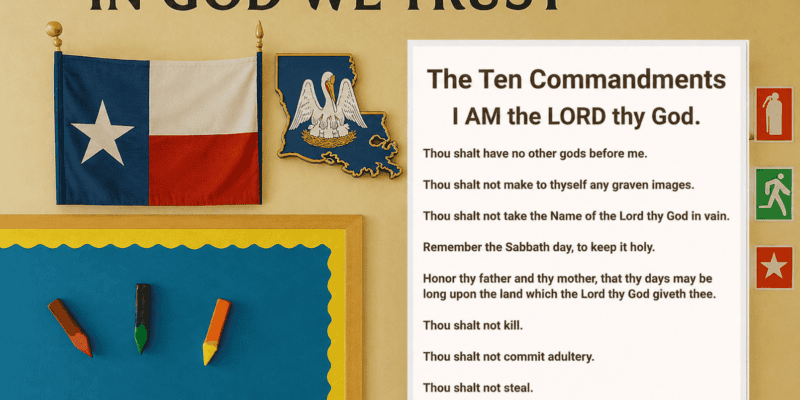
Yes, Texas and Louisiana have enacted laws directing public schools to display the Ten Commandments. But Catholic parents should know that the required wording is apparently a shortened, King James-based version developed by the Fraternal Order of Eagles in the early 1950s for a nonsectarian civic campaign, not the Catholic arrangement long taught in catechism.

According to one source compiled by Professors Marc Zvi Brettler and Jed Wyrick, there are things not being shared with the public:
The Eagles’ text is an inconsistently shortened rendition of the King James Version with a mere nod to Catholic and Lutheran tradition and perhaps a quarter-nod to Judaism. Its arbitrary abridgment of four commandments and its preference for Exodus at the expense of Deuteronomy underscore that it cannot legitimately be considered The Ten Commandments by any historically informed reader. The Eagles’ translation was incorrect seventy years ago, and its archaic English and its predominant use of the King James Bible—which enfranchises one particular religious community—is even less appropriate now.
My voice today is not contentious. This piece is more of a PSA instead of a declaration of right and wrong. If I didn’t know this as a Catholic parent, I’d want to know.
In working on this for over a week now, I’ve realized that the history behind the differences became too much to complete fully or responsibly with just one article, so I’m turning this into a three-part series. This first installment will present the two places where the Catholic arrangement divides the biblical text differently—and explain one of them in depth. In the second, we’ll look at the ancient arrangements, and in the third, we’ll present the Catholic catechisms and a possible response Catholic parents can give their children when questions come their way.
Louisiana and Texas
One of the latest controversies over the Ten Commandments in Texas classrooms is what precipitated this work, well over a week ago, which keeps the debate in territory recognizable enough to not even be news anymore. Still, if one looks deeper, it may very well set up an unfair binary trap for Christians of good faith, both Catholic and non-Catholic alike.
Supporters of the Commandments being posted in classrooms, exhausted and perhaps beaten down by the outbreak in woke ideologies over the last decade, see at least a modest acknowledgment that moral order is important in American society, believing that something is better than nothing. Who would argue with these ten basic precepts, right? After decades in which public schools have taught any number of moral and political orthodoxies without acknowledging that they are, well, orthodoxies, the conservative instinct to welcome the return of even a list suggesting the natural law is completely understandable.
Opponents, on the other hand, at least most of them it would seem (except the kind like my friend mentioned above) see government encroachment on their right to raise their children with the religion of their choice. This is indeed the case in the cited article above:
It’s the mothers’ different religious backgrounds that united them to advocate for religious freedom and parental rights, their attorney, Megan Hassan, said. They, along with many other parents who’ve expressed opposition to the law don’t want their children to attend a school that is “compelled to display a message that conflicts with their faith,” Hassan said.
Nath says she’s raising her children to learn multiple religions, including Hinduism, Jainism, Judaism and Quakerism. Roth says her children are receiving no religious upbringing. Sohal is raising her children as Sikhs.
That alone would create divide enough between conservative and liberal, thus ending the debate for the conservative.
But if prayerfully considered, particularly given so many people’s beef with public education in general, this might not be the woke stance it first appears; many a conservative may be an opponent as well.
The exclusion mentioned in the cited article could creep beyond what is listed and, believe it or not, into the Catholic realm.
I share the instinct of the “better than nothing” group to a degree, especially having read both Exodus and Deuteronomy, but my purpose here is narrower: Catholic parents in Texas and Louisiana have both the civil and divine right to understand why their children may encounter a familiar-looking poster that differs from the list taught at home and through Catholic catechesis.
Texas SB 10 prescribes one exact text for public schools. Louisiana’s HB71 falls in line. The text seems to be an unnumbered, a shortened rendering of Exodus 20 rather than both the familiar Catholic enumeration and the unabridged passage from the King James Bible (which is not Catholic). It seems to have emerged from a twentieth-century civic campaign intended to produce a display acceptable across the major American religious traditions. This is where the cited “Eagles’ translation” comes in, short for Fraternal Order of Eagles (FOE).
Ten Words, No Numbers
If you read the Old Testament, you’ll see that it gives us the “ten words” without placing an inspired numeral beside each command. Several ancient traditions divide the same biblical material differently. The poster avoids numerals, and, what Catholic parents might need to be aware of, its wording and line breaks do not match what the family has learned, and may leave their children wondering why and scrambling for answers with their friends.
The response might well be “something is better than nothing,” and that is the Catholic parent’s prerogative. What it should not be is ignorance and the child having to succumb to the weight of the crowd and change something inherent in their faith without the proper understanding.
The Commandments, or the Decalogue, appears in Exodus 20 and Deuteronomy 5. This translation is the Douay-Rheims, an explicitly Catholic one inspired by the Latin, Hebrew, and Greek—which is a whole other world with nuance we can’t get into here. Scripture later says that God wrote upon the tables “the ten words of the covenant” (Exodus 34:28).
The point: Neither account draws ten numbered compartments around the individual statements. Moreover, because the biblical speech contains more than ten imperative statements, which might imply more than ten commandments, some of them must be grouped if the total is to remain ten.
The first disputed division could be perhaps the most difficult for the Catholic child, because it concerns idolatry and images. In the Douay-Rheims, God says:
Advertisement
Thou shalt not have strange gods before me. Thou shalt not make to thyself a graven thing, nor the likeness of any thing that is in heaven above, or in the earth beneath, nor of those things that are in the waters under the earth. Thou shalt not adore them, nor serve them.
Reading the prohibition through its conclusion, “Thou shalt not adore them, nor serve them,” the Catholic tradition treats this chunk as one commandment. Catholics have never removed the passage from Scripture, as some will contend. Because God later commands two golden cherubim for the Ark (Exodus 25:18) and a brazen serpent in the desert (Numbers 21:8)—not to mention the exhaustive details commanded for the Ark of the Covenant, not to mention the only way early Christians could preach their faith since so many were illiterate—Catholic tradition holds that the contradiction must be mitigated elsewhere, that the law cannot forbid surface-level sacred image use—given elsewhere in His holy Word.
That mitigation, for the Catholic, happens at the line of idolatry, the positive of which is one of the four different forms of worship, one being explicitly reserved explicitly for God. So yes, if a person worshipped an image or a statue in the same way it worships God—which is liturgical (the Mass) for us—then yes, it would be idolatry.
That is why you see grave concerns that Francis did this with Pachamama, but again, that is yet another thread for another day.
My point: Catholic tradition does not, in any way, deviate from what is written right there in Scripture.
All of these distinctions can be difficult on the Catholic child. We hope our Protestant friends read it with charity, because that is the place from which it comes.
The splitting of the First Commandment could become especially important when a Catholic child’s Protestant friends point to what the poster numbers as the Second Commandment and use it to argue that God prohibits sacred images and statues, which have long belonged to Catholic understanding. If the child has never been taught why the Church treats the prohibition of graven images as part of the initial command against idolatry, he may be unable to explain the difference between worshipping an image as a god and merely venerating the person represented through it, perhaps leaving him isolated through ignorance, and worse, changing his beliefs just to fit in.
An unnumbered State-approved text cannot by itself provide the Catholic formation needed to understand any of these eternally important distinctions. Catholic parents must therefore perform their due diligence, making certain that their children know both the complete scriptural text and the reason the Church has arranged it as she has.
That way young people keep their friends and defend what they know. It might well earn a great measure of respect from those peers.
Final Thoughts
In what will become a sort of aside for brevity’s sake and the fact that the first example provides the point we wanted to make today, the second disputed division comes at the end of the Decalogue. Exodus places the neighbor’s house before his wife, whereas Deuteronomy places the wife first and then identifies the property. Following the distinction Saint Augustine found in Deuteronomy, the Catholic tradition treats disordered desire for another man’s wife separately from disordered desire for his goods, in line with Christ’s warning that if a man even look upon a woman with lust, he has already committed adultery.
These become the Ninth and Tenth Commandments.
Ultimately, given that there are actually more than ten explicit commands, the disagreement concerns where the ten divisions should be located within Scripture. It doesn’t alter the words themselves, and both Catholics and Protestants must understand that about Catholic tradition. No one removed the “graven images” part.
But it is, quite obviously for anyone who knows the Catholic-Protestant conversations, where the greatest contention potentially could lie.
I think that knowledge may well be the most useful and charitable starting point for Catholic parents.
It is also where this first installment should end. In Part 2, we’ll go backward through the ancient Jewish and Christian arrangements of the Decalogue, giving our best effort to show how far this incongruence really goes.
Advertisement
Advertisement
