
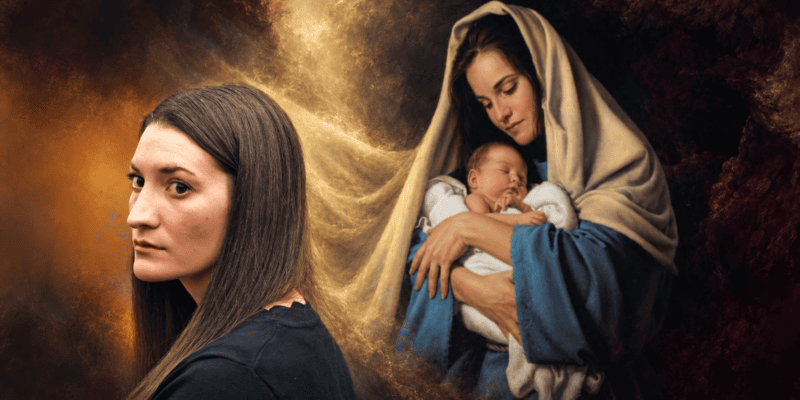
Much of the country has spent the last several weeks being asked to enter the mind of Lindsay Clancy, the Massachusetts mother accused of killing her three children.
The country is most certainly divided.
Even Catholic priests like local Clinton Sensat and non-local James Mawdsley have weighed in. Her defense has argued that postpartum psychosis rendered her incapable of criminal responsibility, while prosecutors have of course maintained that her actions were deliberate.
Here is a pull from each of these two Catholic priests’ work:
“I’ve seen stories of men calling off marriages and asking for divorces because their significant others have dared to speak in defense of Lindsay Clancy. I’m not privy to those conversations. But if these men are denying that mental illness is real, that postpartum mental illness is real, then they deserve a stern talking-to by someone who understands.
I don’t have an opinion on Lindsay Clancy’s guilt. I do have one on mental illness. It’s real. And it drives me nuts that we’re still treating it like a moral failing” (Fr Sensat, Facebook post).
—
“Why are human courts trying to do God’s job in determining culpability? Only God knows that. It suffices for the court to be concerned with the external actions. Murder needs to be severely punished. Questions of whether or not their [sic] was full knowledge or full volition are matters for the confessional, not the court” (Fr Mawdsley, original article).
I leave it to the reader to decide if these works can both exist in the same moral sphere. Perhaps they can, as it is certainly impossible to enunciate every single stance one has in a single social media post or an article. For more on the written perspectives of Catholic priests, and what the old Church taught not that long ago, see this article spotlighting Pope Pius XI’s teaching on the matter.
Regarding Clancy specifically, last week, after the jury remained deadlocked on the case for many days, the judge declared a mistrial.
I don’t know the final resting place of her soul for all eternity, and neither does anyone speaking with the certainties I’ve seen online, which does not include the two aforementioned priests, by the way.
But I definitely have an opinion on matters of sin and justice, and I have it because I’ve applied it harshly to my own life, my own past, my own sins. We’ve written on this before as well. Here are just two of those Catholic perspectives:
NOT MISTY: The Clear-cut Story of Justice and the Final, Single Sentence
Louisiana’s Death Penalty Debate and the Forgotten Meaning of Justice
Entering the defense’s perspective for a moment, I can understand the appeal being made concerning Clancy. Look past the horror long enough to consider the possibility of a mind gravely wounded by illness, medication, fear, or some combination of all three. Such compassion is not inherently dishonest, nor is it inherently non-Christian or uncharitable.
But it must not make the memory of three little souls disappear.
I have struggled with mental illness. That mental illness has hurt a great number of souls. But after discovering tradition and the old Catholic way, I now realize, at least for myself, that no medication was necessary. The old way, the old order, the old discipline and liturgical-season regimen is enough. I was mentally ill because I was sinning so much, period. It was sin that was the root of the disassociation, because it was locking me in the false world and allure of evil rather than the reality of God and His will for me.
Does that apply to Clancy? I’m not making that case today. I’m simply confessing that I was a person once upon a time who thought mental illness was a separate thing from sin, and for me, it never was.
Juxtaposing Two Women
The case I am presenting today, on the Feast of the Nativity of the Blessed Virgin Mary, is that any defense of Clancy and call for patience with her exposes what may be a challenging asymmetry, particularly for non-Catholic souls.
Our society can become remarkably capacious when explaining the modern woman and her psyche, her complexities, her needs, even her sins, particularly when her story intersects with the favored language of trauma, mental health, autonomy, or oppression. I recognize it because I published work on it elsewhere that I’ve since un-published once I saw the error of my thinking.
Yet curiously, curious perhaps only because I am a Catholic and love her so, many of the same people—or let’s just “encapsulate” and say the general sweep of modern America—encountering Catholic devotion to Mary, become suddenly incurious, unfeeling, insensitive. They accuse Catholics of worshipping her, refuse the explanation that follows of four different levels of “worship” in the older language, and occasionally shame Catholic women for participating in the very tradition I and my wife both can testify brought order and healing to our own wounded minds.
Because they show humility under God by wearing veils?
But in the next breath some will use humility under God as the reason one shouldn’t think so highly of Mary.
There is a disconnect there, an asymmetry I am not judging—because I understand the difficulties of cognitive dissonance—but am gently and charitably asking us to consider.
If for nothing else but for my own measly birthday gift to my spiritual mother, no matter what criticism I might get for this article.
The Church’s teaching isn’t new. Marian devotion, even the modern version of the Catechism states, “differs essentially” from the adoration given to God. Catholics honor Mary precisely because of what God accomplished in her and through her, never because she replaces Him.
And as the old saying goes, don’t worry about loving Our Lady too much—you couldn’t possibly love her any more than Our Lord did.
Moreover, just to enter another viewpoint again, if there are indeed some Catholics out there who do go overboard with their devotion, this does not represent the teaching of the Church. Is it really so difficult to imagine that there be laws, but people stretch or break them?
Advertisement
That is their sin if it happens, not the Church’s.
It isn’t hard to see the difference in politics and culture. So it seems to me it shouldn’t be hard to give Mary the benefit of the doubt, not to mention the Catholics who have special eyes toward her as Christ’s mother, especially if we’re going to bend over backwards to do so for Lindsay Clancy.
The idolatry question, then, must be looked at in this case—gently and charitably, I remind you. I beg you not to miss a valuable point I’m trying to make by reading any ill-will into my words.
Having spent decades rejecting nearly every limit placed upon womanhood, we come to that unmistakable question. Have we begun worshipping an abstraction of woman instead, one who must always be defended from judgment, consequence, sacrifice, right order, and sometimes, even truth? This doesn’t illustrate every person who feels attached to defending Clancy, but it does, inarguably because of the collective data online, reveal a reflex in the culture, by which Christian compassion can suddenly devolve into a human-engineered absolution of sins whenever a woman or her mind seems under attack.
It is the “spectacle,” the “cave,” the “arena” we keep warning about. The woman has been relegated to a shadow on the wall, and I continue to fail to see how that defends her.
Is this case not what Fr Mawdsley stated, that, in this fallen world, some of this stuff is up to God and the soul, between them alone, that our human limits on justice must rein us in from becoming the gods of judgment ourselves?
Particularly when that judgment seems to remove the God-given dignity of three little souls, if not the woman herself?
Final Words
The Catholic Church intended Our Lady to be the heroine of women. She offers neither contempt for a woman like Clancy nor such artificial flattery that eliminates Clancy’s God-given dignity. Such protective gauze risks diminishing the very womanhood it says it is defending, presuming that compassion requires us to completely disregard courage, repentance, responsibility, and sound judgment—all virtues that would most certainly be lauded in a superhero action film spotlighting a woman character.
I guess ultimately my point is that there seems always to be an excuse in these situations, but never an excuse to lift up the Virgin Mary, Christ’s own mother.
The Church celebrates today, not the arrival of a goddess, but the birth of a creature whose freedom reaches its fullest extent inside the boundaries, yes boundaries, of uncompromising obedience to God. She gives to all women the “correction” of Eve, just as Christ is the correction of Adam. It is gender symmetry. Yet still she is honored and exalted without being made divine, and most importantly in relation to the Clancy case, compassionate without rendering sin meaningless.
If our culture can ask us to suspend judgment long enough to reframe Lindsay Clancy’s darkness, perhaps some of the more open women among us might suspend their suspicion long enough to reframe Mary as well. They may discover, as a pleasant surprise to themselves, that Catholics are not worshipping a woman as a god.
They are remembering what the one and only God intended woman to be—the last and greatest of His creations.
Read about Mary’s Magnificat from the Gospel of Luke here.
Thank you for reading The Hayride!
Advertisement
Advertisement
