
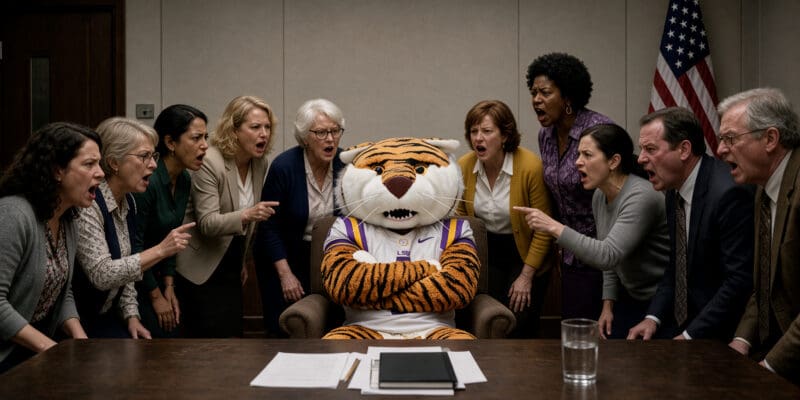
I posted this on X earlier this morning, and I’m going to expand on it here for the benefit of the people who don’t get what I’m saying. The X post…
All week long I've been watching two things without wanting to.
The fallout from the Lindsay Clancy trial and this ridiculous LSU-SEC saga.
And last night when I heard some inside word on what's actually going on with the SEC thing, it finally struck me that these two things…
— Scott McKay (@TheHayride) September 10, 2026
The whole thing…
All week long I’ve been watching two things without wanting to.
The fallout from the Lindsay Clancy trial and this ridiculous LSU-SEC saga.
And last night when I heard some inside word on what’s actually going on with the SEC thing, it finally struck me that these two things are actually the same story playing out in different venues.
LSU is that one juror who insisted she was guilty. And LSU is spending a whole week being berated by hyperemotional, hysterical people making outlandish accusations, threats and demands despite not actually doing anything wrong.
LSU is “arrogant” and refuses to respect the feelings of the rest of the group, and must be thrown off the jury. So the group engages people who talk for a living, and in particular bald old men who shamelessly toe the party line, to make fiery statements about punishing the juror for holding to his position.
And then there’s the army of people on social media, equally hysterical, who screech about the juror while inventing theories which don’t actually hold up to scrutiny.
People on the jury who came to the deliberations with a conventional view then get swept along in the hysteria, taking a position they previously would have thought was unwise, but afraid to buck the mob.
Everyone’s guns are trained on that one juror. They don’t like him.
But they can’t prove anything he did which is actually deserving of their scorn and threats.
Eventually the hysteria blows over. But not before damage is done. Trust is lost. Hard feelings remain.
Does the truth will out? Hard to say. Moments of mass hysteria very rarely lead to clarity.
So there is no confusion, let me explain what I’m equating, because people who miss the analogy – people who tend to be Ole Miss, Alabama and Tennessee fans, mostly, but some others as well – are hung up on the “guilty” part.
Thinking Lindsay Clancy is guilty, and enduring a week of harangues from angry fellow jurors of a certain type – we’ve all seen the after-action interviews; I don’t need to expand on that – is sticking to a principle. And that principle is that you simply can’t strangle your children one by one; that conduct has to be punished.
In the case of the LSU-SEC fight, the principle is a little different, but it’s also pretty simple: there is nothing immoral about playing football for money.
We’ve complicated that principle for a long time, but it’s simple and it’s true. If it wasn’t, the NFL wouldn’t be such a prosperous enterprise. And by extension, the other pro sports leagues wouldn’t, either.
We’re fine with paying athletes, and we like paying excellent athletes more than ordinary athletes. That encourages the pursuit of excellence, which is one of the main purposes of athletics, period.
For some reason, we decided to deny this among our colleges, and we lifted up the concept of amateurism as sacrosanct. That was always a little bizarre, and the effects were more than a little goofy, because while the university presidents and others on those college campuses were signaling their virtue the boosters were hiring the players’ parents for lucrative dead-end job, giving out cash in shoeboxes, distributing Dodge Chargers like candy, and so on.
College sports has been de facto pro sports for as long as any of us have been alive. It was just under the table.
Now it’s above the table.
So when Lane Kiffin told Dae’Quon Wright and Zxavian Harris, who are two kids who played for him at Ole Miss and with whom he has a fond relationship and mutual respect (they were all-conference players last year, after all), that he’d give them an opportunity to play for him at LSU if they could gain eligibility, it needs to be understood as a matter of principle that there is nothing morally wrong with this.
It isn’t morally wrong to play football for money.
And Kiffin was by no means the only coach who told those kids they’d have an opportunity, if they were eligible, to play for them and get an NIL contract in the bargain. But Kiffin was the guy who had the relationships with those players, so they agreed to go with him.
He never guaranteed them spots on the roster. Everything was contingent on their eligibility. Kiffin said that again and again.
Nobody seems to want to recognize that Kiffin has relationships with those guys and he’d like to coach them another year if he could. Frankly, neither one would have changed the outcome of last Saturday’s game – LSU has plenty enough talent without them to potentially win every game on the schedule.
Nobody also seems to want to recognize that both of those two kids could have gone back to Ole Miss and almost certainly gotten the same judicial injunction putatively making them eligible that they got in Baton Rouge. The Trinidad Chambliss case, which the Ole Miss people will tie themselves into rhetorical knots attempting to differentiate between the Wright/Harris cases, proved that.
Chambliss is playing in his sixth year of eligibility at Ole Miss thanks to a friendly local judge who gave him an injunction. By all rights he ought to have entered the draft, where he might have gone as high as the late first round, and certainly would have been taken by the end of the third round. He pursued another year of college eligibility to play at Ole Miss for one very simple reason – he could make more money. Chambliss is getting $6 million to be Ole Miss’ quarterback this year.
Does that make Trinidad Chambliss a bad guy? Of course not. There is nothing immoral about what he’s doing. Nor can anybody fault Ole Miss for sponsoring his efforts at another year of eligibility.
Being sanctimonious about others pursuing the same kinds of advantages makes you ridiculous, though, and this is where the Clancy analogy comes in.
Because what we’re seeing is a lot of overwrought moralizing which misses the basic principle – just like these “Same, Lindsay” TikTokers attempting to defend the indefensible on the basis of “you don’t know how hard it is to be a new mom,” as though society doesn’t have thousands of years of experience with that very thing, there are people screaming about how much of a poopy-head Lane Kiffin is and how LSU is a “rogue” university.
And the arguments of both fall apart pretty quickly because they’re based in emotion.
At the end of the day, Lindsay Clancy killed those kids. She admitted she did it in the pleadings of the trial; her defense was that she suffered from postpartum psychosis, not that her husband set her up.
And at the end of the day, for all the screaming about LSU, Kiffin never actually put Zxavian Harris and Dae’Quon Wright on his roster. He never actually broke any SEC rules. LSU wasn’t a party to the lawsuit the players filed in Baton Rouge and LSU took no active role in generating lawsuits against the SEC. Meanwhile, at Texas, Oklahoma, Kentucky, Missouri and South Carolina there are players who are on the roster today who went to NFL minicamps.
Those players signed a piece of paper from the NFL to take part in those camps, and the aim and activity was exactly the same as that of Harris and Wright, but the piece of paper was different so the other schools are moral and LSU is not for merely considering the addition of Harris and Wright to the roster. This is the basis of the argument LSU should be kicked out.
That, and the accusation Kiffin masterminded the whole thing.
There’s a pretty good analogy to be had between that accusation, made by the SEC without evidence in the pleadings of its lawsuit against LSU filed in Birmingham last week (a hearing on that suit scheduled for yesterday which has been continued will probably never actually happen), and the “Lindsay didn’t do it” crowd. The folks alleging Lane Kiffin/LSU was behind the lawsuits and injunctions the players were getting are touting idiocies like there is “secret evidence” the SEC has, though the whole thing is ridiculous. Over 400 athletes from the Class of 2022 have sought and gained injunctions in courts across the country, many represented by a group of lawyers in Texas with nothing to do with LSU. It’s pretty far-fetched that Kiffin ginned any of this stuff up beyond telling Wright and Harris they’d have roster spots if they could get eligible.
And of course, the main reason the analogy between the Clancy trial and the LSU-SEC controversy came to mind in the first place is the revelation that it isn’t SEC Commissioner Greg Sankey who’s driving the attacks on LSU so much as it’s a woman named Donde Plowman, the chancellor at the University of Tennessee since 2019. Plowman is the head of the SEC’s executive committee and she’s said to be pushing for LSU’s expulsion.
Yes, Plowman looks like those Clancy jurors who went on TV to bash the male juror who wouldn’t budge. Yes, Plowman is her maiden name; she’s married but didn’t take her husband’s name. Yes, she went insane and locked her university down during COVID, forcing a mask mandate far beyond the point of absurdity. Yes, Plowman is allowing, at least as of this writing, the lunatics of the Hard Left to celebrate the one-year anniversary of Charlie Kirk’s murder on her campus.
This is the classic pattern of the academic leftist, and it’s also the classic pattern of the unhinged mob mentality. Lane Kiffin and LSU are heterodox (the fact that LSU has disavowed DEI on its campus and made a fairly sharp break from academic wokism under new president Wade Rousse is not altogether immaterial here) and “arrogant” and must be punished for stepping out of line, says the mob, though there are no specific rules LSU can be credibly accused of breaking.
The more you see of the campaign against LSU, the more you recognize the pattern.
And the more you wish you hadn’t had to watch it play out.
Advertisement
Advertisement
