
The LSU Tiger football team of course blasted Louisiana Tech on the scoreboard 45-14 Saturday night, but anyone who watched that game knows, as the old cliche goes, that the score wasn’t indicative of how the game unfolded.
And depending on whether you’re an LSU fan or a Louisiana Tech fan, that can cut both ways.
From the Tech perspective, it was 10-7 at halftime, and they were an underthrown ball to a wide-open receiver streaking for the endzone in the third quarter from leading that game.
From the LSU perspective, the first-team defense smothered the Bulldogs all night, and were it not for two redzone interceptions thrown by Sam Leavitt, one of which went the other way for Tech’s seven points in the first half—which strangely included a blatant, ignored pass interference on the receiver I’ve seen only Blake Ruffino mention—the scoreboard could have reflected LSU’s defensive domination and offensive raw yardage advantage much more visibly.
Here’s Blake talking about the PI, whilst still conceding the obvious:
The interceptions were a part of head coach Lane Kiffin’s opening statement after the game:
“Tale of two different sides of the ball throughout most of the game. I thought our defense started good. I thought out defense was lights out again. I can’t imagine what the stats are about when the first team defense is out there now through two games. Amazing job, negative yards rushing, even with the twos, but the first team was really lights out. It’s almost like you felt like they were going to get turnovers on every possession, so that was awesome. Really, really good job by them against an offensive that, whatever, put up 80 points last week. Offensively, the other side, obviously, the turnovers in the red zone. You know, turn the ball over four times in the game, and then red zone to be down there 10 times, two times without scores, really disappointing there…. Sam’s got to do a better job taking care of the ball. We made a lot of yards, and we were smooth through that at times. But obviously the red zone is where you got to finish drives, so maybe it was perfect for us that we needed something like that because if we play good on offense and the game is 70-7 or something, then you don’t have their attention. So maybe it’s what we needed, and we’re in a good place. We’re winning by 31 points, and we’re really upset. We got a good standard going.”
True, it’s not like the 23-7 tortoise crawl last year.
Still, we’d like to see Kiffin not share certain tools he has with his team like this, such as the “maybe you don’t have their attention” bit. When players hear that qualification, some may be tempted to dismiss their coaches’ insistence on correcting mistakes as merely a way of getting their attention instead of, well, really meaning it. It’s tricky, but I’ve experienced the difference in both the classroom and on the court—when correction does come with anger, that anger must come from a genuine place, and your understudies must believe it comes from a genuine place in the moment. The coach’s criticism is plenty justified by the film, which should be enough without him explaining his psychological process to the media beforehand.
That important point returns us to last week’s work on rat poison: A comfortable margin on the scoreboard can make glaring problems easier for a young player to excuse when he is constantly being bombarded with reminders of how great he is, even when the game and film themselves have made those problems clear as day.
Kiffin must remember that young people, and the rest of us, don’t always live in the land of reality. We often prefer to go with the comfortable emotion of the moment.
Nick Saban made this famous years ago with his rat poison comment, an image Kiffin himself is using, something we explored twice last week, once from a purely sports-psychology perspective, and once with a more Traditional Catholic approach in video form, for those who enjoy considering more depth behind the different layers of life we all live.
Saturday morning, on ESPN’s College GameDay, Saban was pushing the idea again, challenging Pat McAfee and Kirk Herbstreit’s reactions toward LSU while also rejecting the premature dismissal of Michigan after their escape against Western Michigan a week before.
Pat McAfee opened the segment by saying LSU’s 51-10 win over Clemson convinced him. “I don’t know how you beat that LSU team if they’re able to stay healthy,” McAfee said. “They are dominant across the board.” …
Saban, who won a national title at LSU in 2003 and six more at Alabama, called the takes what he has always called them. “I hear you’ve got rat poison over here for LSU. I hear you proclaiming that they’re going to win the national championship after one game,” Saban said.
Michigan would later beat No. 11 Oklahoma on Saturday, providing immediate support to Saban’s warning about judging a season by one game. The danger for LSU runs in the other direction, of course; remember what we said in the podcast about the media crowning the Tigers as locks for the CFP last year after their Week 1 victory over Clemson.
Such rat poison may or may not have been a part of Brian Kelly’s final team’s plummet last season, but the illustration can be useful for this year’s Kiffin-led squad: Once players accept the media’s premature adulation, they can begin treating the ongoing process of becoming a champion as optional, which is precisely the temptation the coaching staff’s corrections must squash now.
Advertisement
Moreover, regarding another point we made last week, LSU’s villain persona—and the national hostility directed against it—will only be useful if the Tigers indeed avoid the trap of replacing such complacency with a different kind of distraction. The hate must be harnessed into even better preparation and disciplined execution, while giving them another reason to block out the noise of praise.
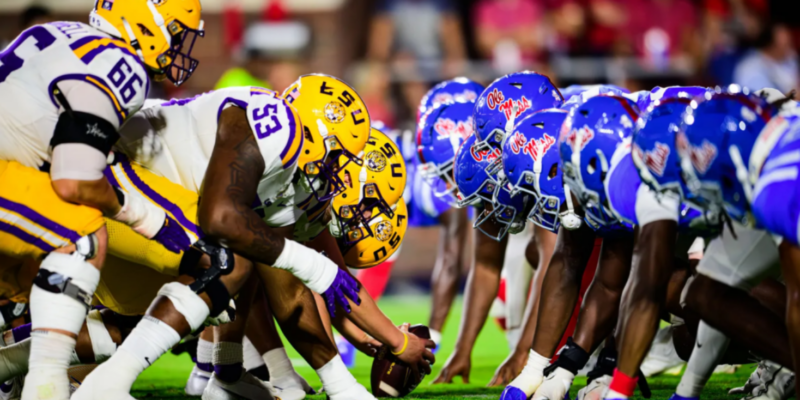
There will be plenty of other noise cascading down on them this coming Saturday in Oxford, and the intensity and composure they establish now, in their own locker room and on the practice field, must hold throughout the game. They will face not just a talented football team and raucous crowd, but also the temptation to let that hostility provoke impatience, retaliation, or selfishness in an effort to win a street fight instead of a football game.
Hat-tip to Giants head coach John Harbaugh during his interview on NBC with former Steelers coach Mike Tomlin for that one.
It is where the art of preparation we explored last week becomes practical and grounded for this LSU football team. A quarterback with the playmaking ability and flair of Leavitt must train himself to check down to the available play when he’s itching for a bigger one. A star on the defensive side of the ball wanting to silence the Rebels and the crowd—particularly one that has played for Ole Miss before—must condition himself to trust the assignment and do his job only, even when doing so allows a teammate to shine.
Knowing what composure means in a dictionary is easy enough, even for young players having to hear it going into a game of this magnitude. But training the will into that composure when every emotion pushes you in an opposite direction requires really hard work, and that is why this coming Saturday will be even more of a test than simply going on the road to face a top-10 opponent.
No matter what the difference in talent is, winning this game will take meeting a standard Kiffin must prepare his team and coaching staff to reach. This day in LSU history provides a useful connection, as it turns out, as it was on this date 24 years ago that Saban’s Tigers beat Ben Roethlisberger’s Miami (Ohio), 33-7. After the game, Saban said, “You shouldn’t let the scoreboard determine how you play in the game.”
This will be of utmost importance this Saturday, because the chance of Ole Miss playing out of their minds at least early is a good one. Remember the 2003 game in Oxford.
LSU must weather that storm.
The scoreboard, no matter which way it is leaning, cannot dictate how the Tigers play or respond to adversity. It is the greatest of “duh” comments, but it is the simple and mundane these young players must remember—this is a game they want to win, not a street fight in which they need to flex.
Thank you for reading The Hayride!
Advertisement
Advertisement
