
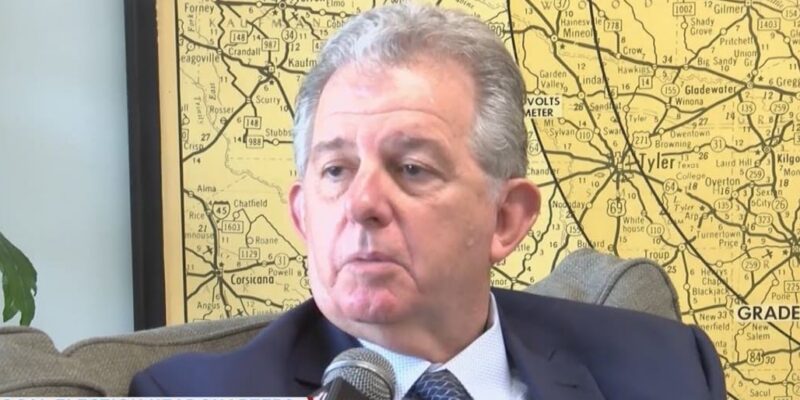
For current context, reporting confirms Arceneaux proposed police and firefighter raises tied to anticipated data-center revenue. Separately, Finance Director Sheila Faour said the city’s overall 2026 budget is about $331 million, with $48.4 million in reserves, including $25 million in the water-and-sewer Rate Stabilization account; excluding those reserve accounts produces the 8.28 percent calculation discussed below.
You can tell it’s election season in Shreveport when pay raises for all coexist with a budget that looks as if it’s running on fumes.
Last week, the administration of Republican Mayor Tom Arceneaux presented a preliminary piece of the city’s 2027 budget. After having previously announced a round of pay hikes focused on public safety and commencing before the next budget cycle, here comes another. Actually, two.
One will focus on issues of salary compression, which occurs when starting wages creep upwards without periodic adjustments to salaries for existing employees, meaning, relatively speaking, green employees make more than seasoned ones. As well, Arceneaux’s last budget unwisely hiked city pay at the lowest levels to a minimum wage of $15 per hour, exacerbating the compression as well as inducing budgetary strain with millions of dollars in new recurring costs.
The 2026 budget accomplished some of that, with the minimum wage jump costing $4.4 million. No cost figure was revealed for the latest round, which would see those wages increase by 4 to 8 percent.
But wait, there’s more. The upcoming budget also bakes in a contemplated 3 percent increase for all city employees beginning in March. No cost estimate was provided for this increase, either. And keep in mind a small number of sanitation workers already got a raise this summer, creating yet another ongoing commitment.
No doubt the City Council, with a majority running for reelection along with Arceneaux in 38 days, will lap this up even as the unrestricted general fund reserve for 2025 dropped below the targeted 8 percent of general fund spending. Arceneaux has expressed confidence that new data center activity in and near the city will increase revenues enough to support the first round of raises announced earlier this month.
However, the city’s Annual Comprehensive Financial Report due to the Legislative Auditor – and late again for 2025 – confusingly tells another story. Its text would indicate the general fund came in $10 million under its revenue budget and $22 million over its spending budget, which would cut the reserve in half, and then says the first half of 2026 saw another $20 million gap, which, if maintained, would drain reserves entirely and send the city scrambling for other sources of money. And while the text – written by the auditors but approved by the city’s Finance Director Sheila Faour – doesn’t make such a drastic prediction, it does say, “This shortfall means the continued use of operating reserves will again be necessary to sustain operations.”
Not so, said Faour in an interview nearly three months after the aged data cited in the report. She said, even though she vetted the reported numbers, that it was all a mistake, asserting that the actual numbers were about $18 million higher for revenues, after transfers, and $18 million lower for expenses.
She also now claims, given the timing of revenues and expenditures, that the former at $331 million will exceed the latter by about 2 percent. That difference, plus slicing out $48.4 million to serve as reserves, of which those for the Water and Sewerage Rate Stabilization Fund will total $25 million, leaves $282.6 million in projected spending, against which a projected unencumbered balance of $23.4 million is 8.28 percent.
Note the tap dancing going on here. The ever-increasing amount of money going into the stabilization fund is intended to pay off future debt related to the black hole of the water and sewerage consent decree that is streaking towards $1 billion in costs and is necessary to remain legally compliant. The only difference is this spending will take place in future years, not the present. Including this amount as current spending would put the proportion at 7.6 percent.
Of greater concern, revenue coverage from last year would have to shoot up almost 10 percent (minus contemplated transfers) in this scenario. That appears to be a big ask given that almost half of city revenues come from sales taxes and other sources should be relatively flat.
But “more for all” nabs votes. Whether it represents realistic budgeting is another thing.
Advertisement
Advertisement
