
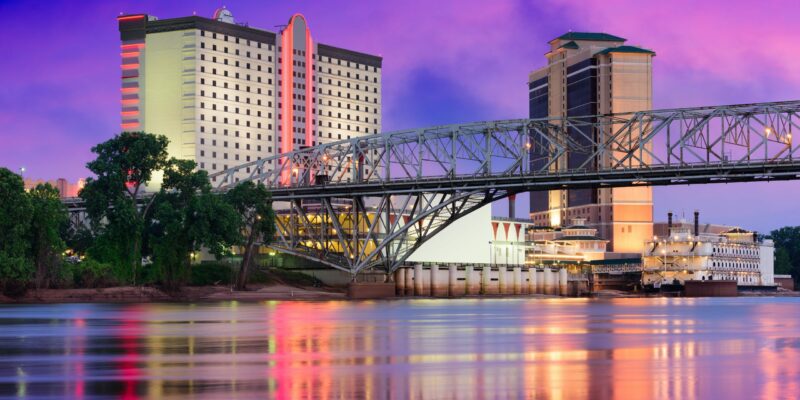
Not inherent flaws, which would have left something fixable, but trying to do too much too perfectly sank the proposed pair of economic development districts in Bossier City.
Last week, the city threw in the towel, for now, on an EDD encompassing only the city’s four casinos and another taking in the East Bank district plus capturing hotels, the Louisiana Boardwalk, and the Chasing Aces golf driving complex. The author of the idea, Republican City Councilor Chris Smith, conceded it went too far too fast, with confusion over what was being taxed, alarm over a 2 percent sales or occupancy surcharge within the districts, concern over a nebulous governing structure that appeared to favor out-of-town casino interests, and uncertainty over spending because of that structure and the outsourcing of management to an area interest group that had no experience in these matters and seemed to drive the process in the first place.
That said, the idea isn’t irredeemable. The city finds itself in a tough spot, burdened by three decades of foolish spending choices that left too much debt, the servicing of which diverts money that otherwise could be dedicated to district matters. With a more constrained budget as a result, district occupants could swallow a fair and equitable tax increase, knowing it will reduce their business for pricing reasons, if the proceeds go to the district and stimulate business at least enough to compensate.
In this instance, a number of occupants didn’t think that would happen under its contemplated organization. Part of that had to do with the split districts giving casinos one exclusively of their own, yet with a single board governing revenue-raising and spending for both, with casinos having guaranteed greater representation than any other occupants plus their having a natural ally in the Boardwalk.
Planners either didn’t understand or didn’t acknowledge the profound differences, even competitive antagonism, that exist between the casinos and the Boardwalk and the East Bank merchants. Casinos and the Boardwalk property are owned by large out-of-town, if not national or even international, interests, their properties being self-contained units with inherent variety. These entities want to capture visitors and have them stay within their confines. They have their own free parking, their own hotels (with the Boardwalk technically separate from the Courtyard by Marriott next to it), and their own entertainment and shopping venues. They have minimal interest in the East Bank, with only the Horseshoe even really close enough for it to be a synergistic factor. And the plan even had the Boardwalk lumped in with the East Bank.
So, there was good reason for the small, locally owned East Bank businesses to be wary that this arrangement would work well for them. They also had genuine fears of discrimination because of the odd district footprint they were in, which ranged far to the north, south, and east with jagged boundaries deliberately avoiding professional and industrial businesses, places of worship, public buildings, and residences, not only out of fairness but also because including residences would make any tax request subject to a public vote by district denizens, which surely the 127 or so registered voters would end up defeating to avoid taxing themselves on mail-order and online purchases.
However, these exempted entities and denizens would enjoy free-rider spillover benefits without paying any costs. One church, the Simple Church, given its Boardwalk location, would enjoy the best of everything: no taxes collected from it because it’s not a taxable entity, but all the benefits from the Boardwalk. Plus, currently exempted businesses could in the future sell their properties to entertainment venues that then gain a competitive advantage courtesy of their exemption from extra taxation, unless the Council embarks on a never-ending tweaking of district boundaries.
But there are ways to construct an EDD to overcome these shortcomings. And it begins with a single district using the previously proposed boundaries for both, with the same exclusions, but with more equitable rules. The governing board should comprise the mayor or designee, the Council president or designee, a local economic development agency head or designee, and two district representatives elected, one by merchants in the area bounded by Traffic Street to the east, Ogilive Street to the north, Hamilton Road to the west, and Delhi Street to the south, and the other by businesses elsewhere in the district.
As for fiscal matters, the district’s funding depends upon tax increment financing, which for more recently birthed districts means a district collects the difference between district receipts prior to district creation and after, which in the case of sales may include up to an additional two percent. The ordinance should specify, however, that at least half of proceeds must be spent on projects that primarily benefit the Traffic-Ogilvie-Hamilton-Delhi rectangle area.
The ordinance should stipulate other things. It should include that the city will administer the district, that it will have a separate audit performed annually, and that the city cannot transfer funds out of its kitty. A final provision should disallow the extra tax from exceeding one percent after five years and make it disappear entirely after twenty; by then a critical mass of incremental revenue will have been established above the baseline to support things, while early on providing a startup boost to get things going.
A couple of potential objections pose little actual difficulty. The free-rider problem still will exist, but theoretically property values will increase as the district improves, so the city will collect more in taxes that way, even if that doesn’t necessarily have to go to district projects. Also, the casinos’ sales taxes may become more complicated (on comped items; gaming revenues are taxed in a separate way), but it’s nothing a good accountant can’t resolve for each casino.
With these as the basics, a district that delivers a holistic bang for the buck could operate very transparently and with certainty that extra taxation lasts only long enough to get matters off the ground. If the city wishes to pursue the EDD idea, this is a far more effective and reassuring way to do it.
Advertisement
Advertisement
