
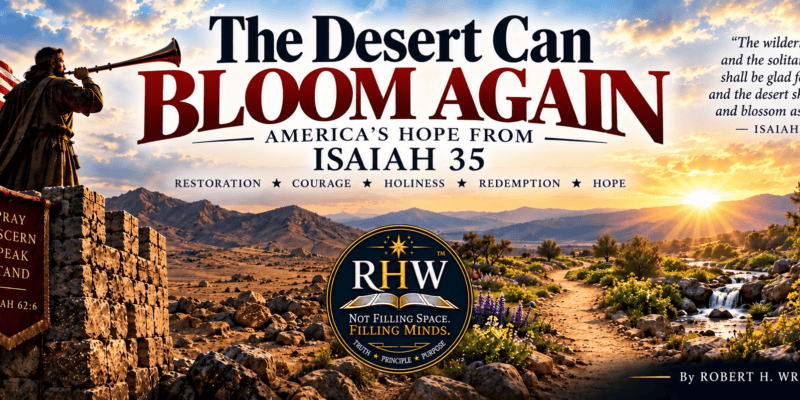
Based on Isaiah Chapter 35
The previous chapters of Isaiah contain some difficult warnings.
Isaiah 31 warns Judah about putting its trust in Egypt’s horses and chariots instead of God. Isaiah 32 teaches that righteousness must come before lasting peace. Isaiah 33 reminds us that God remains Judge, Lawgiver, and King. Isaiah 34 gives the sobering warning that no nation is beyond God’s authority or judgment.
Then we arrive at Isaiah 35.
Everything changes.
The battlefield gives way to a garden.
The wilderness comes alive.
The weak become strong.
The frightened find courage.
The blind see.
The deaf hear.
The lame leap.
And those who have been redeemed begin their journey home.
Isaiah 35 is God’s reminder that judgment does not have to be the final chapter.
The Desert Can Bloom Again
Isaiah begins:
“The wilderness and the solitary place shall be glad for them; and the desert shall rejoice, and blossom as the rose.”
— Isaiah 35:1
Think about that picture.
A desert appears dead. The ground is dry. There is little evidence of life. To human eyes, there seems to be nothing from which a garden could possibly grow.
But God sees something different.
Where we see a desert, God can see flowers.
Where we see destruction, God can see restoration.
Where we see an ending, God can see a beginning.
That should give America hope.
We can look around our nation and become discouraged by political division, broken families, addiction, violence, loneliness, moral confusion, anger, and the loss of trust in institutions.
It would be easy to conclude that things have gone too far.
Isaiah 35 says otherwise.
The desert can bloom again.
Be Strong, Fear Not
Isaiah then speaks directly to discouraged people:
“Strengthen ye the weak hands, and confirm the feeble knees.”
— Isaiah 35:3
Then comes this command:
“Say to them that are of a fearful heart, Be strong, fear not: behold, your God will come…”
— Isaiah 35:4
Notice that Isaiah doesn’t deny the problems surrounding them.
The danger is real.
The fear is understandable.
The circumstances are difficult.
But circumstances do not have the final word.
God does.
That changes the responsibility of the watchman.
A watchman must warn when danger approaches. But if all he ever does is announce darkness, he has only fulfilled part of his calling.
Someone also needs to tell frightened people:
Be strong.
Do not surrender to fear.
God has not abandoned us.
There is still hope.
God Can Restore What Is Broken
Isaiah continues:
“Then the eyes of the blind shall be opened, and the ears of the deaf shall be unstopped.”
Then:
“Then shall the lame man leap as an hart, and the tongue of the dumb sing…”
— Isaiah 35:5–6
For Christians, these words point powerfully toward Jesus Christ. Centuries later, the ministry of Jesus would be marked by these very signs—the blind seeing, the deaf hearing, and the lame walking.
But there is also a broader picture of restoration.
God takes what is broken and makes it whole.
God takes weakness and produces strength.
God takes silence and produces singing.
God takes dry ground and produces water.
That is what genuine spiritual renewal looks like.
America doesn’t merely need another political program.
We need restored lives.
Restored marriages.
Restored families.
Restored churches.
Restored integrity.
Restored truth.
Restored character.
Ultimately, national renewal begins with individual hearts returning to God.
The Highway of Holiness
Then Isaiah describes a road:
“And an highway shall be there, and a way, and it shall be called The way of holiness…”
— Isaiah 35:8
This may be one of the most important statements in the chapter.
God provides a road home.
But notice its name.
It isn’t the Highway of Prosperity.
It isn’t the Highway of Political Victory.
It isn’t the Highway of Military Strength.
It isn’t even the Highway of National Greatness.
It is:
The Highway of Holiness.
That tells us something we desperately need to understand.
We cannot separate restoration from righteousness.
We cannot continually reject God’s standards and simultaneously demand God’s blessings.
We cannot ask God to heal our nation while refusing to allow Him to correct our lives.
Before asking God to change Washington, perhaps we should first pray:
Lord, what needs correcting in me?
The Redeemed Are Going Home
Isaiah concludes:
“And the ransomed of the LORD shall return, and come to Zion with songs and everlasting joy upon their heads…”
— Isaiah 35:10
Then comes one of the most beautiful promises in Scripture:
“They shall obtain joy and gladness, and sorrow and sighing shall flee away.”
Isaiah 35 begins in a desert.
It ends with singing.
That is the Gospel pattern.
Death gives way to life.
Bondage gives way to freedom.
Fear gives way to faith.
Sin gives way to forgiveness.
Sorrow gives way to joy.
And wandering gives way to coming home.
America, There Is Still Hope
Isaiah 31–34 warned us about misplaced trust, moral confusion, judgment, and the limitations of human power.
But Isaiah 35 reminds us why the watchman continues standing on the wall.
There is still hope.
America’s problems are serious.
But God is greater than America’s problems.
Our responsibility is not merely to complain about the darkness.
It is to proclaim the truth, live righteously, strengthen those who are afraid, and point people toward the road home.
That road still has the same name Isaiah gave it:
The Highway of Holiness.
The desert does not have to remain a desert.
The broken do not have to remain broken.
The fearful do not have to remain afraid.
The wandering do not have to remain lost.
God can restore.
God can redeem.
God can revive.
And perhaps the message America most desperately needs to hear from the watchmen on the wall is not merely a warning.
It is this:
Be strong. Fear not. The desert can bloom again.
Advertisement
Advertisement
