
It was the kind of performance we expected going into the Kentucky game in Lexington on October 10.
And had that happened, perhaps—and perhaps not, of course—we would be looking at LSU as a top-five team and not discussing the embarrassing AP Poll once again, like it’s 2003 or something.
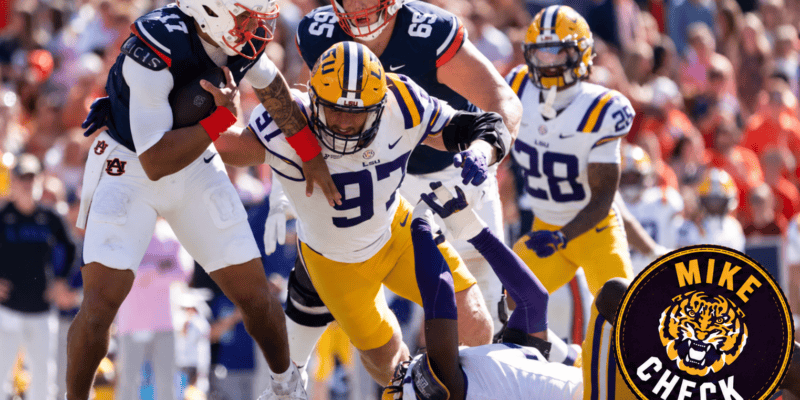
With one-loss juggernauts Wake Forest and Texas Tech still ahead of them, the Tigers might not be sitting right where they want to be, but they’re pretty darn close after dismantling a listless Auburn team on the Plains Saturday, 38–17. The victory ended LSU’s eight-game SEC road losing streak and moved the Tigers to 6–2 overall and 3–2 in conference play.
In Monday’s MIKE CHECK, we revisited those 1990s seasons when beating Mississippi State was one thing and getting past Auburn the next Saturday was another. Friday’s preview couched that history inside a simple expectation: “Improvement,” even in a coach’s first year, must go beyond the amorphous word itself and, at the very least, ought to include winning an SEC road game sometime.
And then LSU went and made the whole thing look stunningly simple again, perhaps a nondescriptness Tiger fans have been waiting for. 38-17, and it could have been worse, at Jordan-Hare. The largest ever margin of victory for a Tiger team there. No last-second escape as it would have needed at Kentucky or Ole Miss, no need for another chapter in this series’ long history of headline-worthy happenings. Just a football team locked in and taking care of its business away from home, and early enough to enjoy the rest of their day. That is how ordinary winning games like this needs to become if LSU is to return to national title contender relevance.
Now it’s on to a bye week and a three-game November stretch every fan had circled on the calendar before the year started. And while 6–2 isn’t the 7–1 record most fans thought the Tigers would need going into that stretch, Alabama, Texas, and Tennessee aren’t as potent as most expected either, at least by the eye test.
Getting Past Auburn
On Saturday, LSU outgained Auburn 552–271, with Sam Leavitt completing 32 of 45 passes for 387 yards and three touchdowns while adding another touchdown on the ground. The one throwing decision that really stood out for the wrong reason resulted in an apparent interception that was overturned to an incomplete pass after replay review. Leavitt’s top target, Jackson Harris, caught nine passes for 178 yards and two scores, and the defense amassed seven sacks and 12 tackles for loss.
Trey’Dez Green’s return was evident, too. No. 7 caught five passes for 50 yards and a touchdown, including the 15-yard score that finished a 95-yard drive and put LSU ahead 17–3. Friday, we wondered how much he would be used and whether his presence would help the Tigers finish possessions near the goal line. That touchdown supplied a pretty direct answer, if his being targeted on the very first snap of the game hadn’t already. LSU got a proven weapon and leader back, and Leavitt immediately took advantage of it.
With the resounding road victory over a team that had just beaten No. 1 Georgia in Athens, LSU moved up three spots to No. 15 and enters the bye week leading the SEC in both total offense and total defense. Its 510 yards per game ranks sixth nationally, while its 258.1 yards allowed ranks fourth. The Tigers are averaging 40.1 points and allowing just 16.0.
LSU’s 16.0 points allowed per game also deserves a little context. Fourteen of the 128 total points came from Louisiana Tech’s interception return and Kentucky’s punt return, including the extra points, with the Tiger defense watching from the sideline. Remove those and the average falls to 14.25. Just as encouraging, the stats show that opponents have started five possessions inside LSU territory following interceptions or lost fumbles and produced only six points: a field goal each for Clemson and Texas A&M, with Louisiana Tech and Kentucky coming away empty on the other three opportunities. Those six points still belong on the defense’s account, but allowing no touchdowns under those circumstances says something good about Blake Baker’s unit.
With the standard set at national championships in Baton Rouge, maybe the two issues still worth watching most closely are the minor inconsistencies of the offensive line and the defensive breakdowns that let opponents extend drives, especially when LSU has forced third-and-long. Auburn converted only five of 16 third downs, so the overall statistical performance there was good. But the missed opportunities to end possessions on third (and fourth) and long seem to be breakdowns that Baker’s defenses can’t consistently correct, particularly on the road.
Still, the way LSU handled this game gives us another reason to consider what we’ve been saying for weeks: This team is indeed different under Lane Kiffin. The Clemson start, the response against A&M after the loss in Oxford, the focus against Mississippi State at an early kickoff and after a deflating loss in Lexington—all of those were telling. The Auburn trouncing gave fans more evidence of it all. Finally, the Tigers didn’t need their own crowd to help them dominate a football game.
The more I listen to Kiffin, the more I hear a serious coach whose public reputation continues to win out because of a most miserable media allergic to nuance and growth, unless it sells, of course. His online trolling that once identified him, as just one illustration, is no longer what I’m seeing. I’m seeing a man explain football, beyond the coach-speak and with intelligence and common sense.
We don’t always agree with how extensively he answers a question. Friday, we questioned the wisdom of publicly discussing the emotional letdown he hoped Auburn might experience after beating Georgia. But even that disagreement concerned how much of his thinking to reveal, not whether or not there was intelligent thinking behind it, or whether or not he was right.
Listen to the philosophy in his answers, then compare it with the familiar circus character still presented by the talkers on the electronic screen. He’s a damn good football mind and coach. Saturday, the most convincing evidence of that was how little drama his team needed to win.
The Old Bowl Mentality
Regarding LSU’s next opponent, Alabama also enters the November 7 clash at 6–2, ranked No. 10, after following consecutive losses to Georgia and Tennessee with a 31–20 victory over Texas A&M. The Tide needed two fourth-quarter touchdowns to overcome a 20–17 deficit. Alabama scored just 17 and 10 points in those defeats.
Through eight games, Alabama averages 411.9 yards and 38.3 points while allowing 330.4 yards and 21.3 points—less offensive production and more defensive yardage and scoring allowed than LSU. Alabama also allows 222.4 passing yards per game, compared with LSU’s 172.8. Against common opponents, LSU beat A&M 35–6 and Mississippi State 31–0, while Alabama won those games 31–20 and 56–23. The comparison cuts the other way at Kentucky, where Alabama won 45–17 and LSU lost 35–34. Another distinction favors the Tide: Alabama’s turnover margin is plus-seven, compared with LSU’s minus-two.
Advertisement
We don’t get into such extensive statistics much in this space, opting instead to analyze the intangibles of a college football game. But since we are at the bye week and the end of what was supposed to be the easier part of LSU’s schedule, we thought it might be good to present them.
One other point in doing it is to illustrate that the Tigers are good. They are really good. Not compared to the 2019 or 2011 LSU teams, no, which doesn’t even matter. But when compared to the current slate of teams in the NIL-transfer portal era, a most resounding yes, and obviously that is all that matters in 2026.
And that brings us to a more pressing question about college football than whether LSU should be three or five places higher this particular week: Has the way pollsters evaluate college football teams caught up with the schedules they’re now playing?
It is just one place where Kiffin’s disgruntlement about a nine-game SEC schedule is spot on. Another conference game creates another loss somewhere in the league, eight of them total in fact, along with another week of physical wear and tear on the body. If pollsters evaluating these teams give more weight to the number of losses than to the difficulty of stacking the wins, the extra game can become a penalty rather than an opportunity.
We saw this in a different way last year with Texas, who had scheduled a difficult non-conference game at Ohio State to start the season—before this new landscape of college football had even arrived. And they were penalized for it, despite losing only two games, both in conference, the rest of the season.
There is still something of the old bowl-era mentality in the way the collective rankings fall: Lose and move backward, but hopefully early enough in the season, then win and continue waiting while the teams ahead of you lose. Everybody stays in line for the most part, except of course when a big victory over a higher-ranked opponent occurs, as we saw this week after Texas topped No. 7 Ole Miss. But these teams aren’t fighting the same gauntlet to get there; they never were, for that matter, even in the bowl era. It was just concealed more. Those who are in charge of rankings and presenting what must become the new mentality of the game must communicate that fewer losses cannot automatically mean a better football team.
Wake Forest is not better than LSU. Everyone knows it, even those along Tobacco Road.
The AP voters don’t select the playoff field, of course. The CFP committee does, and its own criteria expressly include strength of schedule, head-to-head results, and performance against common opponents. The concern still, though, is whether the final judgments will give those categories enough weight—or whether the residue of polling still subconsciously sneaks into the minds and choices of committee members. Kiffin’s warning is clearly of utmost importance if a team’s third loss becomes the end of their playoff hopes before anyone seriously examines its nine wins in relation to another’s ten or even eleven.
Actually, one commentator is already entertaining that possibility for LSU. CBS Sports analyst Danny Kanell said this weekend that the Tigers could make a strong case for the playoff at 9–3, given their schedule and the opportunities still ahead. That isn’t a promise, and LSU hasn’t won any of those games yet. But it is the kind of conversation this new schedule must force.
The future musts of rankings and playoffs aside, LSU simply needs to take this bye week to rest up, heal up, scout itself, and continue to focus on the next six seconds of preparation, over and over again.
Do that, and the Tigers have a better-than-expected chance to win out.
For now, they’ve taken one of the things the program had turned into a two-year embarrassment and made it look like a fairly ordinary Saturday. That is progress visible enough to check the box.
Thank you for reading The Hayride!
Advertisement
Advertisement
