
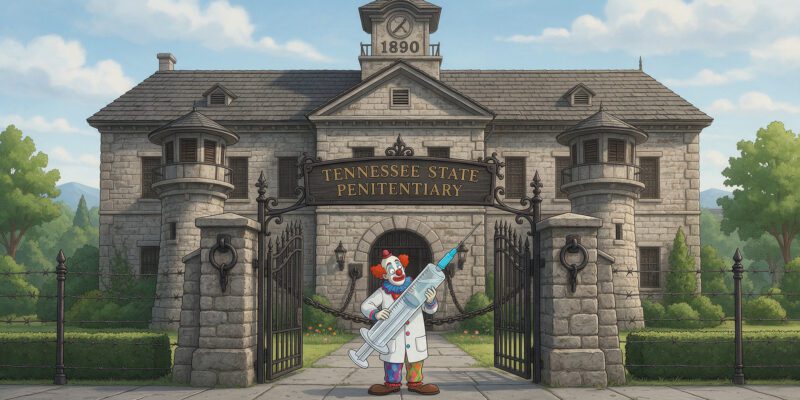
As unpleasant as it might be, the show must go on, in Texas, Tennessee, and Louisiana, in order to save lives.
Controversy has surrounded carrying out capital punishment as of late. In Tennessee, an execution by lethal injection went wrong, leaving the murderess alive but barely surviving. In Texas, a jihadist sentenced to death for killing over a dozen people at an army base in 2009 will face a firing squad in December that at present the federal government will live stream over the Internet.
The former incident has reinvigorated anti-death penalty advocates, whose strategy involves a public relations campaign to make it logistically more difficult to carry out executions so that these either don’t occur or become so convoluted in difficulty in being done correctly that this escalates to the point enough fail that then the judiciary backs the idea that all methods violate the Eighth Amendments stricture against cruel punishment.
Of course, that’s not the way to conceptualize properly a failed execution, ironically lethal injection as that method coming into common use because it presumably reduced potential suffering generally compared to other methods. But no method is without its margin of error, so while additional suffering may occur on those uncommon occasions, that never was the intent behind the method; it’s not being done for cruelty’s sake but because, as research shows, consistent application to cases adequately decided saves lives in aggregate.
Thus, capital punishment is a gruesome but necessary practice. Yet perhaps a quiver in the bow of those opposing it in their campaign to convince jurists and other policy-makers, that bad outcomes stem not from flawed carrying out but are inherent to any method, is the general squeamishness of the public towards death. As it has become less common for people to die unnaturally and natural death becomes more confined to older ages, it becomes less comfortable for people to deal with that and they shy away from it despite its necessity in protection of others.
That’s something a more public display could counter. That execution would have to occur with dignity and solemnity, emphasizing the performance of a distasteful duty that serves public safety and not as an encouragement of glorification of killing. Nobody would be forced to watch, and the very act of making it public would impact those not inclined to watch as the publicity reminds all of the consequences.
But Republican state Sen. Thomas Pressly doesn’t admit to any redeeming value to that exercise. He describes public execution as only practiced by retrograde regimes, for entertainment value, apparently unaware that there was a long history of it in America. The last instance occurred in 1937, and the practice fell into disuse precisely because of concern over these becoming spectacles.
Interestingly about this presentation, by transmitting remotely it allows control to prevent the event from becoming a carnival. And if conveyed in that fashion this turns on its head the argument that those desensitized to the death of human beings will tune in vicariously, to one that it can shake out of torpor a mass public desensitized to the suffering of murder victims and their families, the amount of which would be reduced if the deterrent value of capital punishment were restored.
Part of the reason why ideologues have seized more control over the issue of capital punishment, where now only 52 percent of Americans support it, is just such a desensitized public’s putting its psychic convenience over society’s difficult duty. It’s why Louisiana has failed in that duty for a long time, with a brief resurgence earlier in GOP Gov. Jeff Landry’s term that since has gone quiet. Capital punishment makes us uncomfortable, but lives depend upon performing it, thus Louisiana, as it seems poised to do, needs to resume it as soon as possible.
Advertisement
Advertisement
