
“Hear, all ye people; hearken, O earth, and all that therein is.”
— Micah 1:2
God sent Micah to warn Israel and Judah that their prosperity, religious traditions, political power, and national defenses could not protect them from the consequences of persistent rebellion against God.
Micah’s prophecy was addressed directly to ancient Israel and Judah—not to the United States. America is not Israel, and we should be careful about claiming that every judgment described in the Old Testament applies directly to our country.
Nevertheless, the character of God has not changed. Neither have the weaknesses of the human heart. The principles found in Micah remain relevant to every generation and every nation.
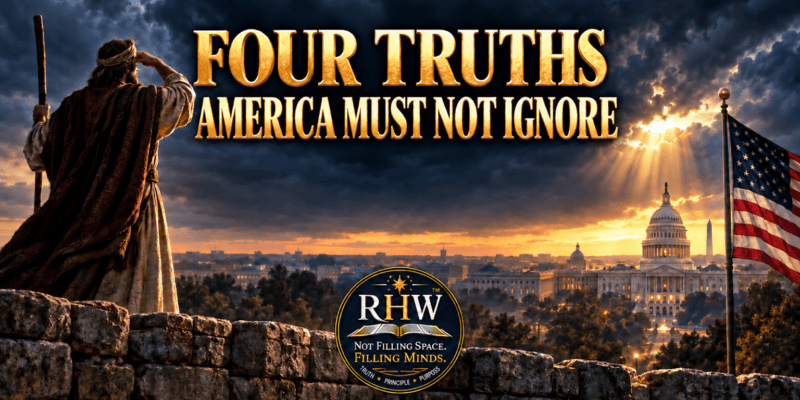
Micah presents four truths America must not ignore.
1. God sees what we would rather hide
The people could conceal their sins from one another, but they could not conceal them from God.
Their outward religious identity remained, but beneath it were idolatry and rebellion—sins that Micah would go on to expose as injustice, exploitation, corruption, and abuse of power.
America often behaves as though something becomes morally acceptable when it becomes legally permissible, culturally popular, or politically useful. But changing a law does not change God’s standard. Winning an election does not transform wrong into right. Public approval cannot erase moral truth.
God sees what happens in government offices, corporate boardrooms, classrooms, churches, homes, and individual hearts. He sees the unborn child whose life is treated as disposable. He sees children being confused about their identity. He sees families being weakened, truth being manipulated, violence being excused, and greed being celebrated.
But He also sees the sins within the Church.
Christians cannot condemn the darkness in society while ignoring pride, compromise, bitterness, materialism, dishonesty, and hypocrisy among those who profess Christ.
Hebrews 4:13 reminds us that nothing is hidden from God’s sight. Ecclesiastes 12:14 says that even the things done in secret will be brought into judgment. Numbers 32:23 gives the warning plainly: “be sure your sin will find you out.”
So before asking what is wrong with America, perhaps Christians should begin with a more difficult question:
“Lord, what needs correcting in me?”
National repentance cannot begin somewhere else. It must begin with us.
2. Corruption at the top can spread throughout a nation
Micah 1 focuses attention on Samaria and Jerusalem—the capitals of Israel and Judah. In the chapters that follow, Micah becomes even more explicit about the failures of rulers, priests, and prophets.
Leadership matters because those in authority establish more than policies. They establish examples.
When political leaders lie without shame, dishonesty becomes easier for citizens to excuse. When the law treats what Scripture calls wrong as morally neutral—or even worthy of protection—Christians must remember that legality and morality are not always the same thing.
When education becomes more concerned with ideology than learning, children inherit the consequences. When entertainment celebrates destructive behavior, what once shocked society can gradually become normalized.
Religious leadership carries enormous responsibility as well. A nation is endangered when its pulpits become silent about sin, judgment, repentance, forgiveness, and salvation. A minister who refuses to proclaim truth simply because it might offend people is not protecting his congregation. He may be leaving it unprepared.
But corrupt leadership does not remove personal responsibility.
The people of Israel could not excuse their actions by blaming their kings, priests, or prophets. Neither can Americans blame every national failure on presidents, governors, judges, or members of Congress.
In a republic, citizens have significant responsibility for those they place in authority. When voters repeatedly tolerate dishonesty, corruption, irresponsibility, and moral compromise, those characteristics can become increasingly embedded in government.
America needs courageous leaders. But it also needs citizens with enough wisdom and moral discernment to judge leadership carefully.
3. False gods and human defenses cannot save a nation
Israel trusted idols and the things human beings often trust when they stop trusting God.
America possesses tremendous military power, natural resources, advanced technology, financial influence, intelligence capabilities, and agricultural capacity. These are blessings, but they must never become substitutes for God.
Military strength cannot heal a nation collapsing morally from within.
Economic prosperity cannot purchase God’s favor.
Technology cannot repair the human heart.
Government cannot eliminate sin.
Political parties cannot save a people who refuse to repent.
America’s modern idols may not be carved from stone. They may be money, government, political power, pleasure, celebrity, technology, personal autonomy, or even national pride.
Anything we ultimately trust in place of God can become an idol.
National defense is necessary, but not every threat to America comes from beyond our borders. A nation can possess the world’s strongest military and still be weakened from within by family breakdown, uncontrolled debt, addiction, lawlessness, hatred, dishonesty, and the loss of a shared moral foundation.
Micah reminds us that human strength has limits.
A nation that trusts everything except God may eventually discover that the things it trusted were never capable of saving it.
4. A faithful messenger warns with courage and compassion
Micah did not soften God’s warning. But neither did he celebrate the suffering that was coming.
He mourned:
“Therefore I will wail and howl.”
— Micah 1:8
That may be one of the most important lessons for anyone who wants to be a watchman.
Micah possessed both courage and compassion. He spoke boldly because he cared enough about the people to tell them the truth.
America needs watchmen willing to stand on the wall and sound the alarm. We need pastors, parents, teachers, public officials, and ordinary citizens willing to speak truth even when it is unpopular.
However, a faithful watchman does not warn people with hatred or arrogance. He does not desire destruction, nor does he celebrate the suffering of those with whom he disagrees.
His purpose is not to prove himself right.
His purpose is to call people back before it is too late.
Truth without compassion can become harshness. Compassion without truth becomes permission to continue down a destructive path.
A faithful messenger must possess both.
For Christians, however, the message cannot end with judgment.
It must lead to the cross.
God does not merely expose sin. He offers forgiveness through Jesus Christ. The Christian watchman therefore does more than warn people about where a road leads. He points them toward the One to whom they can return.
The purpose of sounding the alarm is not simply to announce destruction.
It is to give people an opportunity to change direction.
The Warning Is Meant to Be Heard
There is a dangerous assumption buried deep within the human heart:
We think we can get away with it.
If nobody sees it, we think we got away with it.
If nobody confronts us, we think we got away with it.
If the law permits it, we convince ourselves it must be acceptable.
If everyone else is doing it, we tell ourselves it cannot be that wrong.
And if judgment does not come immediately, we may eventually convince ourselves that it is never coming.
That may be one of the most dangerous places a person—or a nation—can reach.
Have we no fear of God?
Yet God also shows His people the way back:
“If my people, which are called by my name, shall humble themselves, and pray, and seek my face, and turn from their wicked ways; then will I hear from heaven, and will forgive their sin, and will heal their land.”
— 2 Chronicles 7:14
The promise was spoken to God’s covenant people, Israel, so we should not simply claim it as a guarantee of national prosperity for the United States. But the spiritual principles are unmistakable: humility, prayer, seeking God, and turning from sin.
Micah’s generation had religion. They had leaders. They had cities, wealth, defenses, and traditions.
What they did not have was immunity from the consequences of turning away from God.
Neither do we.
America cannot assume that yesterday’s blessings guarantee tomorrow’s protection. We cannot repeatedly reject God’s standards and then presume that prosperity, military strength, technology, elections, or political power will protect us from every consequence.
But before we point toward Washington, Hollywood, the media, our schools, or our neighbors, there is a harder place to look.
The mirror.
What have I excused because nobody knows?
What have I justified because everyone else seems to be doing it?
What have I hidden because I do not want it brought into the light?
We may fool our neighbors, our families, the people sitting beside us in church—and perhaps even ourselves.
We may think we are getting away with something.
But before God, we are getting away with nothing.
The warning has been sounded.
The people must decide whether they will listen.
Advertisement
Advertisement
