
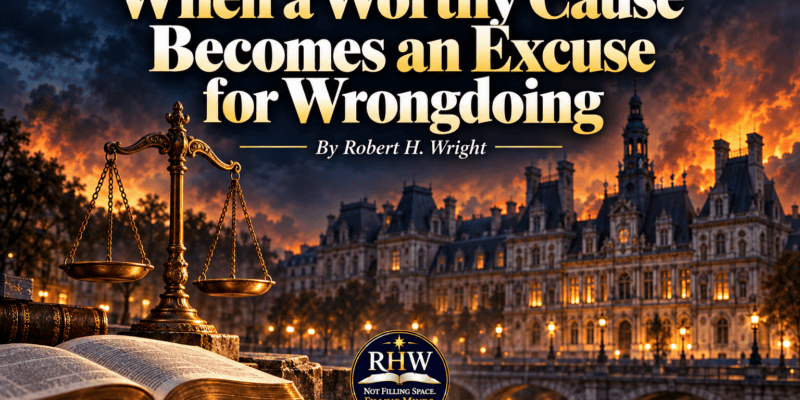
Limoges City Hall survived two world wars. On October 17, rioters set it ablaze during unrest that grew out of demands for better schools and relief from rising living costs.
Its clock tower collapsed. Much of the nineteenth-century landmark was devastated. Whatever the grievance, burning a community’s inheritance could not put a single textbook in a classroom.
Most Christians will have little difficulty condemning that destruction. The real test of our judgment comes when wrongdoing threatens a cause we want to succeed.
Will we examine the evidence as carefully when it implicates an ally?
French officials blamed radical far-left elements and criminal looters for much of the violence. Fox News’s October 7 report quoted analysts alleging that far-left and Islamist groups were working together to fuel the unrest.
Those allegations require attribution. Responsibility belongs to those who committed, directed, or encouraged particular acts; peaceful demonstrators cannot simply be assigned the same guilt. But no political objective can make arson or theft acceptable.
The principle is straightforward. Applying it to people we trust is harder.
I serve as an elected constable and a member of the Louisiana Republican State Central Committee. Those responsibilities give me strong convictions about public order and political participation. They also make this question personal: Do my convictions govern my loyalties, or do my loyalties determine when I apply them?
An example from Christian ministry shows how easily admiration can interfere with judgment.
In July 2021, Michael Ramsden, then president of Ravi Zacharias International Ministries, apologized for defending the ministry’s founder against allegations of sexual misconduct. He acknowledged believing Zacharias’s false explanations and wrongly regarding him as the victim when Lori Anne Thompson had been victimized.
“I was wrong to repeat his false narratives, and I was wrong to rush to his defense,” Ramsden said.
His apology went beyond acknowledging an incorrect conclusion. He recognized that his admiration for Zacharias and desire for his approval had influenced his judgment. His assurances had encouraged others to trust an account that harmed the person bringing the complaint.
That is the danger: loyalty can make us less demanding of evidence precisely when we have the greatest influence over whether others believe it.
Ramsden’s eventual acknowledgment deserves recognition. His admission also gives Christians a concrete warning. We need not consciously decide to defend evil to help protect someone doing wrong. Confidence that we know a person’s character can lead us to dismiss evidence we ought to examine.
The French riots and the ministry scandal involve different conduct and different responsibilities. The connection is the question they put before observers: Will we judge the actions, or let our attachment to a cause or person settle the matter first?
Scripture directly challenges selective judgment. Leviticus 19:15 forbids favoring either the poor or the powerful and commands us to judge our neighbor fairly. A person’s standing with us cannot determine the standard of evidence.
Matthew 11:20–25 adds a warning about our response when truth reaches us.
Jesus rebuked Chorazin, Bethsaida, and Capernaum because they had witnessed His mighty works without repenting.
“Then began he to upbraid the cities wherein most of his mighty works were done, because they repented not” (Matthew 11:20, KJV).
Jesus said Tyre and Sidon would have repented had they received the same witness. He warned Capernaum that even Sodom would have remained.
Those cities were accountable for what they had received. Their opportunity to encounter Jesus made their refusal to respond more serious.
The passage does not pronounce judgment on modern France or endorse an American political party. Its application begins with Christians who hear biblical teaching but resist it when obedience becomes costly.
We know false witness is wrong. Will we correct an accusation we circulated against an opponent? We know people deserve a fair hearing. Will we listen when the complaint concerns a respected leader?
Some will object that acknowledging an ally’s failure supplies ammunition to adversaries. A ministry may lose support. A candidate may lose votes. The opposing side may exploit every admission.
Those are real possibilities. Concealing or minimizing wrongdoing also has consequences—and places the burden on the people harmed.
Supporting a candidate’s policies does not require defending every statement. Valuing a ministry does not require accepting its leader’s account without scrutiny. Responsible loyalty leaves room for investigation, correction, and accountability.
That means taking credible complaints seriously without presuming guilt. It means correcting false claims publicly enough to reach those who heard them. It means refusing to treat a request for evidence as betrayal.
Ramsden eventually acknowledged that he had been wrong. Christians should make that admission possible before years of misplaced confidence compound the damage.
As November 3 approaches, our political choices matter. So does the standard we will apply after making them.
Condemning destruction in France costs most of us little. Challenging someone whose success we have invested in may cost considerably more.
That is where our stated convictions become a test of character.
A worthy cause needs supporters willing to confront wrongdoing within it. When we defend what we would condemn in an opponent, we surrender the standard by which we claimed our cause was worthy.
Robert H. Wright is a Christian writer, former pastor, and educator from Bossier Parish, Louisiana. An observer of conservative politics and Christian public life for more than 40 years, he serves as an elected constable and a member of the Louisiana Republican State Central Committee. His writing explores biblical faith, freedom, civic responsibility, and the America we leave to future generations. For past columns visit roberthwright.com.
Advertisement
Advertisement
