
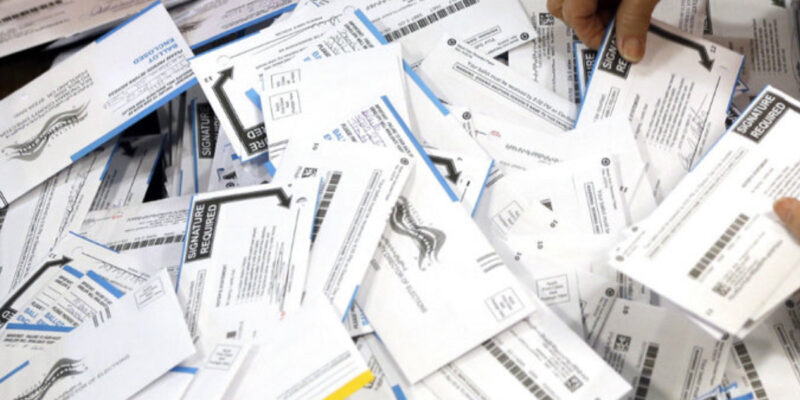
(By Fred Lucas/Daily Signal) – Which party controls Congress might not be determined until long after Election Day due to lengthy state counting timelines and election litigation.
Election litigation began well before Tuesday and the counting of ballots will almost certainly persist for days. More than a dozen states have laws on the books to keep counting mail ballots arriving after Election Day.
In addition, officials in two key Senate battleground states predicted the winners might not be determined for days or weeks.
What Early-Voting Trends Tell
As of Oct. 29, 43.6 million people had already voted, according to the University of Florida’s Election Lab, which has data for 27 states. Of those, 20 million ballots were sent in the mail and 22 million were cast in-person.
Of those early votes, registered Democrats hold a sizable edge overall over registered Republicans, 44% to 31%. That advantage shrinks to just seven percentage points, 39% to 32%, for in-person early voting. Democrats hold a 46.5% to 30.5% edge over Republicans in mail voting.
A 2024 Pew Research Center poll showed that 39% of Republicans say they vote in-person on Election Day, compared with 28% of Democratic voters.
As for states with some of the most competitive Senate races, Democrats have a 5.4% edge in Kansas and a 4.9% edge in Iowa. Democrats have only a 1.6% edge in Maine for early voting and 1.2% edge in North Carolina.
Post-Election Anti-Trump ‘Task Force’
Democrat lawmakers, staffers and liberal organizations have already formed a “task force” that had “prewritten legal briefs and a Rolodex of key contacts in places they believe to be high risk” to challenge the Trump administration’s actions. Another aim is to challenge local election officials it accuses of “election denial rhetoric,” according to NPR.
The Elias Law Group, a law firm, and the liberal legal nonprofit Democracy Forward, both led by veteran Democrat election lawyer Marc Elias, are playing a key role in the task force, according to NPR.
Federal-State Legal Standoffs?
In July, U.S. Assistant Attorney General for Civil Rights Harmeet Dhillon wrote to election officials in all 50 states, warning, “Any election officer, including the chief election officer of the state, who knowingly retains noncitizens on the state’s [state voter registration list] or facilitates noncitizens in receiving and casting ballots could be subject to criminal liability.”
In October, Acting Deputy Attorney General Trent McCotter wrote to California election officials, “If persons knowingly tabulate ballots cast by individuals identified by federal agencies as noncitizens, they risk becoming aiders and abettors to a federal crime.”
However, in an October report, the liberal think tank Center for American Progress argued that states would not recognize qualified immunity for federal employees acting on orders to review ballots and voting machines.
“States also have strict criminal laws without law enforcement exceptions governing who can handle ballots, election-related materials, and voting machines, including chain-of-custody requirements. States such as California even have penalties of imprisonment for some of these crimes,” the center’s report says, noting that “federal personnel would expose themselves—at the personal level—to a wide range of legal jeopardy, both criminal and civil.”
California recently won a district court ruling rejecting a Justice Department demand to set aside the mail-in votes of 20,000 likely noncitizens until their citizenship status could be verified. The ruling was upheld Friday by the U.S. 9th Circuit Court of Appeals.
The Democratic Senatorial Campaign Committee has countersued in U.S. District Court for the District of Columbia to prevent the Justice Department’s actions to set aside suspected noncitizen ballots, including in California and Washington state. The complaint also challenged the Justice Department’s warnings about prosecution of state election officials as intimidation.
Controversial Chief Judge James Boasberg, a Barack Obama appointee whom Republicans have criticized on several fronts, is presiding in the case.
Keep Counting Mail Ballots
The Supreme Court cleared the way this year for states to continue counting mail ballots that arrive after Election Day.
Illinois and Utah count ballots arriving up to 14 days after Election Day, according to the National Conference of State Legislatures. Alaska and Maryland allow ballots to be counted up to 10 days after the election.
California, New York, and Oregon count ballots arriving seven days after the election. New Jersey counts ballots arriving up to six days after Election Day, while West Virginia’s grace period is five days. Nevada and Ohio count up to four days after Election Day, while Kansas, Massachusetts, and Virginia count ballots arriving up to three days after Election Day.
Washington state, where the Justice Department contends 405 likely noncitizens voted by mail, allows ballots received after Election Day to be counted, but no deadline is specified for when they must be received, according to the National Conference of State Legislatures.
Alaska Double Dan Lawsuit
Alaska is likely to continue counting votes until at least Nov. 18 and likely won’t certify results in the ranked choice voting system until Nov. 25, the Alaska Beacon reported.
The Justice Department sued Alaska over the “Decoy Dan” case, in which Daniel J. Sullivan is on the ballot, running against incumbent Sen. Daniel S. Sullivan, a Republican. The New York Times first reported that the other Sullivan was recruited to run by campaign aides of Democrat Mary Peltola.
In its Oct. 22 lawsuit, the DOJ asked U.S. District Judge Sharon Gleason, a Barack Obama appointee, to delay certification of a Peltola victory until the Justice Department had time to investigate the impact of the other Sullivan, and determine whether the final results reflected voters’ intent.
Maine Delay
Maine Secretary of State Shenna Bellows said her office likely wouldn’t certify the closely watched Senate race between Republican Sen. Susan Collins and Democrat challenger Troy Jackson until at least a week after Election Day, the Maine Morning Star reported.
Although just two candidates are on the ballot for the Senate race, the presence of six declared write-in candidates could delay the count in the state’s ranked choice system.
Advertisement
Advertisement
