
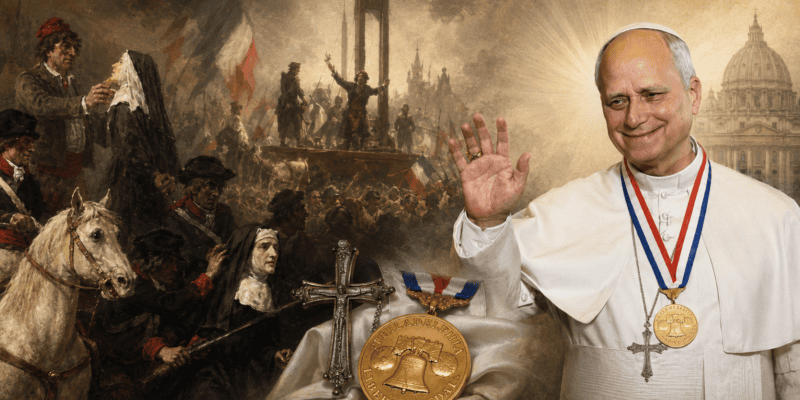
The Martyrs of Compiègne help reveal the dark side of the French Revolution’s slogans on liberty, and why Catholics should question ongoing modern confusion.
On July 17, 1794, near the end of the French Revolution’s Reign of Terror, sixteen Carmelite women from Compiègne were taken to the guillotine in Paris. Long before 2024, they had already been beatified by Pope Pius X in 1906, which means Catholics attached to Tradition do not need to lean on modern Rome’s judgment in order to honor them. They can be safely remembered as the Blessed Martyrs of Compiègne, victims of the Revolution’s hatred for the Catholic Faith.
Here are the names of the martyrs, along with a little description for each, from New Advent:
- Madeleine-Claudine Ledoine (Mother Teresa of St. Augustine), prioress, b. in Paris, 22 Sept., 1752, professed 16 or 17 May, 1775;
- Marie-Anne (or Antoinette) Brideau (Mother St. Louis), sub-prioress, b. at Belfort, 7 Dec., 1752, professed 3 Sept, 1771;
- Marie-Anne Piedcourt (Sister of Jesus Crucified), choir-nun, b. 1715, professed 1737; on mounting the scaffold she said “I forgive you as heartily as I wish God to forgive me”;
- Anne-Marie-Madeleine Thouret (Sister Charlotte of the Resurrection), sacristan, b. at Mouy, 16 Sept., 1715, professed 19 Aug., 1740, twice sub-prioress in 1764 and 1778. Her portrait is reproduced opposite p. 2 of Miss Willson’s work cited below;
- Marie-Antoniette or Anne Hanisset (Sister Teresa of the Holy Heart of Mary), b. at Rheims in 1740 or 1742, professed in 1764;
- Marie-Françoise Gabrielle de Croissy (Mother Henriette of Jesus), b. in Paris, 18 June, 1745, professed 22 Feb., 1764, prioress from 1779 to 1785;
- Marie-Gabrielle Trézel (Sister Teresa of St. Ignatius), choir-nun, b. at Compiègne, 4 April, 1743, professed 12 Dec., 1771;
- Rose-Chrétien de la Neuville, widow, choir-nun (Sister Julia Louisa of Jesus), b. at Loreau (or Evreux), in 1741, professed probably in 1777;
- Anne Petras (Sister Mary Henrietta of Providence), choir-nun, b. at Cajarc (Lot), 17 June, 1760, professed 22 Oct., 1786.
- Concerning Sister Euphrasia of the Immaculate Conception accounts vary. Miss Willson says that her name was Marie Claude Cyprienne Brard, and that she was born 12 May, 1736; Pierre, that her name was Catherine Charlotte Brard, and that she was born 7 Sept., 1736. She was born at Bourth, and professed in 1757;
- Marie-Geneviève Meunier (Sister Constance), novice, b. 28 May, 1765, or 1766, at St. Denis, received the habit 16 Dec., 1788. She mounted the scaffold singing “Laudate Dominum”. In addition to the above, three lay sisters suffered and two tourières. The lay sisters are:
- Angélique Roussel (Sister Mary of the Holy Ghost), lay sister, b. at Fresnes, 4 August, 1742, professed 14 May, 1769;
- Marie Dufour (Sister St. Martha), lay sister, b. at Beaune, 1 or 2 Oct., 1742, entered the community in 1772;
- Julie or Juliette Vérolot (Sister St. Francis Xavier), lay sister, b. at Laignes or Lignières, 11 Jan., 1764, professed 12 Jan., 1789.
May the Blessed Martyrs of Compiègne pray for us.
Revolution’s True Face
Most of us learned the sanitized classroom version of that Revolution: liberty, equality, fraternity—considered the greatest of all virtues and a staple of course in America. Those words were presented as obvious goods, nearly beyond examination, as though the movement that invoked them must be understood mainly as the natural and necessary step forward in human progress.
The historical record, however, particularly for us Catholics, is darker than the slogans. In 1789, Catholicism was still the official religion of France; by 1794, churches and religious orders had been closed and worship suppressed. That is not “woke history” or revisionist history and it doesn’t make me a liberal. It is simply the part of the story hidden for what has become obviously nefarious reasons.
That should also give Protestants and Catholics alike a reason to revisit the inherited story, because many of us, if not all of us, were taught a version of Catholic history shaped by the very forces that hated and have infiltrated the Church.
For readers who want the deeper historical and doctrinal background, this earlier piece is worth revisiting: Guarding the Deposit: Pius VII, the French Revolution, & the Great Conspiracy
When the Revolution turned against the Church, it did so in the name of its own virtues—that was and has been the gaslight. The old Catholic order and hierarchy was treated as oppression—and has been framed in that way in classrooms ever since, despite the beauty and power of Christendom and the reality that Catholic monarchy cannot be reduced to the cartoon tyranny many of us were taught.
Priests and religious who would not submit to the new revolutionary order were treated as enemies of freedom—of said liberty, equality, and fraternity. The Martyrs of Compiègne, then, reveal their relevance to us today because they show what happens when political freedom, a supposed virtue, is severed from Christ, and then turned back against His Church.
We are seeing the disastrous fruits of that today. Freedom without the true God does not remain neutral for long. It often becomes the right of the State to redefine what man and religion are foundationally, and then what measure of obedience to God is acceptable.
We all see it. And yet so many cannot bring themselves to distrust it.
The Current Moment
That is why the timing of this feast day speaks so inspiringly to the current moment in Catholicism.
Just this month, the Vatican announced “excommunications” connected to the SSPX episcopal consecrations, with the Dicastery for the Doctrine of the Faith saying the July 1 consecrations constituted an act of a schismatic nature. The decree was released July 2, and Vatican News emphasized that the decision came twenty-four hours after the ceremony in Écône.
You may have noticed many Catholics celebrating with strange and chilling vitriol.
The next day, Pope Leo XIV accepted the National Constitution Center’s Liberty Medal, given in recognition of his work promoting religious liberty, freedom of conscience, and freedom of expression. Many Catholics celebrated that too.
The fact that it was the next day doesn’t necessarily add to the confusion this should cause Catholics; had the acceptance occurred on any date, the same question should be raised. But there is an irony in such public brazenness in the sequence falling in just two short calendar dates, and if we say that we believe God has a hand in everything, it is important we consider this most direct spotlight as being perhaps more than coincidence.
But take note of the juxtaposition. How can anyone of goodwill pass over such a stark contrast, indeed hypocrisy, so quickly?
Moreover, as has been the way of the postconciliar Church, this language often appears diametrically opposed—not merely differently phrased—to what popes, councils, and Catholic teaching presented for nearly two millennia. These things don’t happen overnight, of course, and even so-called Old Catholics take the problem back much further, but the juxtapositions are alarming, and any honest Catholic must take inventory of them.
Don’t misunderstand. We don’t intend to sneer at modern Catholics or even religious liberty as a civil concept alone. The last thing I want is confrontation. My work seeks the salvation of souls. The point is that modern Catholic language around freedom and liberty has become so confused that many Catholics, including my own family, no longer know how to distinguish the Church’s historically taught freedom from the Revolution’s freedom. One day, Rome preaches law and authority against traditional Catholics trying to preserve the older sacramental life. The next, Leo is honored for religious liberty and freedom of conscience relating to all religions in front of the world.
Even if one accepts every premise behind the Vatican’s action, the contrast should be jarring.
For Catholics who have been paying attention, that disorientation is not new. It is the atmosphere of the postconciliar world. We are constantly told that the Church honors conscience, religious liberty, dialogue, synodality, pluralism, encounter, and openness. It is a story we have covered over dozens of articles since late October 2025. Yet when Catholics ask whether these modern formulations can be reconciled with the older teaching, older worship, older condemnations, and older claims of Christ the King, the conversation often narrows very quickly.
Liberty is shackled with limits, seemingly in a blink. The conscience is condemned. The law and legalities are cuffed to their letters. And it is then, in a cruel twist, that Catholics attached to the very tradition used against Protestants in the comment sections of social media are treated as the problem, are treated as the anathema.
Read the Catechism of Trent when Catholicism was working to survive under philosophical and religious attack. That is part of the Tradition too. And when you read it next to so much modern Catholic language, you begin to see why ordinary Catholics feel as though up is down and down is up.
Advertisement
This is why a better understanding of the French Revolution is paramount in living in America today.
The comparison isn’t exact, of course not. The modern hierarchy is not marching nuns to the guillotine. But the deeper conflict is what is important and not being raised by enough people. The misleading virtues of the Revolution still work by ambiguity, by confusion, by the slow rot of meaning.
They take Catholic words and empty them. They take virtues like freedom and liberty and make them mean autonomy from a Christendom that kept the very order for which so many pray. They take equality and make it mean the flattening of hierarchy and justice. They take fraternity and make it mean brotherhood—without the Father or the true divine family.
Then Catholics, having been educated inside that modern atmosphere for generations, struggle to recognize why the older Church spoke so sharply against these errors.
The Martyrs of Compiègne cannot be just figures on a prayer card. They cannot be saints we honor but then desecrate with our diametrically opposite religious views. They must help restore Catholic intelligence because they force us to ask what “liberty” meant to the women who died singing on the way to the scaffold. Their freedom was not the freedom to negotiate with the revolutionary age. It was the freedom to belong completely to Christ.
New Advent summarizes:
Guillotined at the Place du Trône Renversé (now called Place de la Nation), Paris, 17 July, 1794. They are the first sufferers under the French Revolution on whom the Holy See has passed judgment, and were solemnly beatified 27 May, 1906. Before their execution they knelt and chanted the “Veni Creator”, as at a profession, after which they all renewed aloud their baptismal and religious vows. The novice was executed first and the prioress last. Absolute silence prevailed the whole time that the executions were proceeding. The heads and bodies of the martyrs were interred in a deep sand-pit about thirty feet square in a cemetery at Picpus. As this sand-pit was the receptacle of the bodies of 1298 victims of the Revolution, there seems to be no hope of their relics being recovered.
Their freedom was in Christ, and they sang it to their last breaths.
Even the fictional Sister Blanche of the Agony of Christ, from Dialogues of the Carmelites, serves the point. Though invented, her name places fear and a holy death under the gathering clouds of Gethsemane—one of the Scripture passages, not to mention the first Sorrowful Mystery, we saw in our spotlight on the Divine Office in our recent Saint Benedict tribute.
Psalm XV of that July 1 Matins could stand as the manifesto of the Carmelite nuns, they who chose to unite their blood with the Blood of Christ, and shun any temptation to betray their vows to him, to be as Judas, who provides the continuation into the next Psalm of Matins:
“Judas, which had betrayed Him, repented himself, and brought again the thirty pieces of silver, saying: I have sinned, in that I have betrayed the innocent Blood.”
Psalm XV could be the Carmelite nuns’ response, to both Judas’ betrayal and Our Lord.
Preserve me, O Lord, for I have put my trust in thee.
I have said to the Lord, thou art my God, for thou hast no need of my goods.
To the saints, who are in his land, he hath made wonderful all my desires in them.
Their infirmities were multiplied: afterwards they made haste.
I will not gather together their meetings for blood offerings: nor will I be mindful of their names by my lips.
The Lord is the portion of my inheritance and of my cup: it is thou that wilt restore my inheritance to me.
May their witness inspire us all to martyrdom if the time ever comes.
Final Thoughts
These courageous souls are probably saints, regardless of what reservations so many of us have made in the way of postconciliar canonizations. In the face of death, they preserved the Catholic mind in the sinister face of the State when it called obedience to Christ a crime.
Their dignity was not granted by the State, however good civil order can be. Their conscience was not formed by a constitution, however good constitutional protections can be. They knew that a civil order can speak poetry and inspiring speeches while doing abominable things, especially when it decides that Catholic obedience must be subordinated to the political religion of the age.
That is the part traditional Catholics continue to battle and what so many of us are trying to get our family members to see.
And finally, perhaps as a most necessary aside, it is one reason the Hildebrand claim to the papacy becomes harder to dismiss with a mocking laugh. It is another topic that fills the archive if you’re interested. I am not saying that every Catholic must leap instantly to allegiance, but the fact is that we have what Catholic history has faced numerous times: disputed claimants to the throne.
All questions don’t have to be answered this weekend. But when the visible leadership of the Catholic world so often sounds more comfortable with the language of modern liberty than with the old language of Christ’s social kingship, and when that same leadership moves harshly against those preserving Tradition while being celebrated by the modern world for religious liberty, Catholics who spend time bemoaning woke politics have to be honest enough to ask God in prayer whether these are really separate problems, or whether they belong to the same long revolt against Christ’s social kingship.
On July 17, the Church does not merely remember sixteen holy women.
She remembers what false liberty can do when it no longer has to hide what it is.
Advertisement
Advertisement
