
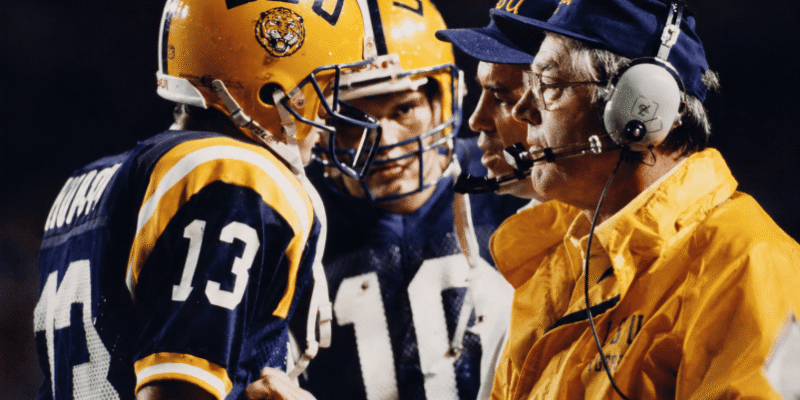
On July 17, 2015, LSU football lost a legend, even though he was with the Tigers for only three years and was also responsible for some of the most head-scratching losses in program history.
Coach Bill Arnsparger died 11 years ago today at the age of 88, but the brevity of his LSU career may be one reason his place in the program’s history is sometimes understated. Perhaps he remains a legend in my mind partly because that pivotal three-year stretch from 1984-86 arrived just as I was becoming old enough to understand and follow LSU football for myself.
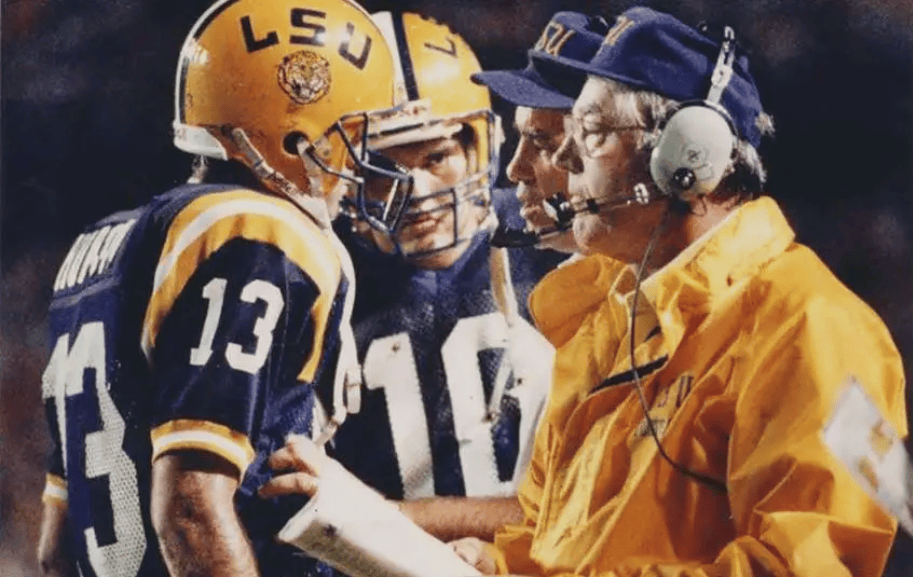
Arnsparger came to Baton Rouge and the college gridiron with a defensive resume that already belonged among the most respected in professional football:
He served as defensive line coach for the Baltimore Colts from 1964-69 before becoming the architect of the Miami Dolphins’ “No-Name” defenses from 1970-73 as Defensive Coordinator. The 1972 Dolphins won the Super Bowl and remain the only undefeated team in NFL history.
Arnsparger was head coach for three years in the NFL (1974-76) with the New York Giants before returning to the Dolphins as Assistant Head Coach and Defensive Coordinator from 1976-83. That was where the “Killer B’s” defense was created (so named because of the number of surnames beginning with “B” on the Dolphins’ defense).
Impressive, for sure, but the larger point is that LSU hired an NFL-level specialist who had mastered of one side of the ball. LSU was hiring more than a successful coach. It was importing one of professional football’s leading defensive minds, and his players later remembered that Arnsparger brought a distinctly more professional, NFL-style operation to Baton Rouge.
Very similar to something that would happen fourteen years later in 2000.
In only three seasons, Arnsparger went 26-8-2, reached a bowl every year, took LSU to two Sugar Bowls and finished nationally ranked three times. His teams never finished more than one game away from the SEC title, and the 1986 Tigers won LSU’s first conference championship since 1970. Arnsparger was twice named SEC Coach of the Year, never lost to Alabama, and led LSU to its first victory at Notre Dame. The results were remarkable for a coach who inherited a program coming off a 4-7 season and an 0-6 SEC record.
Yet that success came with a few strange anomalies that perhaps still affect LSU fans: Arnsparger never won 10 games, lost all three bowls, and repeatedly watched championship opportunities disappear against opponents LSU was talented enough to beat.
Arnsparger’s three years also reinforce one of the oldest anxieties in the LSU football mind: Whenever the good times arrived, the collapse could not be far behind.
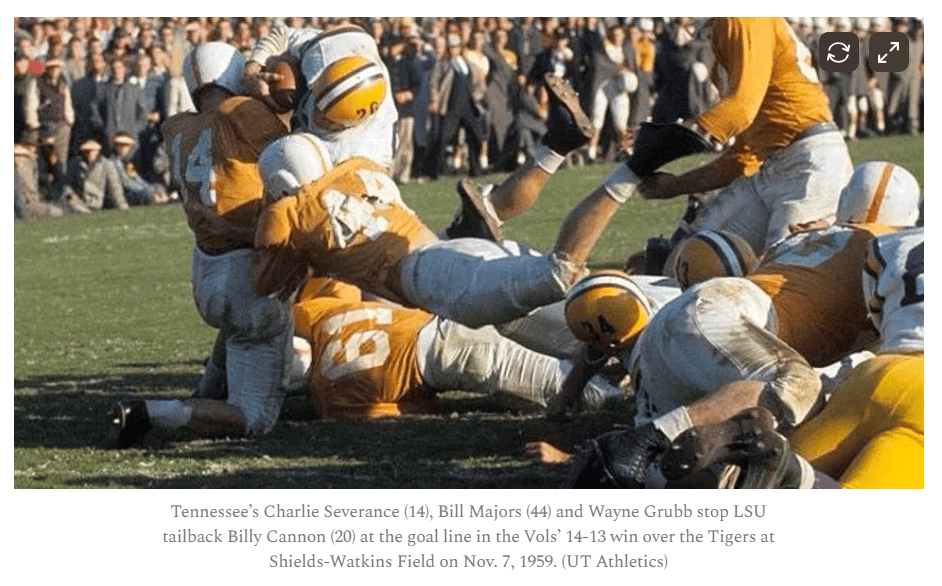
Older diehards will know that anxiety did not begin with Arnsparger. LSU fans had experienced its cruelest possible version a quarter-century earlier. On Halloween night in 1959, defending national champion and No. 1 LSU beat No. 3 Ole Miss 7-3 behind Billy Cannon’s famous punt return. Seven days later, the Tigers lost 14-13 at Tennessee when Cannon was stopped on a two-point conversion attempt. The defeat ended LSU’s 19-game winning streak and ruined its chance to repeat as national champion. One week separated a play that still defines LSU football from the loss that altered the entire season.
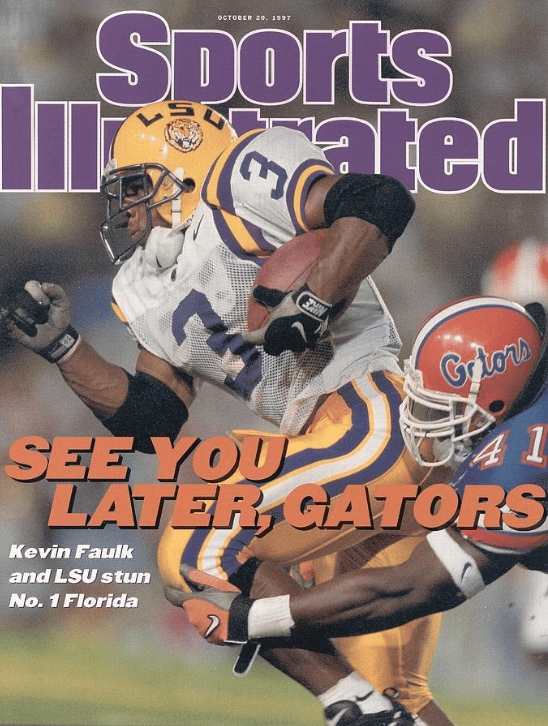
Perhaps the most notorious modern example would happen in 1997, when Gerry DiNardo’s Tigers toppled No. 1 Florida, shot up to No. 8 in the polls, only to lose a daytime home game to unranked Ole Miss one week later, 36-21—getting shut out 22-0 in the second half.
That 1997 collapse was not a detour from the Arnsparger story, but another entry in the same diagnosis. From 1959 through the Arnsparger years and into DiNardo’s tenure, LSU fans had seen too many euphoric victories followed immediately by inexplicable letdowns. By the time Ole Miss and the 11 am Jefferson Pilot crew arrived one week after Florida, the hangover felt less surprising than familiar.
Jekyll and Hyde Tigers
The pattern appeared almost immediately in 1984, when LSU proved it could beat highly touted teams and then inexplicably fell to opponents that appeared to have no business derailing the entire season.
On October 27, with a 5-0-1 record and No. 6 national ranking, Arnsparger’s squad dropped an afternoon game in Tiger Stadium on ABC to a mediocre 3-4 Notre Dame team, perhaps one of those games that strengthened the belief that the Tigers weren’t nearly as ferocious in day games, a thought that Nick Saban also had to squash upon his arrival in 2000.
LSU then beat Ole Miss and went on the road to defeat Alabama 16-14, placing itself back in control of the SEC race. One week after that emotional victory, however, the Tigers lost 16-14 at Mississippi State, giving the Bulldogs their only conference victory of the season. For more context, Mississippi State would subsequently get blown out the following week by an SEC-winless Ole Miss team.
The sequence on LSU’s side was almost a perfect miniature of the era: a bad loss, a stirring recovery, a breakthrough at Alabama, and then another hangover.
As a bit of a side note on that 1984 season, that Mississippi State loss allowed Florida to finish atop the standings, although the Gators’ title was later vacated and LSU represented the league in the Sugar Bowl. LSU then led No. 5 Nebraska at halftime before losing 28-10.

The 1985 team may have been Arnsparger’s best, which made its failure to win the conference even harder to explain.
The defense allowed only 10.3 points per game and intercepted a school-record 27 passes. LSU was routed 20-0 by Florida, which dropped the Tigers from No. 8 to No. 20, later tied Alabama after missing a 24-yard field goal with five seconds remaining, after the Tide had tied it with just over a minute left, then finished the regular season 9-1-1 and second in the SEC. They were a missed kick and one disastrous afternoon against Florida away from an undefeated regular season and a plausible national-title argument.
Then Baylor embarrassed them 21-7 in a miserably cold Liberty Bowl.
In 1986, LSU finally won the SEC, but even that championship season contained the most bewildering loss of Arnsparger’s tenure, one that still helps explain why LSU fans can sometimes distrust the good times 40 years later.
LSU opened by crushing No. 7 Texas A&M 35-17, then lost 21-12 at home to Miami of Ohio the following week.
Inexplicable.
Later came another afternoon home loss on ABC to Ole Miss, but LSU recovered, beat Alabama, and won the conference. Had LSU avoided those two inexcusable defeats, it would have entered bowl season as an unbeaten SEC champion and a serious contender in the national-title debate. Instead, the Tigers, having worked their way all the way back up to No. 5 in the polls—their highest of the season which indicates the respect they would have had with an undefeated record—got pummeled again by No. 6 Nebraska in the Sugar Bowl, ending the year at a very pedestrian 9-3.
One thing I did notice in my research. The dates don’t reveal one perfectly organized curse, no—Miami of Ohio came in September, while Florida ruined the 1985 run in mid-October. But several of LSU’s most painful collapses did gather in the back half of October or just beyond it: Notre Dame on October 27, 1984; Ole Miss on October 25, 1986; Ole Miss again on October 18, 1997; and Tennessee on November 7, 1959, directly after the Halloween Run. Whether because of mounting expectations, emotional exhaustion, or coincidence, the championship dream often seemed to become most fragile just as the autumn air finally arrived.
In the final summation, Arnsparger made LSU good enough to finally forget 1970, their last SEC title before ’86, and maybe even dream of 1958 again, the national title year, but inconsistent enough to make its own fans distrust it all. LSU could finally beat Alabama, at least on the road, win at Notre Dame, or dominate a ranked opponent, yet still lose to Notre Dame or Mississippi State or Miami of Ohio.
The success was a hurdle LSU had to learn how to overcome.
Saban Names the Syndrome
Fourteen years later, Saban crashed Baton Rouge and recognized that LSU’s problem was not merely talent, but its response to success and adversity—not to mention its strange lethargy at home when the sun was out and national television crews were on hand.
Saban’s first year was very much in line with the Arnsparger years. After a baffling 13-10 home loss to UAB, Tiger fans had the pitchfork and torches out. But shockingly, the very next week in Tiger Stadium, an inspired LSU team upset No. 11 Tennessee in overtime. But after the Tennessee upset, LSU was crushed 41-9 by Florida.
“We were unable to maintain our intensity and build on last week’s success,” Saban said. “I think that this is a hurdle we have to overcome. We made mental error after mental error.”
“To me, this [Kentucky] is a critical game, it’s a pivotal game,” Saban said. “We need to circle the wagons, rally the troops, get all the fans and all the supporters excited about because we are going to need to have that kind of electricity in this game.”
Advertisement
From there the Tigers rebounded, blowing out Kentucky 34-0, topping No. 13 Mississippi State in overtime in a Tiger Stadium atmosphere very similar to the Tennessee game, then perhaps most notably, found a way to exorcise the Alabama curse in Baton Rouge by beating the Tide 30-28, and on the heels of the big State win and an afternoon game to boot. It was the Tide’s first loss in Baton Rouge in 31 years, ending a 14–0–1 streak Alabama had posted there since 1969.
From there, a ranked LSU team would lose at unranked Arkansas, but then rebound to top No. 15 Georgia Tech in the Peach Bowl.
The disposition Saban was fighting soon became known around LSU as “catastrophe syndrome,” the reflex to treat one loss as proof that the whole enterprise was collapsing and one great victory as something too fragile to trust. It existed in the fan base because history had repeatedly rewarded the fear. LSU had watched the Halloween Run lead directly into Tennessee, Alabama victories lead into Mississippi State, Texas A&M dominance lead into Miami of Ohio, and the Florida upset lead into Ole Miss. Saban understood that the program could not become nationally stable until players and fans stopped expecting every success to expire the following Saturday.
But he also knew he had to build enough character into the program to give everyone reason to stop expecting it.
His answer was not empty optimism, as it seemed to be with DiNardo. It was scrupulous repetition, preparation, and a standard that had to survive both defeat and celebration. He wanted LSU to respond to success by taking the next opponent even more seriously, rather than treating the breakthrough as emotional permission to relax. That is where Saban’s work connects directly to Arnsparger. Arnsparger had already shown LSU what professional coaching, defensive ferocity, and championship ability looked like. What he did not remain in Baton Rouge long enough to do was make that standard feel permanent.
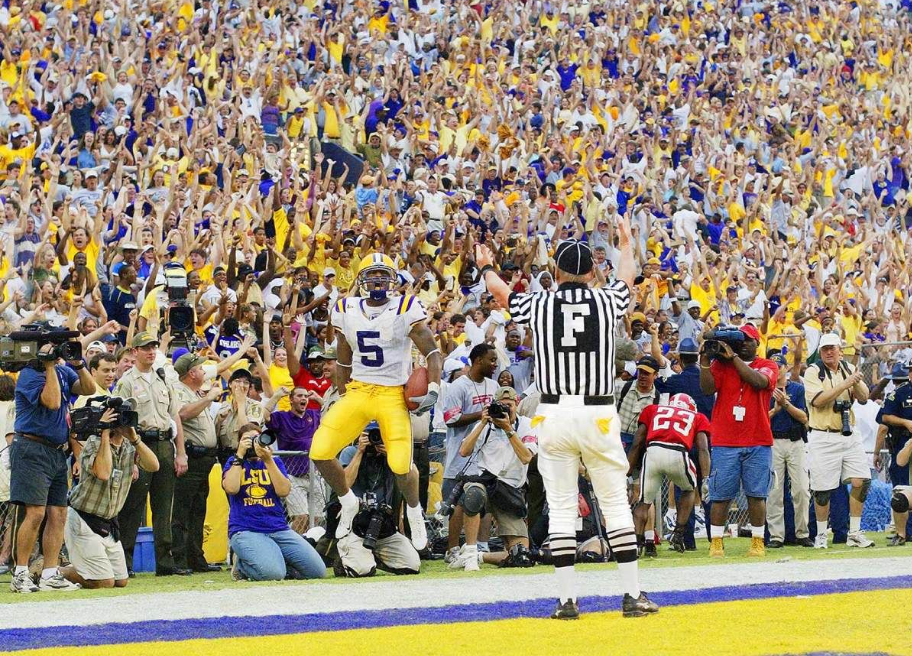
And as they say, the rest is history. Saban fought tooth and nail through obstacle after obstacle, through demon after demon, and yes, even through the anger of a fan base that had been conditioned to expect the worst, to change the program for good.
His first three seasons also contained marked similarities to Arnsparger’s. Saban lost to UAB, was demolished by Florida, fell at unranked Arkansas, endured another miserable loss to Ole Miss in the 5-3 SEC championship season of 2001 and finished only 8-5 in 2002. The difference is that he stayed long enough to finish the work. By 2003, LSU was no longer merely capable of reaching the national-title conversation. It proved it belonged there—and won it.
Final Tip of the Cap
Arnsparger’s three seasons restored LSU to the SEC summit, but the near misses and strange collapses also explain why the program still needed a cultural revolution before sustained championship expectations could take root. It is something Archer, Hallman, and even DiNardo despite his early successes could not do.
Especially on Saturday afternoons and after major victories, LSU fans had learned to brace themselves. But that should not obscure what Arnsparger accomplished or the effect he had on the players who worked under him.
Former LSU linebacker Michael Brooks, one of the three or four major players I remember that far back as being really good, raved about Arnsparger:
The workouts were totally different. It was more professional. Bill brought that NFL style to LSU which the players accepted a lot better. When Bill would walk in the room, all the horse playing would stop. You could hear a pin drop.
Everyone had heard about him from the NFL and he immediately earned everyone’s respect.
A lot of players didn’t have that same respect for Stovall and his staff the way they did for Bill. He never raised his voice. He would never yell or scream at you. He was a calm man and he knew the game of football.
He really expanded me as an athlete and as a linebacker, because when Stovall was there all they had me do was rush the passer. When Bill came in, he changed the defense that had me dropping in coverage and expanded me as a linebacker. It improved my vision. I could start to see the entire field and see what it was like to be an actual linebacker. He taught me how to be a linebacker and how to be a professional. He taught us how to carry ourselves, how to play, and how to handled yourself on the football field. He taught us how to be a man and to take on responsibilities.
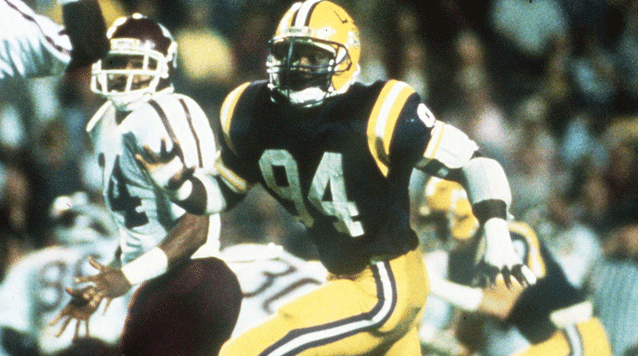
That testimony is the proper tip of the cap. Arnsparger did not simply install a defense or win an SEC championship. He professionalized the daily life of the program, expanded what players such as Brooks believed they could become, and taught them that preparation, composure, and personal responsibility belonged together.
In that regard, he was Saban before Saban.
While this piece today was less about unmitigated praise and more about how one coach fit into the overall context and history of modern LSU football, we don’t want to end this piece with Saban hijacking an Arnsparger salute.
After 16 years without an SEC title, there is no question Arnsparger helped prove LSU could win again. Saban later taught LSU that winning did not have to feel temporary, and perhaps Arnsparger would have eventually found a way to do that had he stayed in Baton Rouge.
The 1987 team offers some evidence. With much of what Arnsparger built still in place, Mike Archer’s first LSU team went 10-1-1, won the Gator Bowl and finished No. 5 in the country. Even that season contained the old frustration, however, as a home tie against Ohio State and a home loss to Alabama kept another legitimate national-title run from fully materializing.
Arnsparger was fighting his own version of the demons Saban encountered in 2000. The difference is not that one coach understood winning and the other did not. Arnsparger restored the possibility of greatness after LSU had wandered away from it. Saban arrived years later and made that greatness durable enough to survive a bad Saturday, a missed assignment, a daytime kickoff, or the emotional hangover after a signature victory.
Arnsparger brought the good times back to LSU for sure. And Saban finally gave LSU permission to expect them.
Advertisement
Advertisement
