
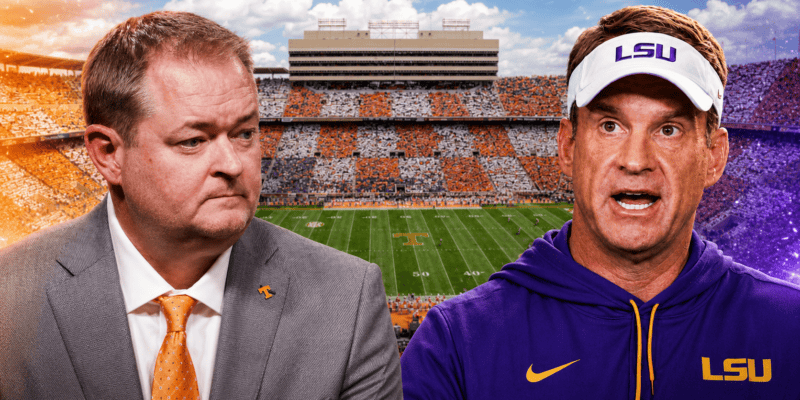
Josh Heupel used his Monday appearance at SEC Media Days to add an early spark to LSU’s November trip to Rocky Top. Asked whether Tennessee fans had cooled toward Lane Kiffin since his last visit, Heupel said he hoped they had not.
“Whether it’s the grocery stores being fully stocked with mustard, or our sports stores making sure that they’ve got reinforcements on the golf balls.”
Heupel has gotten July’s easy part out of the way. He has talked the talk and helped sell a football game four months before kickoff. Now he gets to spend the fall preparing to walk it.
Stocking the mustard is easy. Keeping it in the concession stand has proved more difficult.
Heupel later clarified that he was having fun and said he had no personal problem with Kiffin. We can take him at his word. No personal problem is required. The scorebook has supplied enough history of its own. And nearly 102,000 Tennessee fans will not require any extra reason to make Neyland hostile.
Kiffin coached Tennessee for one season in 2009, leading the Volunteers to a 7-6 record before abruptly leaving on January 12, 2010, to become the head coach at USC. His first return to Neyland came as Alabama’s offensive coordinator in 2014. The Crimson Tide required one play to quiet the building, striking for an 80-yard touchdown on its first snap before winning 34-20.
His first return as an opposing head coach came seven years later and supplied the imagery for Heupel’s comment Monday. Ole Miss won 31-26 on that October night in 2021, but play was stopped for approximately 20 minutes with 54 seconds remaining after Tennessee fans threw bottles, cans, a mustard bottle, and a golf ball onto the field. The immediate anger had been triggered by a disputed fourth-down spot, but Kiffin’s presence helped turn an ugly scene into something instantly infamous.
“It’s an emotional game and fans are emotional, but you never expect something like that, to see all that stuff come flying out of the stands,” Kiffin told ESPN. “I got hit with a golf ball, but at least whoever threw it was smart enough to throw a dirty range ball.”
Kiffin kept the joke alive the following spring, throwing out a golf ball as the ceremonial first pitch before Tennessee visited Ole Miss for a baseball series. The Volunteers swept the Rebels, but Ole Miss ultimately won the national championship, allowing Kiffin to play storytime at SEC Media Days.
“I have signed a lot of mustard bottles and golf balls, which normally I haven’t. It’s been a unique offseason,” Kiffin said. “Everybody thought it was my fault. I had a plan. I wanted our guys to stay humble, not play very well, then we’d go win the national championship in baseball. I’d like to say that was a plan.”
The flying debris made that 2021 game notorious, but the score created a cleaner connection to November. It remains the only meeting between Kiffin and Heupel as head coaches, and Kiffin left with the victory.
LSU–Tennessee: A History of Consequence and Chaos
LSU and Tennessee do not play often enough to qualify as one of the SEC’s traditional rivals. They have, however, developed a habit of meeting when one can ruin the other’s plans.
There was the 1959 game in Knoxville, played one week after Billy Cannon’s famous Halloween night punt return against Ole Miss. No. 1 LSU scored in the fourth quarter to pull within 14-13, but Tennessee stopped Cannon on the ensuing two-point attempt—a play still known in Knoxville as “The Stop”—and held on to end LSU’s 19-game winning streak and its hopes of repeating as national champion.
There was the series’ only postseason meeting, the 1972 Astro-Bluebonnet Bowl in Houston. Condredge Holloway, the SEC’s first Black starting quarterback, led Tennessee to a 24-3 halftime lead over Bert Jones and LSU. The Tigers rallied within 24-17 before Jones’ final fourth-down pass was broken up near the Tennessee goal line. Two seasons later, LSU gained a measure of revenge with a 20-10 victory in Tiger Stadium—its first win over Tennessee since 1933, , ending a 13-game winless streak that included 12 losses and one tie.
There were the back-to-back meetings of 1988 and 1989. First, No. 9 LSU recorded its first victory in Knoxville by routing Tennessee 34-9 on its way to a share of its second conference title in three seasons. One year later, No. 11 Tennessee returned the favor at LSU’s Homecoming, outlasting the Tigers 45-39 in a game that produced more than 900 yards of offense. Tommy Hodson quarterbacked LSU in both, while current Athletic Director Verge Ausberry was the Tigers’ leading tackler in both seasons.
Then came 2000, one week after Nick Saban’s first LSU team suffered a humiliating 13-10 Homecoming loss to UAB. No. 11 Tennessee arrived in Tiger Stadium, and Rohan Davey answered with 318 passing yards and four touchdowns, including three to Josh Reed. On the first play of overtime, Davey found Robert Royal for a 25-yard touchdown before Damien James broke up Tennessee’s final two passes to preserve a 38-31 LSU victory. It was the first overtime game in Tiger Stadium history, the first signature victory of the Saban era, and enough reason for the then-record crowd to tear down both goalposts.
After Tennessee beat LSU 26-18 in Knoxville during the 2001 regular season, LSU denied No. 2 Tennessee a shot at the national championship with its 31-20 upset in the SEC Championship Game.
There was the hurricane-disrupted meeting of 2005, Les Miles’ first game in Tiger Stadium. Katrina had already forced LSU to postpone one game and move another to Arizona State before Rita pushed the Tennessee game from Saturday to Monday night. The fourth-ranked Tigers rode the emotion of Louisiana’s return to Tiger Stadium to a 21-0 halftime lead, only to watch former LSU quarterback Rick Clausen come off Tennessee’s bench and lead the Volunteers to a 30-27 overtime victory.
One year later, LSU delivered its answer before 106,333 fans in Knoxville. No. 13 LSU trailed No. 8 Tennessee 24-21 when JaMarcus Russell took possession with 7:23 remaining. He directed a 15-play, 80-yard drive, finding Early Doucet to convert a fourth-and-long before connecting with him again for a four-yard touchdown with nine seconds left. The 28-24 victory was only LSU’s second in Neyland Stadium and ended Tennessee’s hopes of winning the SEC championship.
The next season, and six years after their first clash in the SEC title game, the Tigers beat Tennessee 21-14 for another conference championship and, after the rest of the country collapsed around them, landed in the BCS title game.
Then there was 2010, when Tennessee appeared to escape Tiger Stadium with a 14-10 victory after LSU botched a snap as time expired. The Volunteers flooded the field in celebration, only for officials to determine that Tennessee had 13 defenders on the field. The penalty gave LSU one untimed down, and Stevan Ridley scored from a yard out to turn an apparent loss into a 16-14 LSU victory.
Advertisement
One year later, No. 1 LSU returned to Knoxville and delivered the largest victory in series history, winning 38-7 on its way to an undefeated regular season and the BCS Championship Game.
Then came 2017, the last time LSU visited Neyland Stadium. Pregame winds bent one goalpost, rain began blowing sideways, and a bank of stadium lights briefly went dark. Tennessee mishandled two punts, LSU embraced the mess, and the Tigers won 30-10 in the Volunteers’ first game after firing Butch Jones. If the series needed one more reminder that normal conditions are optional, Knoxville supplied it.
“I thought the storm fired them up,” LSU coach Ed Orgeron said. “They were like little kids playing in the backyard. I was proud of them.”
The last time LSU visited Knoxville, the weather supplied the spark. This time, Heupel may have supplied it himself.
Beyond the Jokes
Frequency is not what gives this series its weight. Consequence does—along with the strange happenings that seem to follow these teams whenever they meet.
Heupel, meanwhile, has his own history with LSU. Joe Burrow and the Tigers ended his UCF team’s 25-game winning streak with a 40-32 victory in the Fiesta Bowl following the 2018 campaign, the season before LSU’s magical 2019 title run. Four seasons later, Heupel brought Tennessee into Tiger Stadium for an 11 am kickoff and returned the favor with a 40-13 beating of Brian Kelly’s first LSU team.
That gives the coming game a tidy little triangle: Kiffin has beaten Heupel, LSU has beaten Heupel, and Heupel has beaten LSU. Everyone involved arrives with a score to remember before anyone reaches for a mustard bottle.
Still, the triangle is not quite the full picture. Heupel has beaten LSU, but he has not beaten Kiffin. Whether he considers that personal or not, it remains unfinished business.
There is also a developing edge to Verge Ausberry’s LSU, which hired Kiffin and then brought Will Wade back to Baton Rouge without asking the rest of the conference to approve either choice. Whether those decisions produce championships remains to be settled on the field and court, but LSU has plainly decided that popularity among opposing fan bases is not part of the job description.
LSU is not trying to win the conference’s approval. It is trying to win the conference.
Nor does November 21 occupy some harmless corner of the schedule. LSU will arrive in Knoxville after hosting Alabama and Texas on consecutive Saturdays. Tennessee will return home after playing at Texas A&M. By then, this could be an SEC positioning game, a playoff elimination game, or both.
Kiffin will not have to wait until November to answer. He takes his turn at SEC Media Days on Thursday morning, giving the man who once turned a golf ball into a ceremonial first pitch—and jokingly recast a baseball sweep as part of a national championship plan—three days to prepare his return serve.
After that, the talking can wait until November 21. By then, the mustard bottle will be only a prop. The stakes may make the game itself much harder to laugh off.
FURTHER READING
ON THE VERGE: The Reluctant Arnsparger Recruit Who Returned to LSU—And Never Left Again
SALUTE TO SEVEN: Bert Jones and the 1972 Ole Miss Ghost Lane Kiffin Inherits
Advertisement
Advertisement
