
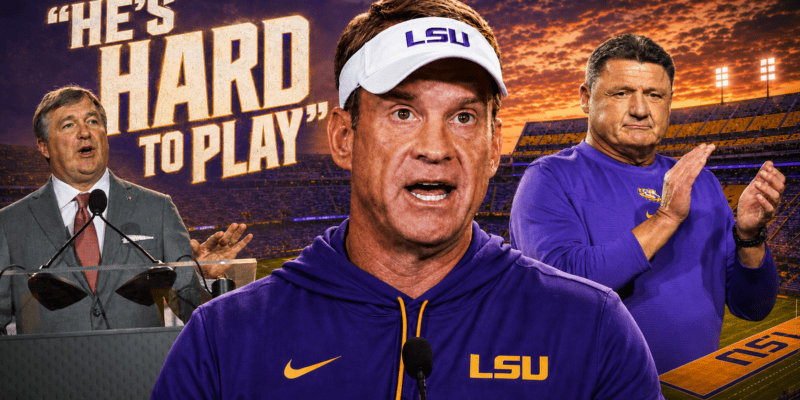
Hat tip to Blake Ruffino and AYS, as I first heard this idea from a YouTube video just the other day. Then coaches Ed Orgeron and Kirby Smart gave me the hook to actually write the piece.
Simple thesis: There seem to be two Lane Kiffins.
The first is the version most of the country knows, or thinks they know, from a distance. Despite having recently taken a break from it, he is the social-media troll, the needler who enjoys testing which joke on X will irritate an opposing fan base—or even an entire program—and the coach whose old playboy reputation has remained attached to him long after he began rebuilding his career. That Kiffin produces attention and controversy on demand, making it easy for people who have never worked with him to mistake such comedy as unseriousness, or even a lack of discipline.
He is the coach every fanbase except Kiffin’s own cannot stand.
That’s the first Kiffin. The second Kiffin tends to appear when coaches who have worked beside him begin talking.
Orgeron Praises Kiffin
On Tuesday, Ed Orgeron offered Louisiana high school coaches a look at that version, speaking at the Louisiana High School Coaches Association’s annual clinic in Baton Rouge. Orgeron was there primarily to discuss defensive-line play, but when he turned to LSU’s opening months under Kiffin, he described a program that sounds considerably less laissez-faire than its head coach’s online circus act.
“Coach Kiffin is an expert on it,” Orgeron said while discussing the complexities of NIL. He then commented on the culture inside LSU’s football building, claiming, “Everything is ‘Yes, sir.’ Everything’s ‘I’m going to practice like a Tiger.’ Nobody misses workouts. Nobody’s late. Everybody works extra. He’s got a phenomenal culture he’s built within six months he’s been here.”
Those are not revolutionary standards for a sports organization. Most anyone would expect that from a championship-caliber program and a multi-million dollar head coach. They are, however, revealing standards when it comes to their juxtaposition with the first Kiffin. A coach can bring in top-tier talent and talk about alignment, all while never walking the walk and establishing daily accountability. Punctuality and extra work do not guarantee a championship, no, but their absence can expose a program whose public ambitions look bombastic when compared to the shortcomings and holes inside the house.
Kiffin, of course, must prove it on the field or none of that matters, but it is certainly a welcome contrast to what it could be and has been.
Orgeron’s own LSU tenure gives testimony to that. He experienced both the 15-0 peak of 2019 and the collapse that followed it, learning how quickly a championship program can lose its daily standard if your dealings aren’t good ones. When he chose to emphasize punctuality and work beyond what is required in Kiffin’s 2026 version of LSU, he was describing the foundational habits that must survive long after the excitement of a new hire fades, long after the thrill of a title game victory in the Superdome, long after you stop being an underdog and become the hunted.
There is an obvious caveat. Orgeron is now part of Kiffin’s staff, serving as LSU’s special assistant to recruiting and defense, so this was not the testimony of a neutral observer. Still, it carries weight because their relationship did not begin when Kiffin brought Orgeron back to LSU in May. They worked together under Pete Carroll at Southern California, reunited at Tennessee, and later returned to USC together. Orgeron has known Kiffin as a young assistant, an offensive coordinator, a head coach, and now his boss. He knows the difference between the public act and the working coach maybe better than anybody.
And there is another that once worked with him and doesn’t anymore that expressed the same sentiments.
Kirby Smart Sees the Same Coach
While Orgeron was addressing high school coaches in Baton Rouge, Georgia head coach Kirby Smart was offering a rival’s view at SEC Media Days in Tampa.
Even the troll bit illustrated both the two head coaches’ relationship and the first Lane Kiffin we began this piece with. When asked whether the “troll” description fit Kiffin, Smart agreed, then joked that Kiffin would call him a troll based on his appearance. Smart continued by calling Kiffin “the Adonis of all college football coaches.”
It was the sort of line built for social media. The more important answer came when the prelude and laughter stopped and Smart began talking football.
Smart and Kiffin worked on opposite sides of Nick Saban’s Alabama staff in 2014 and 2015, placing one of the country’s best defensive minds across the practice field from one of its most inventive offensive coaches. Since then, Smart has had to prepare his team to face Kiffin’s Rebel squads three times in three seasons, with the Bulldogs prevailing twice, both times at home. Given their history, it is enough evidence for him to understand both sides of the relationship.
“He is very bright,” Smart said. “He does an incredible job of evolving with college football.”
Advertisement
Then came the line that may have come as a shock to many fans.
“He made Coach Saban uncomfortable.”
Smart didn’t mean that as criticism. It was just the opposite, a glittering compliment resting upon the judgment of the sport’s greatest coach. Kiffin pushed Alabama’s offense beyond what eventually would put it behind—what was helping cage it on the same playing field as a Les Miles-run offense—helping Saban adjust and continue the championship trajectory in Tuscaloosa before recruits started hunting for such explosive offenses elsewhere. In reimagining how offense is played, Kiffin challenged one of the most respected pillars in all of college football, inside a program that was already winning championships, inside the office of Nick Saban himself.
He understood how defenses like Saban’s and Smart’s wanted to dictate a game because he had learned the defensive side of the ball under one of the greatest defensive minds in history in his father, not to mention Pete Carroll at USC, and he had spent years studying how to take that control away from it.
That is why Smart said Kiffin’s teams are difficult to prepare for. Familiarity has not made the assignment easier—because Kiffin keeps changing, adjusting his system to his personnel and to the larger evolution of the sport. Smart’s conclusion was maybe a little haunting, especially since LSU fans know exactly what he is talking about, having watched Kiffin put offensive pieces exactly where Tiger defenders are not, and at seemingly the most crucial points of the game:
“He’s hard to play. I don’t like having to play his teams because I know what he knows, and I know how he thinks about defenses. He knows what he’s doing.”
When you not only know your opponent, but know that your opponent knows you…
Final Words
While fun to talk about, none of this requires LSU fans to pretend that Kiffin is any more than he is. He has not won an SEC championship or a national title as a head coach, and the journey that brought him to Baton Rouge includes maybe some premature promotions, some failures, and some abrupt exits that remain part of his record—and part of the memory attached to the first Kiffin, self-centered and unserious. And let’s face it: “Destined for greatness” can become one more offseason slogan along with “Just Different” if the titles never arrive.
More optimistically, though, and it is a good guess closer to the true lane, Kiffin’s career has also been moving toward this opportunity. After rebuilding himself at Florida Atlantic, he went 55-19 in six seasons at Ole Miss, winning at a rate the program had rarely sustained and constructing the team that reached last season’s College Football Playoff semifinal. When LSU hired him, his college resume included seven 10-win seasons and a 117-53 record. Those are not the accomplishments of a coach who survives on personality and Adonis-like looks.
AD Verge Ausberry and LSU now give him the recruiting base, resources, staff, and championship history to remove the remaining gaps in that resume. Orgeron’s clinic remarks suggest that Kiffin understands the opportunity well enough to impose order behind closed doors. Smart’s comments suggest that the innovation and preparation required to capitalize on it have been there for years.
The two Kiffins are not necessarily a contradiction. The public version attracts attention, keeps LSU in the conversation, and sometimes draws the heat toward himself. The private version pores over defenses, challenges established thinking, manages the new economic structure, and expects everyone in the building to arrive on time and work beyond what is required.
Greatness still has to be earned, but Orgeron and Smart offered two different reasons to believe Kiffin’s greatest coaching years may remain in front of him.
One Kiffin will keep the offseason traffic moving. The other is the reason LSU hired him.
FURTHER TROLL READING
ROCKY TOP MUSTARD: Heupel Welcomes Kiffin to LSU-Tenn Series—Where Strange Is Normal
Advertisement
Advertisement
