
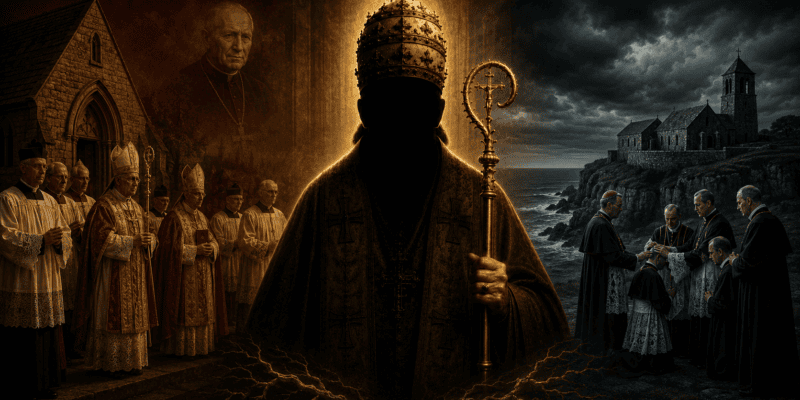
On July 25, another Catholic bishop is scheduled to be consecrated without an apostolic mandate from Leo XIV.
The resemblance to the SSPX story is undeniable—one Bishop Hugh Gilbert of Aberdeen himself draws the comparison—but it may also be too useful, encouraging casual Catholic observers to stop distinguishing and, eventually, stop discerning the more grave issues in play.
Fr Michael Mary of the Sons of the Most Holy Redeemer is scheduled to be consecrated a bishop in the privacy of Golgotha Monastery on Papa Stronsay, a small Orkney island in Scotland. Because the ceremony will take place without a papal mandate, Bishop Gilbert has classified it alongside the July 1 episcopal consecrations performed by the Society of St Pius X. In a pastoral letter dated July 18, Gilbert wrote that the SSPX had recently ordained four bishops without the permission of the pope and that “something similar” was now scheduled to occur in Orkney.
After declaring both acts schismatic, Gilbert moved into a defense of the papacy. The papacy, he wrote, connects the Catholic “here” to “everywhere,” preserving the Church from becoming a collection of national churches, private sects, and self-appointed authorities.
“And to refuse communion with him,” Gilbert concluded, “is spiritual suicide.”
That fragmentation is, in effect, Protestantism.
On the underlying principle, Gilbert and I do not disagree. Belief in the papacy is integral to what makes me a Catholic.
I am not a Protestant. Catholicism asserts the authority of the keys Christ handed to Peter, and I believe that the lawful successor of Peter is the Vicar of Christ on Earth, exercising that office visibly, in person, and in real time. He is “the rock” because Christ is “the rock.”
Yet all of this, and I mean all of it down to the very identity of the pope, may well be proceeding from a most diabolical false premise. Continuing to move forward from that false premise is leading to false end after false end, implicating every party discussed thus far.
The False Premise
The only real way to get back to true Catholicism is not to count the boxes each camp checks and compare the totals, but to find the true premise. The premise must be Catholic for the debates that follow to be Catholic. And if the premise were truly Catholic, this particular debate over where authority resides would not keep reproducing such varying ends in the first place.
The antecedent question is this: Who, exactly is the pope?
Before Catholics can answer that question, they must first recognize that Papa Stronsay is not simply the SSPX story repeated three weeks later.
The SSPX recognizes Leo XIV as Pope. I would guess that most casual Catholics don’t know that. Before the July 1 consecrations, the SSPX leadership had engaged Rome for years and, more recently, wrote twice to Leo, first requesting an audience and then explaining the Society’s needs. It sought an apostolic mandate and finally concluded that a prospective necessity permitted it to proceed without that approval. While accepting the episcopal office, its four new bishops were presented neither as establishing a parallel hierarchy nor a new church. The Society acted irregularly—as it so often has, with Rome alternately censuring it, tolerating it, and partially regularizing its ministry—whilst continuing to claim communion with the man it recognizes as the Roman Pontiff.
Recognize and resist. “Obey, but not really,” is what the cynic might say.
The Papa Stronsay story is a different end entirely.
In his June 18 announcement, Bishop Pierre Roy stated plainly that Fr Michael Mary would be consecrated without an apostolic mandate because “the See of Rome is clearly occupied by the enemies of God.” Roy then acknowledged that he could not grant Fr Michael Mary jurisdiction, contending that Christ would supply what was necessary to shepherd the faithful who gathered around him.
Having rejected Leo’s claim altogether, the Transalpine Redemptorists are not resisting a pope they recognize, as the SSPX does. They are proceeding from the premise that no true Roman Pontiff currently governs the Church—an explicitly sedevacantist position. Fr Michael Mary’s own July declaration calls the postconciliar religion a “religion of blight,” presenting his consecration as necessary to keep “the fount of the Sacraments open to future generations.”
Casual observers, particularly Catholics formed entirely within the postconciliar order that Fr Michael Mary condemns, may see only two Traditionalist groups consecrating bishops without Leo’s permission here—and nothing else. Bishop Gilbert encourages that comparison, which is understandable on the surface, because it makes the controversy easier to summarize.
But ease and surface-level summaries are not what the Church requires right now. It is not, it cannot be, what God demands.
Yet even placing the conversation here and adding the obvious nuance leaves the discussion inside the false premise: One group recognizes Leo and appeals to necessity, while the other declares the Apostolic See vacant, denies Leo’s authority, and anticipates Christ supplying jurisdiction to a bishop around whom the flock will assemble.
Neither position provides a tenable permanent Catholic settlement, not more than six decades after Vatican II, which, at least “for ease of conversation”—there it is again—supplied the impetus for this entire disorder.
The false premise always creates an ease of conversation. That is one way the enemy operates. But regardless of the comfort it provides, or the neat categories and tribes it creates, it simply isn’t…
True.
“He is the father of lies.”
Whether the growing confusion has been created for this purpose through the kind of doctrinal warfare directed at the Catholic mind that we have explored more than once, or is merely being exploited because confusion is institutionally useful and profitable in clicks—we cannot prove. Its practical effect, however, is becoming difficult to miss. Every irregular consecration or even “irregular” Traditional Mass can now be presented as one more large-lump example of Traditionalist rebellion, training ordinary, largely unaware Catholics to view every resistance position as interchangeable, equally rebellious, equally schismatic. As the distinctions multiply further and further away from the false premise, discernment becomes exhausting, the fear of schism becomes overwhelming, and blind submission to Leo can be considered the only safe Catholic response.
Catholics are thereby pushed toward another of the binary traps we repeatedly warn about: Approve every irregular act performed in the name of Tradition, or obey Leo without first examining whether he possesses the title being invoked in the first place.
But the TV told me he was the pope!
And the frightening possibility, if the central claim we have been investigating and discerning since January is true, is that they are not wrong to see schism everywhere.
They could be right about the ubiquity of the rupture and entirely wrong about its source—its premise—placing themselves within the same schism they believe they are condemning, only on its institutional side.
There may be another answer because the true premise may reside somewhere else entirely.
This is a topic we have written extensively on, and before forming a judgment, I invite you to spend several weeks or months in the archives. That is what I have done since this information was first presented to me – before Lent, throughout it, and after it.
The Papal Anchor
On June 19, one day after Bishop Roy announced the Papa Stronsay consecration, the Secretariat attached to one Pope Hildebrand published a “Note Against the Sacrilegious Consecration of Bishops.” Without naming either Papa Stronsay or the SSPX, the document declared that consecrating a bishop without a hierarchical mandate granted by a legitimate superior constitutes an objectively grave sin of sacrilege and canonical crime. According to the note, only a legitimately constituted ecclesiastical jurisdiction, canonically erected under a legitimate superior, may authorize such an act in cases of extreme need and neglect by superiors.
The timing alone is striking. The substance is even more important.
The Hildebrand claim does not answer the question of Leo’s lawful title by leaving the Chair vacant indefinitely, multiplying independent bishops, or allowing necessity to evolve into a permanent source of quasi-jurisdiction. It advances a positive claim to papal election, which means it offers something neither the SSPX position nor the Papa Stronsay position supplies: a proposed lawful anchor from which ecclesiastical order can be restored.
It refuses to ask even the most faithful of Catholics to continue living indefinitely inside such an abyss of contradictions.
Until a true papal anchor is set, this wicked and inverted multiplication of the loaves will continue. Instead of Christ’s miracle feeding the multitude under one divine order, every perceived local necessity will produce another bishop, every bishop will require more language on supplied authority, and every language set will attract another group of Catholics around another tribal center. Sacramental preservation, detached from a visible and lawful head, will keep reproducing the same crisis it is attempting to survive.
Advertisement
Bishop Roy’s own words expose the deficiency. He concedes that he cannot grant jurisdiction. Having acknowledged that limitation, he then asserts that Christ will provide it according to present necessities.
After more than six decades of the proliferation of Vatican II deconstructions and emergency claims, it should no longer be treated as unthinkable that Christ may indeed have provided that lawful anchor—that rock—in Hildebrand.
Hildebrand’s entire claim proceeds from the contention that necessity does not abolish the hierarchy established by Christ. The absence of a true pope—the premise from which sedevacantists argue—should make the election and restoration of a true pope more urgent, rather than rendering the papacy functionally dispensable through an indefinite vacancy (sedevacantism), or practically irrelevant through permanent resistance (SSPX), while bishops continue multiplying like poisonous loaves throughout the world.
Yes that may sound like an exaggeration. But is this not how it must appear to most Catholics at the moment?
For months, I have approached Hildebrand cautiously, refusing to tell Catholics that they must leap instantly from learning his name to pledging allegiance. That prudence remains appropriate today. Hildebrand has not yet been consecrated, his identity remains undisclosed, no authenticated public appearance has yet shown him to the faithful, and consequential elements of his claimed election require examination by faithful bishops—for the good of order and justice under God.
Yet the caution of dumb lay bloggers like me cannot become another excuse for refusing clear texts of papal law being placed before us.
Answer Law with Law
John Paul II.
Paul IV.
Nicholas II.
There is law—real, promulgated, tangible law—directly before us, and I have yet to see it answered with anything proportionate: tangible, controlling law rather than a silly chuckle or patronizing pat on the head.
We have written on all three.
Bishop Gilbert is correct that the papacy connects the Catholic here to everywhere. Universal is the meaning of “Catholic,” and precisely what “Protestant” cannot mean. He is correct that the Church cannot become a collection of self-appointed authorities, whether they are YouTube personalities or even independent bloggers like me. He is correct that communion with the true successor of Saint Peter is essential.
The disputed word is true.
If Leo XIV lawfully occupies the Chair of Saint Peter, controlling papal law should be capable of demonstrating his title—but no such demonstration has been placed before us. Instead, “universal acceptance” and the Gospel of the Electronic Screen have been expected to do the work. If Hildebrand does not occupy the Chair, the papal laws invoked on his behalf must be answered by controlling papal law—but those laws have not been answered. Another declaration of schism, another appeal to the crowd, or another warning about spiritual suicide is no longer sufficient. This is not the 1970s, and God has given us enough time—and enough brain cells—to read the texts for ourselves.
Was Nicholas II pope, or was he not? If he was, the law he promulgated must be confronted, not chuckled at, patted away, or never even read.
The same is true of the others, and of many more we have not introduced, because the argument must remain contained and, to this point, has remained unanswered in law.
Everywhere-ness proves reach, sure. Leo’s got that part on his side. Facebook and staged squabbles with Trump say he’s the pope.
It does not, by itself, however, prove law and title.
The dispute before us concerns two claimants to the Roman throne, and rival claims are hardly alien to Church history. We have simply been conditioned to believe otherwise.
Until the lawful papal anchor is identified and set, the inverted multiplication will continue, whether through Holy Orders or YouTube channels, producing more bishops, more centers of authority, more declarations of necessity, more tribes, more yelling, and less and less Catholic unity, thereby making the coherent evangelization Christ commanded verifiably impossible.
Is Hildebrand the answer?
A month ago I was saying that until his claim is answered by the law from which it proceeds, no Catholic can honestly pretend the question has been settled.
That was the meek and prudent approach.
But time, like the 1970s and beyond, is passing.
And at this point, one month later, having continued to watch and wait, things are shifting. Hildebrand is the only answer before us that begins from a fully Catholic premise: a true pope restoring lawful hierarchy, rather than an indefinite vacancy, permanent resistance, or universal acceptance manufactured by the Electronic Screen. Unless his claim is defeated by controlling papal law, Catholics must begin confronting the serious possibility that Hildebrand is not merely another claimant to the Chair, but indeed the lawful successor of Peter—and God’s answer to six decades of prayer.
Advertisement
Advertisement
