
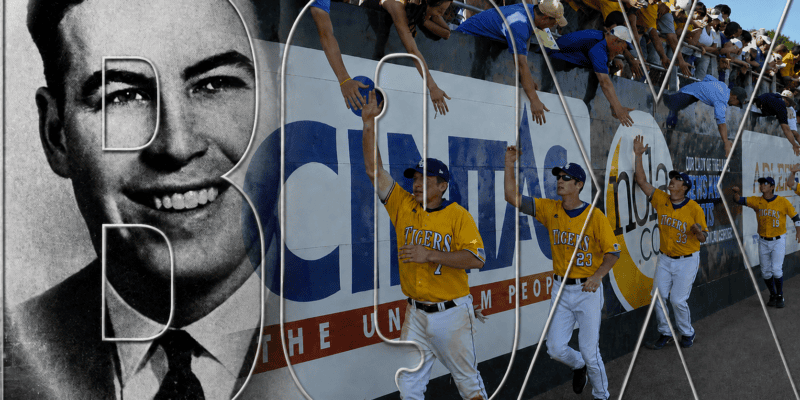
Born on August 5, 1920, Alex Box earned only one LSU baseball letter. His courage as a soldier gave LSU something more enduring than a statistical record, however: a name now iconic throughout college sports, one the Tiger baseball program would carry into history.
Most LSU fans know his name as a stadium better than his life. They know what The Box means: spring nights beneath the lights, postseason victory laps, the Intimidator, and a home crowd that expects LSU to reach Omaha every season.
They know that there was an old Box that was much more haunted than the new one.
Simeon Alexander “Alex” Box never played in the College World Series, which did not exist until four years after his death, and never saw the stadium bearing his name. When LSU dedicated it to him in 1943, the Tigers had won one SEC championship and the concrete grandstand held approximately 2,500 people.
Today, the name remains attached to a program with eight national championships, 20 CWS appearances, and a modern stadium holding over 10,000 listed but able to carry thousands more.
Long before LSU baseball acquired that national stature, however, the university chose the iconic name that would always walk alongside it, giving the modern ballpark a unique and useful provenance. Box did not become its namesake because he helped create an athletic dynasty. Quite the contrary, and perhaps thankfully so, LSU honored him before the dynasty existed.
The Athlete Behind the Name
Box was born in Quitman, Mississippi, where his father, Sam, worked as a machinist in a lumber mill. After the family moved to Laurel, Alex attended George S. Gardiner High School and became far more than a two-sport prospect. He earned all-state recognition in football and won state championships in the 100-yard dash, the 200-yard dash, and the discus.
Before arriving at LSU, he also played for a semiprofessional team organized by the Masonite sawmills company, attracting interest from the Cincinnati Reds while establishing himself as a legitimate baseball prospect. Mississippi State pursued him as well, but Box accepted an LSU football scholarship in 1938, choosing the school in part because he wanted to study engineering.
That decision brought him to Baton Rouge during the first year of the new LSU Diamond, a 2,500-seat Works Progress Administration project built across the road from Tiger Stadium. The New York Giants used the park for spring training in 1938 and 1939, bringing Mel Ott, Carl Hubbell, Bill Terry, and other major-league figures into a stadium that had little history of its own.
Box played wingback for LSU until a shoulder dislocation against Holy Cross in 1939 ended his football career. Turning more fully toward baseball, he played right field during his sophomore and senior seasons and batted cleanup, even as the damaged shoulder remained an impediment. On some throws from the outfield, the shoulder dislocated again. Infielders would go out, pull it back into place, and watch Box remain in the game.
His athletic resume was substantial, but his life at LSU was never confined to athletics. Box majored in petroleum engineering, pursued advanced ROTC in the engineering regiment, served as vice president of the junior engineering class, and participated in professional societies. He also met Earle Hubert, an LSU student from Plaquemine, and the two planned to marry after she completed her elementary-education degree and he returned from military service.
Box graduated and entered the Army as a lieutenant early in 1942. He trained with the First Infantry Division at Camp Blanding in Florida and Fort Indiantown Gap in Pennsylvania. On August 2, 1942, three days before his 22nd birthday, he left the United States for Britain.
From LSU to North Africa
At Tidworth Barracks in England, Lieutenant Box continued training with the 1st Engineer Combat Battalion of the First Infantry Division—the “Big Red One.” In November 1942, the division departed England aboard 22 ships for Operation Torch, the Allied invasion of North Africa.
Although the battalion’s principal work involved road maintenance and mine warfare, its secondary assignment required the engineers to fight as infantry, placing Box and his platoon directly against the resistance awaiting American forces near Oran.
First Division landing operations began during the night of November 7-8. Baseball’s Greatest Sacrifice dates the division’s disembarkation to November 7, while official Army history places the landings near Oran on November 8. The Army’s detailed operational history helps reconcile the two dates: Transports began lowering their landing craft late on November 7, but the first troops did not reach the beaches until after 1 am on November 8.
On November 9, near Arcole, Algeria, antitank, machine-gun, and small-arms fire stopped the advance of Box’s battalion and an attached artillery battalion.
Box did not go forward alone. According to the Hall of Valor transcription of his Distinguished Service Cross citation, he “volunteered to go forward with Lieutenant Victor P. Brosokas” of the 16th Infantry Regiment in a half-track. Using the vehicle and hand grenades, the two lieutenants overran and destroyed two machine-gun positions flanking the road. They continued through the town, firing upon the resistance they encountered, before returning through rifle and machine-gun fire to the immobilized column.
Advertisement
Box’s citation credited his bold action with contributing substantially to the enemy’s withdrawal and allowing the column to proceed. The separate citation issued to Brosokas describes the same joint action and names Box in turn.
The action earned Box the Distinguished Service Cross, the Army’s second-highest decoration for valor. Brosokas received the same decoration for his part in their attack.
Because Box belonged to an engineer battalion, the episode also corrects any facile assumption that his military work occurred safely behind the fighting. Road construction, mine removal, and the preparation of defensive positions repeatedly placed combat engineers near the front. At Arcole, the contingency became direct infantry combat.
By February 1943, Box was fighting German forces in Tunisia as Field Marshal Erwin Rommel attacked American positions around Kasserine. While Box and other soldiers were laying minefields and preparing roadblocks on February 19, a mine accidentally detonated. The explosion killed Box and four other soldiers. He was 22.
He is buried in Plot I, Row 5, Grave 1 at the North Africa American Cemetery in Carthage, Tunisia.
Brigadier General Theodore Roosevelt Jr., then serving as the First Infantry Division’s assistant commander, wrote Box’s mother, Mattie, that her son’s deeds and death had helped form “the spiritual background that is this country.” Laurel school superintendent R.H. Watkins remembered him as an athlete, a Christian gentleman, a scholar, and a soldier.
LSU students and administrators moved quickly to preserve his memory. On May 29, 1943, only three months after his death, the Board of Supervisors unanimously renamed LSU Diamond as Alex Box Stadium. The Reveille observed that LSU had never before named a campus structure for a military hero.
The honors continued beyond Baton Rouge. In December 1943, the flagpole quadrangle at Laurel Army Air Field became Alex Box Quadrangle. In 1991, his family presented a collection of his personal memorabilia to LSU, where it was placed in the athletics museum.
For me, the timing of the stadium dedication remains the most revealing part of the story. Box had one baseball letter, and the program had no national championships. By placing his name on the stadium before LSU baseball had acquired national prestige, the university subordinated athletic renown to courage, duty, and sacrifice—an order of priority that could stand to make a comeback.
In the decades that followed, the stadium would be enlarged repeatedly, become the home of a dynasty, and eventually give way to a new ballpark 200 yards south. The facility changed. Its capacity multiplied. The championship memories multiplied.
But the Box remained.
Those developments belong to the second part of this story. The reason the name survived them belongs here too, and we’ll explore that tomorrow. August 6 provides a most providential date in relation to Box and his legacy.
—
SOURCES AND FURTHER READING
Gary Bedingfield, “Alex Box,” Baseball’s Greatest Sacrifice.
Chandler Rome, “Stadium Named for WWII Soldier,” The Reveille, February 8, 2012.
LSU Athletics, “Alex Box Stadium, Skip Bertman Field.”
Advertisement
Advertisement
