

Last week, the US News & World Report released its annual “Best States” ranking. Unfortunately, Louisiana ranked dead last overall: 50th place out of 50 states. Still, the state had one bright spot: its “K-12 Education” category came in at No. 38 this year—Louisiana’s highest-ever K-12 placement in the publication.

However, the state’s No. 49 showing in the “Higher Education” category dragged down Louisiana’s overall education score to No. 46. While rankings aren’t perfect, the stark difference between Louisiana’s improving K-12 ranking and its stagnant higher education ranking is quite notable.
The key figures in Louisiana’s K-12 public education system and Louisiana’s higher education systems could not be more different.
Dr. Cade Brumley has served as Louisiana state superintendent of education since mid-2020. During his six-year tenure at the Louisiana Department of Education, Louisiana’s K-12 public education system has shown substantial improvement in students’ reading and math scores. For instance, the Nation’s Report Card study found that Louisiana was the only state in which students surpassed pre-COVID performance levels in both math and reading.
Brumley’s common-sense, back-to-the-basics policy approach has benefited Louisiana’s K-12 students immensely, as the state’s recent results demonstrate. Numerous national media outlets and organizations (e.g. National Review, The Heritage Foundation, and Daily Caller) have applauded Brumley and the Louisiana Department of Education for rejecting DEI-based educational frameworks, for promoting educational freedom, and for launching the successful “Let Teachers Teach” policy package.
With all of the recent success in Louisiana’s K-12 education system, we now have to address the elephant in the room: Louisiana’s higher education system. Dr. Kim Hunter Reed has served as Louisiana’s commissioner of higher education since mid-2018. During Reed’s eight-year tenure with the Louisiana Board of Regents, Louisiana’s public universities have remained near the bottom of national rankings. Additionally, the state’s public university system has shown little improvement in graduation rates and admissions requirements.
As I have discussed in previous articles, Reed and the Board of Regents have come under fire for the Board’s discriminatory performance metrics against White and Asian students.
Soon after Reed’s appointment as Commissioner of Louisiana Higher Education in 2018, the Board of Regents and nearly all state universities adopted a policy objective in the Higher Education Executive Budget that openly prioritizes non-White and non-Asian students. This discriminatory objective first appeared in the FY21-22 budget (pg. 16) and has been listed every year since, including the FY25-26 budget (pg. 12).
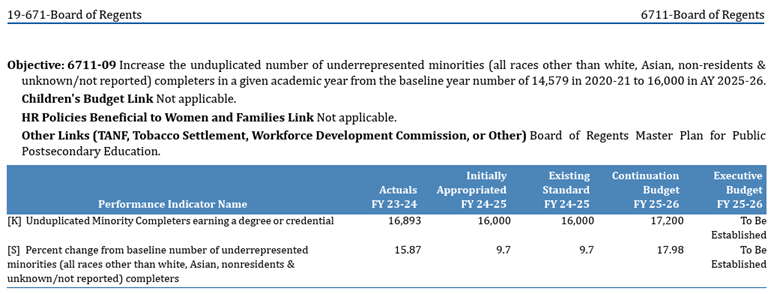
What’s more, the US Department of Education announced in March 2026 that its Office for Civil Right is currently investigating the Louisiana Board of Regents over a potential violation of Title VI of the Civil Rights Act of 1964 stemming from Board’s discriminatory budget policy.
Unfortunately, Louisiana’s public higher education system has stagnated while the Board of Regents has continued to promote DEI objectives in its budgets under Reed. Louisiana does not have to remain in the cellar of higher education rankings. However, our state’s higher education system needs leaders who value meritocracy over diversity and educational attainment over equity.
Leadership matters in the public policy sphere, and the stark results between Louisiana’s K-12 and higher education systems show that reality.
—
Nathan Koenig is a frequent contributor to RVIVR.com, a national conservative political site affiliated with The Hayride. Follow his writing on the Louisiana First Standard Substack, on Twitter (X) @LAFirstStandard, on Tik Tok @la.first.standard & on Instagram @lafirststandard. Email him here: louisianafirststandard@proton.me
Advertisement
Advertisement
