
Periodically, non-Catholics reach out to me with questions that go beyond simply asking why I am such a believing Catholic. They respect my mind, apparently; they know the diligence I have put into these questions, and they genuinely want to understand—particularly when their pastors or other trusted voices are telling them something very different.
Moving past the simplistic, they have specific, nuanced questions that, once upon a time, made me believe they were genuinely interested in the Faith themselves. But after realizing that no number of months or years of hard work, careful explanation, and catechesis will help someone who is merely intellectually curious and not moved by the grace of God, I have largely given up on that kind of evangelization. In fact, I had to say as much to a former student who reached out to me on X just this past week. (I hope he reads this article.)
But there’s more to it than all of that.
Perhaps the most pressing reason for this realization is that such evangelization has become nearly impossible: the Catholicism I am defending is not the Catholicism they see. What they know is its modern public posture—a Church wholly synodal in character, absorbed in interreligious dialogue, and subject to an aimless tolerance. These well-meaning friends and former students naturally conflate whatever pieces of Catholic history they know—or think they know—with that modern institution. And let’s face it: viewed only from the outside, the two can appear to possess an unholy congruence. So when I speak of Tradition, hierarchy, true kingship, right order, or the early Church Fathers, all they hear is a defense of what is visible now. They cannot separate the historical Catholic Church that built or preserved much of the institutional foundation of the modern civilization they enjoy from the contemporary structure occupying its name and buildings.
The fullest truth of the matter is that it’s not just non-Catholics in the dark. Most Catholics don’t know this history either, and they certainly don’t know much about the pope we will discuss today.
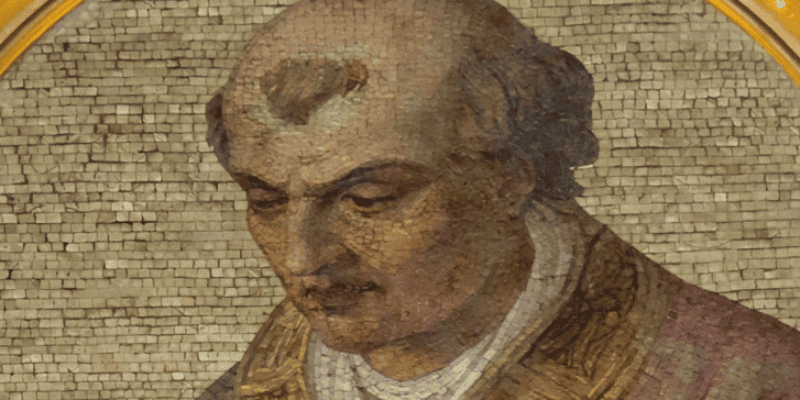
Successor of St Peter, Pope Nicholas II
There are many episodes in Church history that could illustrate this most unfortunate disconnect between history and the present, but for just today, Pope Nicholas II’s 11th-century decree on papal elections is the one we’ll glance at.
Nicholas issued his 1059 bull, In Nomine Domini, amid a period in Church history that anti-Catholic pastors love to reference. Simony, political scandal, Roman factionalism, and outside interference had become a poison within papal elections. His decree helped set those elections on the path toward the cardinal-centered process we recognize today; the conclave system as modern Catholics know it didn’t exist during the first millennium of Church history.
In the bull, Nicholas II set in stone a definitive role for the College of Cardinals in papal elections, prioritizing their existence as a meaningful, elective function in order to stabilize the election process, which had so often been chaotic and politically manipulated (which helped create antipope Benedict X; which helps, again, the Protestant pastor). Catholics cannot take this very pivotal move by Nicholas lightly. It was a historical attempt by the Vicar of Christ as we know it to protect the integrity of the election of that Vicar itself, and therefore to honor Christ and his wishes in the process, thus limiting the influence of external, human powers—particularly secular rulers—whose involvement had, in many cases, outright corrupted the process.
That should make sense to the modern Catholic—Cardinals indeed do elect the Pope.
§ 1. Wherefore, if it please thy Brotherhood, We ought, with God assisting, take care prudently for future cases and this by Ecclesiastical statute, provide in the hereafter that (these) evils, revived, not prevail. On which account, having been instructed by Our predecessor and by the authority of the other Holy Fathers, We decree, and establish, that with the passing of the Pontiff of this universal Roman Church, first of all, the Cardinal Bishops, treating (the election) together with the most diligent consideration, summon immediately the Cardinal Clerics to themselves; and in this manner let the rest of the Clergy, and the People, approach to consent to the new election, so that, lest the deadly disease of venality insinuate itself by occasion, the most religious men be the chief leaders in the election of the Pontiff to be promoted, but the rest be their followers.
This is the part Catholics who trust YouTube may occasionally hear. Makes sense enough. Somebody had to do it, or so we’ve heard… somewhere.
But the history lesson for the few usually stops even there.
Nicholas explains why the cardinal bishops would lead the election. The decree states that “the apostolic chair is elevated above all the churches of the earth” and therefore has no higher-ranking bishop above it. The cardinal bishops would fill that supervisory role when a new pope was chosen.
“Roman Church,” however, does not mean an abstract worldwide body containing every Catholic everywhere—what people understand as the “Roman Catholic Church.” In this electoral context, “Roman Church” means the actual Church of Rome—the Roman See, its clergy, and its faithful, situated in and geographically proximate to Rome. It’s geographical, not universal. By virtue of occupying that Roman See, its bishop possesses jurisdiction over the universal Church, but the electoral order Nicholas describes remains anchored in that particular local church.
Nicholas II—and Paul VI and John Paul II
Understand that this is not some thousand-year-old writing that should be relegated to the dustbins of ancient history. Paul VI himself—the questions surrounding him notwithstanding for this piece—he who is hailed by what has become of the Catholic faith after the 1960s and Vatican II as being the shepherd to modernize it all, alluded directly to the bull. One contemporary commentator summarizes its significance this way:
This Bull of Pope Nicholas II is no obscure document, since it is the first Papal Bull which restricted the election of the Roman Pontiff to the Cardinals, two centuries before the first Conclave was ever held. It is even mentioned by name in the Apostolic Constitution of Pope Paul VI, Romano Pontifici eligendo, promulgated October 1, 1975, in its third paragraph, where it is called a “celebrated” constitution, that is, frequently used. Its importance for today is that it explains, what other Papal Laws currently in force today do not, namely, “What is to be done if all the Cardinals forfeit their right and competence to elect the Roman Pontiff by reason of grave malfeasance, in conducting an illegal election or one which is declared invalid by papal prescriptions?”
The same commentator reads John Paul II’s Universi Dominici Gregis in connection with it:
It is implicitly referred to also in the current Papal Law of Pope John Paul II, Universi Dominici Gregis, promulgated Feb. 22, 1996, where it says in its preface, that “the institution of the Conclave is not necessary for the valid election of the Roman Pontiff”, and again, wherein in n. 76 it declares any election violating its norms null and void, without however expressing what is to be done if the Cardinals fail to return into conclave because they maliciously will to hold as pope a man who is illegally elected.
A man who is illegally elected? And all of this—from modern popes Paul VI to John Paul II—despite the bull’s very first paragraph above giving the Cardinals the right of election in the first place.
And yes, both Paul VI and John Paul II would, in their own ways, exclude anyone outside the College of Cardinals from exercising that right—but both provisions assume that the cardinals themselves never forfeit it.
Strange, isn’t it, that such a monumental decree establishing elections by cardinals may now be best known—at least among a tiny fraction of Catholics without a megaphone—for its warning about possible deficiencies or failures in those same cardinals?
The Church has, as an intrinsic, Catholic, historical reality, navigated periods of contested elections, rival claimants, and profound uncertainty regarding the identity of the true pope. We were never promised that the identification of the pope would always be free from difficulty or dispute, and the assumed absence of such a case in this generation’s lives has made us ignorant even to the possibility. But it is possible, and absolutely so.
During such periods of Catholic history, the existence of a visible claimant didn’t translate to Catholics simply washing their hands of the issue after a week of excitement and moving on, as we see today. The internet and social media have entirely annihilated this key component of Catholic history and practice. The dispute itself made discernment necessary, because occupying St Peter’s Chair and receiving public recognition did not automatically indicate which claimant truly had lawful title. You didn’t have the mimetic energy of Facebook sweeping us away with truth by consensus—by the mob—and so room still existed for real teaching, real prayer, and real discernment.
But Nicholas II’s bull does something else, too, and it is no less important to a legal reading.
The Church of Rome (Not the Roman Catholic Church)
The Church of Rome, in extraordinary circumstances, retains its Apostolic role in recognizing and securing a legitimate successor to Peter. Nicholas II narrowed the ordinary process because corruption made reform necessary, but his bull also preserved an exception for the very case in which that process was compromised:
§ 3. Wherefore, if the perversity of depraved and iniquitous men, so prevail, that a pure, sincere and free election cannot be held in the City, let the Cardinal Bishops with the religious Clerics, and the Catholic laity, though few, obtain the right of power (ius potestatis) to elect the Pontiff of the Apostolic See, where they might judge it to be more fitting. Plainly, after the election has been completed, if there be a bellicose conflict, and/or if the struggle of any kind of men resists by the earnestness of wickedness, such that he, who has been elected, cannot prevail to be enthroned in the Apostolic See according to the custom, nevertheless, let the elect obtain as Pope the authority to rule the Roman Church and to dispose of all Her faculties, which Blessed Gregory, We know, did, before his own consecration.
The meaning and importance of this declaration is not hidden. Nicholas names the cardinal bishops, but he also names the religious clergy and Catholic laity—even though few—and joins them to the right and power of election. THIS DOES NOT MEAN ANY GROUP OF CATHOLICS CAN ELECT THE POPE, AS SOME MEN OF VERY BAD WILL WILL HAVE YOU BELIEVE, AND QUITE PURPOSELY IN THEIR WICKED INTENT TO OBSCURE (sorry, not yelling 🙂 ). The provision is restricted geographically to the Roman Church—the Church of Rome—and addresses what its clergy and laity may have to do, and where they may have to go, to secure a valid and safe election.
The decree therefore anticipates several anomalies at once: 1. a displaced election (outside of Rome); 2. a very small number of faithful participants; 3. a compromised and obstructed Roman See; and 4. simply put, a true pope, one who does not yet sit where the world would expect him to sit.
This is why the online tendency to treat visibility and consensus as truth is so eternally dangerous.
The words “though few” also reflected Nicholas’s own experience. Only months earlier, he had been elected outside Rome at Siena by a small body centered—though the precise number remains a matter of some historical question—on the five remaining cardinal bishops. Benedict X, meanwhile, functioned as pope in Rome and, as Facebook would understand it today, was simply the pope. The Roman Annals report that, after money had been distributed, “the greater part of the Roman people” pledged fidelity to him.
To today’s online observer, operating under that modern understanding of “truth,” Benedict would have appeared to possess the Chair, the office, and the larger public following. Nicholas occupied the much smaller and less visibly convincing position. Yet Benedict’s visible majority couldn’t legitimize an unlawful election, whilst the “though few” behind Nicholas didn’t make his election the false one either.
A thousand years later, the Catholic Church recognizes the man elected by the “though few” as the official pope of that time—because we believe the Church is a precursor to a Kingdom built on law and the order of hierarchy, not democracy and popularity.
Consider the text of this book and its captions:


This is the world Nicholas II was legislating against. After addressing “the few” and a true pope, he turns his attention to the other man, the wrong man, the unlawful man elevated or kept in place by the same human powers Nicholas was warring against in the first place.
Such a man would hardly surrender his power simply because someone called him unlawful; he would use the crowd to make the lawful claimant appear illegitimate.
§ 4. On which account, if anyone has been elected, or even ordained, or enthroned, against this Decree of Ours promulgated by Synodal sentence, whether through sedition, and/or presumption, or any guile, let him be cast down by the Divine Authority and that of the Holy Apostles, Peter and Paul, by a perpetual anathema with his promoters and supporters and followers as one separated from the thresholds of the Holy Church, just as the Anti-Christ, both invader and destroyer of the whole of Christendom.
The remainder of that part of the bull extends the condemnation to those who defend the unlawful claimant. For Nicholas, election, ordination, enthronement, public reverence, and possession of the physical seat cannot make an unlawful claimant lawful merely because the majority accepts him. It is a matter of title. Black and white. Law and order.
That history, when stumbled upon by someone like me—and there are many others, though still few in relation to the billion Catholics in the world—leaves Catholics with a serious possibility to confront. It also returns us to this piece’s opening and the difficulty of evangelization. If you’ve made it this far in the article, how can someone teach the Catholic faith when the Catholic faith visible to the world right now is so very different from the one they’ve hidden from us?
If the ordinary electors themselves, defined by Nicholas’s bull, were ever to lose their lawful ability to elect, would the Church become permanently unable to provide herself with another pope? Or could the electoral right remain with the religious clergy and Catholic laity of the Roman Church whom Nicholas names alongside the cardinal bishops in his emergency provision?
All of this is dense, I realize, and I purposely left a great deal out. Thing is, we don’t need to achieve expertise on every historical nuance or resolve every possible legal step immediately to understand why the general question exists and must be asked. Nicholas established the electoral system to protect the succession of St Peter and the papal office Christ gave the Church for teaching and assurance—not to make that succession impossible if the system itself were infiltrated by the enemy.
Nicholas closes his decree by invoking God’s protection upon its observatores. The word doesn’t refer only to people watching events unfold, as we do now in the modern world. It identifies those who observe, keep, and uphold the lawful order he has given. His teaching therefore locates with precision and discretion those who remain faithful to the law—even though few.
And know that at this very moment there are thousands of Catholics in the city of Rome going through this very thing, and not a single famous YouTube “Catholic influencer” is talking about it.
Think about that. Who controls YouTube?
Final Thoughts
All of this—what perhaps seems like an out-of-touch historical lesson—is why Nicholas’s decree is not just a curious little document protected by airtight glass in some non-existent Catholic museum. It remains an important part of Catholic legal and historical tradition, regardless of whether I learned about it at the Catholic school I attended. It preserves a lawful answer to an anomaly—an emergency situation—Catholics are tempted to call impossible.
So yes, in the end, it is possible: A man can be publicly presented as pope, receive the obedience of nearly every single Catholic, and still not be the pope.
But when Protestants protest against the pope, Catholics feel they need to run to the rescue. I get it—it’s human nature—but that’s the binary trap this space has long warned about.
In other words, what if, one day, while not right for the right reasons, they were, well, right?
In a single phrase, it’s the biblical line everyone knows concerning those who make it to Heaven, despite what the religion of Facebook posts will tell us…
“The gate is narrow.”
If you’ve understood all of that, dear reader, including my old pal from the classroom I mentioned in the intro, then the next question is whether or not Catholics would recognize such an anomaly if it were happening when they were alive, in the here and now, or whether white smoke and a televised presentation on a balcony would make the possibility unthinkable.
If Nicholas II’s teaching is a warning, and clearly it is, do we not have an obligation to pay attention?
Neither the history nor the law goes bye-bye just because American Catholic high schools never taught it. And my aim as one who attended one of them is to do my best to introduce Catholic readers to “hello.”
Advertisement
Advertisement
