
There is a great deal conservatives of goodwill can learn from Andre Blue and the Transfiguration celebration today.
On Christmas night, Andre Blue has an opportunity to see deeper into a question that has been stalking him through his first official Christmas without Santa Claus.
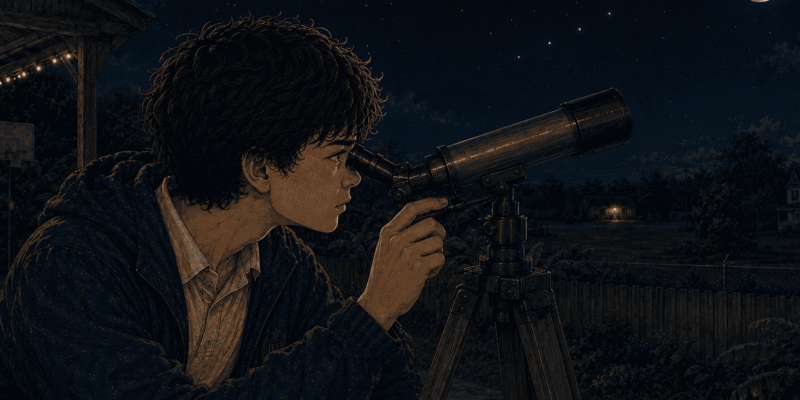
Pop has assembled Andre’s new telescope, and across the busy yards, beyond the fences and the gardens and the street and so much more, Mr. Borel’s robot Santa continues walking sideways on the porch. Through the telescope, Andre is about to see it well enough to make, perhaps, the old belief in Santa linger a little longer, or, destroy entirely the myth of everything he has built his childhood on. Robot Santa, then, is a most powerful symbol. At twelve years old, nearing thirteen, Andre understands where whatever he sees will change something irrevocably—for better or worse.
And for that reason, despite his all-day excitement over the telescope, when the opportunity arrives, Andre flinches. He doesn’t look.
Turning the telescope away from Mr. Borel’s porch, he chooses to look at the Moon instead. The decision is small enough that Andre struggles to explain it to his brother and father, and really, doesn’t even try. He has spent much of December trying to see Christmas correctly, though he still isn’t sure what that means. He has brought his mother camellias, prayed a Saint Jude novena, worried about Duncan’s migraines, watched his parents smoke which gives him allergies, and tried to distinguish between the consolations of childhood and the truth about growing up he must eventually accept.
Although the symbol of the telescope is new to the third Andre novel, this struggle to see clearly permeates the series. Andre wants to understand what Hanson’s 42-40 victory is doing to him, whether Holly Gale’s attention means what he hopes it means, why his mother and father can’t stop smoking, whether Duncan will recover and play ball again, and how God can answer one prayer while disappearing for another.
Despite his boyish, extreme chase of such highs, he also can’t just be comfortable inside them, for the moment that it is. Alternating with his desire to hold on to these moments, is a gloomy anticipation of the next argument with Mom, Pop’s next cigarette, the next migraine, the return of Duncan’s cruelty, and everything he fears happening again at Hanson as it happened at his old school. The struggle is genuine, but Andre must learn that it can’t put a pause on everyday life.
That pattern—of wrestling with the spirit in the midst of the inevitable highs and lows of life—brings Andre, and can bring us, to the Feast of the Transfiguration.
RELATED: THE PERMANENT THINGS: Reclaiming a Louisiana Childhood Worth Saving
It Is Good for Us to Be Here
On August 6, the Church celebrates the event recorded in Matthew, Mark, and Luke, when Christ took Peter, James, and John “into a high mountain apart” and was transfigured before them. Saint Matthew writes, “And his face did shine as the sun, and his garments became white as snow,” and we see Moses and Elias there speaking with Him, while the Apostles stand before the holy collision of New and Old Testaments in one spectacular moment.
The usual definition of transfiguration refers to a complete change of appearance into a more beautiful or spiritual state. Applied indiscriminately, however, that definition can leave the wrong impression about Christ. Our Lord did not suddenly “change” into the divine on the mountain, nor did He advance from a lower form into a higher form. He was already that God. On Mount Tabor, He simply permitted the glory already belonging to Him to become visible, allowing three chosen Apostles to see what their natural eyes normally couldn’t bear.
Peter’s response is deeply human:
“Lord, it is good for us to be here: if thou wilt, let us make here three tabernacles, one for thee, and one for Moses, and one for Elias.”
Peter has seen something he does not want to lose, something he wants to clutch and never let go of. Wanting to preserve it, he proposes a construction of sorts, a holding in place of the moment. If they can build tabernacles, perhaps the moment can be given a tangible location and be forced to stay.
Andre often responds the same way to the great moments in his young life. Following Hanson’s 42-40 victory, he treats the final score as a measurable resurrection, and it follows him in myriad ways. Forty-two points. Eighteen of them his. One final pass to Pastor. One scoreboard declaring that the ordeal is finished. But then he thinks, how close it was that we lost.
As the months pass and the memory should begin to recede, a secret part of Andre has taken a simple glimpse of the mountaintop and blurred it, worrying that the greatest moment so far in his life may have happened when he was twelve, leaving him to spend the remaining years looking backward.
Andre wants to build tabernacles inside that gym on that night he won. But he can’t do that, and he encounters a new wave of the spirit that finds him simultaneously wanting to grow up and wanting to stay behind.
Humans are all like that, to varying degrees. Even when the experience is authentic, our interpretation can become distorted over time, elevating a transitory consolation into a place where we expect to live for good—even though, like Andre, we also want to get to the next thing.
Conservatives can recognize this temptation in ourselves too. After years of defeat after defeat at the hands of cultural Marxists, an election victory, a favorable court ruling, or the public exposure of some long-denied truth can feel like the mountaintop. We begin treating single reprieves as evidences of some grand restoration, or the leader associated with it as the secular savior of everything great still to come. The glimpse may be genuine, of course, not to mention needed, but it was never intended to relieve us of discernment or the more difficult work waiting below.
Christ does not permit Peter to remain there at the top of Tabor, and nor will Andre. Nor can we. While Peter is still speaking, a bright cloud overshadows them, and the Father’s voice supplies the command Peter needs more than an explanation of the light: “This is my beloved Son, in whom I am well pleased: hear ye him.”
The Apostles fall upon their faces, becoming “very much afraid.” Christ approaches them, touches them, and tells them to arise. When they lift their eyes, they see “no one but only Jesus.”
Then they descend.
What the Vision Was For
The Transfiguration occurred before the Passion of Christ, fortifying the Apostles before they witnessed the apparent defeat of the One they had confessed as their Lord. They saw His glory before they saw Him arrested and beaten. They heard the Father’s voice before hearing the mob shouting for Barabbas. They beheld garments white as snow before watching soldiers divide them while He hung on the Cross.
Christ therefore charged them to tell no one about the vision “till the Son of man be risen from the dead.” Until Calvary and the Resurrection had occurred, even the Apostles would miss the full context required to comprehend what they had seen. And even more so the others besides Peter, James, and John.
Years later, Peter returned to that scene, that mountaintop, in a figurative way, to teach on Christ. He said, “And this voice we heard brought from heaven, when we were with him in the holy mount. And we have the more firm prophetical word: whereunto you do well to attend, as to a light that shineth in a dark place, until the day dawn, and the day star arise in your hearts” (2 Peter 1:18-19).
Advertisement
The light on the mountain in the past was given for the dark place below it in the future. Having received the vision, Peter was expected to carry its truth into the world waiting below—one of fear, confusion, failure, and eventual martyrdom. And Peter perhaps failed at that the worst among the twelve, outside of Judas of course. But the consolation prepared him for eventual total fidelity to Christ, although his first instinct well before his total transformation into a saint was, as the story of the Transfiguration shows, to remain where that fidelity seemed easiest—which meant right there in that exact moment.
Tabernacles.
Conservatives can apply that test to every political awakening. If exposing institutional corruption leaves us only watching, posting, and waiting for the next “gotcha” moment, truth itself has simply been converted into more content, more noise, and more spectacle. Whatever we have been permitted to see should make us more capable of fulfilling concrete duties below, where politics can’t substitute for the dogged formation of children, the restoration of quiet family time, and the rebuilding of Christian institutions.
Peter tries to control life, as does young Andre at times. And it is when we do this that God must point us in a different direction. He shifts the telescope ever so gently.
We sometimes imagine that a great spiritual experience, an answered prayer, or a thrilling victory should eliminate any struggles we knew before. And when hardship returns, we wonder whether the earlier mountaintop was even real.
The Story Is Larger
Andre encounters such temptations throughout the 51 series. A basketball victory cannot heal Maw’s cancer. LSU beating Georgetown can’t cure Duncan’s migraines or make Pop stop smoking. A promising moment with Holly Gale can’t settle what she thinks of him. Even the occasional recognitions that his mother loves him beneath her addiction to nicotine, her exhaustion and suffering over her dying mother, and her ornery moods do not make the cigarettes or his allergies themselves disappear.
Although he hasn’t put the words to it yet, Andre must learn that grace doesn’t become false just because the suffering, or even the questioning, resumes. He, along with Peter and us, must learn that that is simply life. It is life and its natural ebbs and flows, and why eternal life and our own transfiguration to the beatific vision is what we should all be aspiring to.
On a rudimentary level, Andre has already begun to understand this, although only in fragments, and certainly not in that language. He hopes the telescope might somehow “magnify” his eyesight toward spiritual things. He wants to know what is right, what is wrong, who people really are, and what God expects him to do once he knows. Like most of us, he would prefer an instrument that settles every question at once.
Sort of like Peter’s tabernacles.
Instead, Andre must decide where to point it, just as Christ points Peter, James, and John back down the mountain.
The story is bigger than Andre and his childhood fears, just as it is bigger than politics, even when God assigns each of us a real and necessary duty within it. Psalm 22 in the Douay-Rheims, numbered Psalm 23 in many modern Bibles, does not promise the faithful an escape from the valley in this life. It tells us how to enter it: “For though I should walk in the midst of the shadow of death, I will fear no evils, for thou art with me.”
The promise is God’s faithful presence through the valley, not the absence of the valley entirely. For conservatives, that distinction keeps both the victories and the defeats in their proper perspective. The Father’s command from the cloud is not to place our faith in a movement or a charismatic political leader. It is to hear ye Him, and Him only.
On Christmas night, Andre turns his telescope away from Robot Santa and toward the Moon. He has not by any stretch solved Christmas, childhood, or growing up. He has simply flinched from forcing one beloved image to give him a certainty it cannot provide—one he’s not quite ready for in the first place anyway. In that small decision, maybe based on a providential little fear, he begins learning that seeing clearly doesn’t mean seeing everything, and that growing older doesn’t ask him to strip every mystery down to the realities of cigarette smoke and cancer.
Likewise, Peter, James, and John descended from Mount Tabor without understanding the violence awaiting them below. Christ knew they were not ready for that, not any of it. They would still fear, fail, and eventually suffer the fires of martyrdom, but they had seen enough to know what and Whom to believe in once they got there. Conservatives also have to descend at times, carrying whatever political clarity we have received into the family, the parish, the school, and the local community, where a culture is actually preserved or lost. A mountaintop experience has served its purpose when it strengthens us for that descent, rather than teaching us to wait greedily for the next high or even stay fixed there, unwilling to do the grunt work for others.
None of this is an invitation to fear the world below the mountain. It is simply the right order for returning to it. The Transfiguration gives us enough light to follow Christ through the valley, even at times when the light is not even visible.
Thank you for reading The Hayride!
Find Andre’s world, and perhaps a glimpse of your world too, right here:
BOOK 2 PRICE OF ADMISSION on Amazon
BOOK 3 THIRD BELL RINGING on Substack
Advertisement
Advertisement
