
Writers on politics and culture spend a great deal of time, whether they intentionally do it or not, identifying the decay of a childhood once common across small-town Louisiana and much of America. Writers document the phones, pornography, social media, political tribes, woke culture, the erosion of the nuclear family, and adult-level anxieties imposed upon children before they possess the judgment to carry such burdens. Much of that work is necessary, particularly when powerful groups prevaricate about the myriad of psychological and societal injuries they have helped cause.
Exposure alone, however, cannot rebuild a childhood.
While conservative politics is relatively proficient at diagnosing the problems with liberalism, when it isn’t missing the wooden beam in its own eye, of course, it has devoted less attention to describing the life liberalism swore it would protect and expand for all. Such an unintentional void, innocuous as it may be, leaves many conservative victories without the clarity of human purpose, and, dare I say it, progressiveness.
A form of progress toward something more traditional, more meaningful, more wholesome. It is a look back, perhaps a hope that somehow nostalgia can transform into real life.
The middle-grade/young-adult novel series 51 is my attempt to place one small-town Louisiana version of that life back into view.
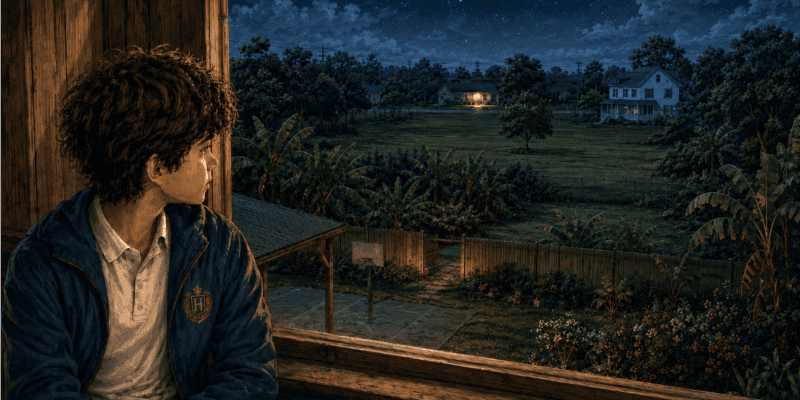
In Opening Acts, the first book of the series, 12-year-old Andre Blue watches a mechanical Santa Claus walk back and forth across Mr. Borel’s porch. Because Andre’s window and Mr. Borel’s porch are nearly 500 feet apart, Robot Santa appears as a tiny red figure moving sideways in another world, which is precisely how Andre understands him.
But it’s not just the 500 feet. If physical distance were all that separated them, that wouldn’t be a story worth telling.
The porch sits across the street from Andre’s house, but “the street” is more symbolic than anything, greatly understating the distance. It is “the street” because his boyhood world can be found in the land between Andre’s window and Mr. Borel’s porch, his parents’ own yard and that of his grandmother. From Andre’s large window, the view extends across the concrete basketball court beside the carport, Mom’s flowers and bushes, a wooden fence, Dad’s gardens and banana trees, another fence, Maw Blue’s long lawn, a pear tree, and the street itself. A huge white house stands off to one side, while Mr. Borel’s house seems to wait among the neighboring homes beyond it.
Andre has never crossed the street to inspect the decoration, and something inside him says he should leave it that way.
“Some things are better from a distance,” he concludes.
Some Things Are Better From a Distance
Although Andre knows by Book II, Price of Admission, that Santa Claus is no longer real in the way he once believed, the knowledge has not destroyed the magic surrounding Mr. Borel’s porch. Mom occasionally stands at the window and watches too, as though she, at her age, is searching for something else. At night, the little Santa continues his mechanical journey, reaching one end of the porch, turning around, and beginning again.
When Andre permits the image to remain partially unexplained, his imagination occupies the space between his window and the porch, preserving something that complete access would have dissolved.
That small scene is a microcosm of why I began writing these books. The world across the street is neither exotic nor spectacular. It consists of connected yards, ordinary neighbors, family property, flowers, fences, a makeshift basketball court, banana trees, a grandmother’s lawn that serves as a football field, and a Christmas decoration on somebody else’s porch. Those prosaic elements acquire their poetry and significance only because Andre has enough time, freedom, and interior quiet to notice them and share his story with us.
The modern spectacle—Plato’s cave if you will—changes that relationship. Its most insidious effect extends beyond the hours consumed by a screen. It teaches the child that every curiosity should be approached immediately, magnified, and replayed ten times. The Psalmist’s prayer sounds almost written for that condition: “Turn away my eyes that they may not behold vanity: quicken me in thy way” (Psalm 118.37, D-R). Andre’s distance from Robot Santa protects something the screen will eventually destroy in a child’s life. He can see it, but he cannot inspect it endlessly, nor does he want to inspect it at all, leaving mystery enough for innocent imagination to do its work, and for the discipline of waiting to take form.
The result is a doom loop of instant gratification and diminishing returns. The child is trained to answer the ensuing low with another shot of dopamine, beginning another cycle of instantly satisfied curiosity.
Nothing stays across the street for very long in today’s world. There is no room for wonder.
Because the screen abolishes nearly every interval between desire and satisfaction, it gradually weakens the child’s ability to contemplate what remains beyond his reach, training his attention to demand instant access rather than attend patiently to experience as it unfolds.
Advertisement
Robot Santa asks Andre to wait. The fences and gardens and concrete establish boundaries, while the yards give the neighborhood a scale that his mind can enlarge into a world all unto itself. Even his refusal to cross the street possesses a child’s rudimentary prudence, recognizing a limit before he can fully explain why the limit deserves to be there at all.
This was never a perfect world. Andre’s parents smoke. His grandmother is ill. His brother suffers from migraines. Adults make mistakes, boys lie to one another, coaches misread players, and Andre’s fixation on Holly Gale repeatedly makes him foolish. But what made that older Louisiana childhood valuable was its capacity to place those troubles inside a network of family, authority, faith, neighborhood mythology, and consequences.
Although no sensible person would attempt to reproduce every feature of 1990, particularly since many of the processes driving today’s decay were already underway then, we should recognize what our technological and cultural progress in the 21st century has regretfully displaced, including the ordinary conditions under which a child once developed a world and an interior life where he could simply listen.
The Life Beneath the Politics
A potential motto coming to The Hayride, “Revivalism, Southern Style,” can reach deeper than politics and elections, government and policy. A Southern revival must concern itself with the front porch, the parish, the broken concrete basketball court, the grandmother next door, the T-shaped clothes-drying poles, the Creole Festival, the Little League uniforms without names on them, the father correcting his son, and the child looking through a window, with longing but also hesitation, at something he cannot quite understand.
Otherwise, politics becomes another form of content, oscillating between outrage and victory while the culture underneath continues to disappear.
When I write about Andre watching Robot Santa, I am writing about the positive object beneath the politics—the kind of life authority should defend, families should guard and hand down, and cultural revival should make tangible again.
Over the coming weeks, you’ll see more of Andre’s world through particular scenes involving fathers, mothers, teachers, priests, coaches, friendships, sports, first attractions, failures, griefs, and, maybe most importantly, the ongoing prayers of a boy on the cusp of adolescence simply trying to figure it all out. The books carry the same concerns addressed by politics and government into fiction, allowing a boy’s experiences to show what political abstractions like “tradition” and “freedom” actually look like when somebody is living inside them.
“Revivalism, Southern Style” possesses serious cultural meaning and can therefore produce more than arguments against the red and blue forces destroying childhood. It can give families stories that help them remember what childhood is for and why the kind preserved in old scrapbooks may be worth recovering.
Andre never crosses the street. He remains at the window, watching the little red figure reach the end of Mr. Borel’s porch and turn around again.
Over and over again.
I wrote the scene because I remembered how large an ordinary world could become in the mind of a child. I keep returning to it because children still deserve a world large enough to imagine—and close enough to call home.
Thank you for reading The Hayride!
FIND ANDRE’S STORY HERE!
BOOK 1 OPENING ACTS (2015)
BOOK 2 PRICE OF ADMISSION (2023)
BOOK 3 THIRD BELL RINGING (2026)
Advertisement
Advertisement
