
There is so much to address here—and to address in charity—that we’ve decided to divide this discussion into two articles. And remember, in this space we’re not like so many others. You know the ones, the ones that create the noise.
So read the article in full without getting lost in the sauce.
We don’t judge Lane Kiffin’s soul here. We make judgments on external actions, which, contrary to the religion of meme world on Facebook, is absolutely required according to biblical teaching. God commands us to make assessments on right and wrong, and by extension, what we are willing to support, where we are willing to invest our time, how we will go about guarding the peace of our souls.
In our case, on weekends in the fall.
Not all of Coach Kiffin’s actions and decisions should be thrown into the same great heap, in a most unjust exercise through which a man becomes either wholly good or wholly bad, depending on who is talking, what the incentives are online, and whether or not LSU won on Saturday.
Such a distinction should never have to be announced in a civilized society engaged in equitable discourse, but such is not the makeup of this society. Such a distinction and counter-cultural approach should be familiar to anyone who has absorbed this space’s work beyond the picture preview on social media. My intention remains to help Tiger fans navigate their fandom under God without surrendering either their judgment or their charity. And if Coach Kiffin happens to read along, perhaps something here can help him too.
The eighth commandment, in the Catholic numbering of the Decalogue, governs how we speak about our neighbor, including the neighbor whose decisions deserve criticism. It doesn’t disappear because the subject makes millions of dollars or because we dislike the people criticizing him. In fact, those things make it even more imperative that we do have these discussions.
There is so much sin online in the name of being right, or worse, in “owning” people. This space remembers that every time it speaks.
The Rule of the Program
Our first installment of The Right Lane several months ago examined Kiffin’s own description of growth through subtraction. Removing alcohol, destructive relationships, distractions, and an unhealthy dependence on other people’s approval seemed to be helping him order his life. The disappearance of him and his trolling on Twitter has also been a welcome surprise. We applauded him for that in the hopes that it would encourage him to continue doing the things that work, not just with the ones he’d already chosen, but the future ones that would inevitably come his way. When a man decides to change, he is often faced with small tasks before more challenging ones come. Growth happens in layers, with intermittent points of moving forward and remaining still serving as the pattern.
What happens so often is that that same man recognizes the growth at one point, moves forward, and then remains still, but doesn’t recognize when God is calling him to the next round of movement.
After that article, and after LSU’s convincing victory to start the season against Clemson, we questioned whether his next subtraction might involve his seeming need to land one more verbal blow after the scoreboard had already settled the football game. And on October 12, well before this weekend’s celebrity controversy finally swamped the internet (we’ve been expecting it), we asked whether Kiffin was trying in vain to establish the freedom and fun associated with Pete Carroll’s USC from two decades ago—long before the advent of the iPhone and the persistent noise of social media—and also before establishing the foundation of discipline absolutely necessary to hold it all.
We’re not saying Coach Carroll’s teams lacked discipline, mind you. The contention is that Kiffin must establish that foundation with the modern-day locker room that is burdened with the attention, the money, and the possibility of transferring to another program—all packaged neatly in a little box players carry around in their pockets. The circumstances have changed, and not by just a little bit, and the order by which he builds the program is paramount.
Think of the tired old cliche about the horse and the cart. Truth is, tired cliches are true for a reason.
The title of that October 12 article was “Kiffin Must Put the Rule Before the Show,” and it was produced in conjunction with a video we did in relation to the Rule of St Benedict.
The obligation—the rule—must order one’s day before external factors, or even one’s own mood, determine one’s actions. That was the point of By Rule, just as our Rat Poison video concerned what happens when outside praise starts to negatively impact practice and preparation. But negative criticism too can create the same dependence when proving somebody wrong becomes more important than doing the work correctly.
We haven’t abandoned those things we admire about Coach Kiffin because some of the people who dislike him now happen to be questioning something we’ve questioned already. That’s where the lumping into the heap comes in. Let’s be more nuanced in our thinking, in our approach. The standard—the rule of life—should stand firm through both a victory and a defeat, or it probably wasn’t much of a standard in the first place.
Lessons Unspoken
This week, former Tiger tailback Leonard Fournette’s criticism concerned the celebrity presence surrounding the team’s arrival and the disconnect he sees between that production and winning football games. Here’s the pull:
“The superstars coming out. F— all that. They had Shaq come out, they had Angel Reese come out. Angel Reese, Shaq, and Kevin (Costner) they not about to come help us on this f–king football field. What the f–k are we doing? They not about to sit up and help us win on no goddamn game. why are they coming out on the bus with us? Why? It does not make no sense to me. Yes, I love everything Coach Kiffin is doing, but that sh–, especially we losing, that shit has to stop. This ain’t no f–cking concert. This ain’t no party. The game is to win. We get paid to win.”
“To win. Success come off winning. I could care less who you come out with, especially guys like us who put our hard work, sweat, tears into that shit. And that’s— and you know what? And NIL has messed the game up so much. They don’t realize they’re not just representing themselves and their family, they’re representing us.”
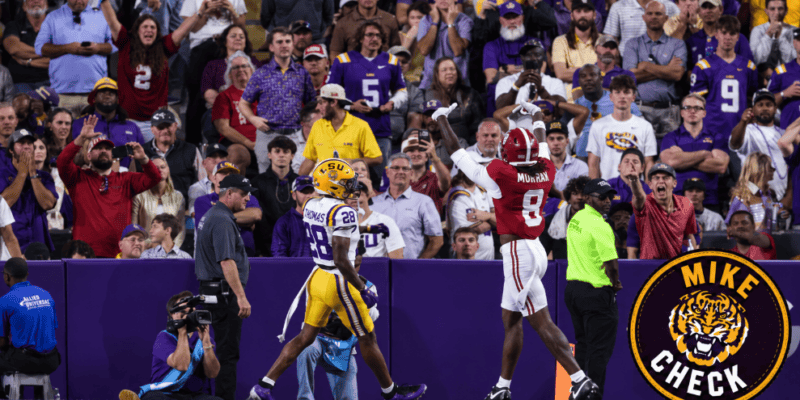
We don’t need all of his language to understand the point. Indeed, sans the language, it’s exactly what we’ve been getting at here—players, both former and current, think and talk about these things. Saturday’s parade included Shaquille O’Neal, Angel Reese, Paul Skenes, and Kevin Costner, making for quite a spectacle before a game LSU would lose and lose in embarrassing fashion in the fourth quarter.
The idea from so many coming out of the woodwork after Saturday’s loss is that, hey Coach Kiffin, let’s fix our offensive line issues and our red zone issues and our fourth down decisions and our special teams play and actually win some games over power teams before acting with such pomp and circumstance.
There is nothing inherently wrong with accomplished LSU alumni returning to support their university. Those former Tigers have earned their place in its history, and their presence can indeed encourage players, attract recruits, and strengthen relationships. According to the summary of Monday’s press conference, Kiffin defended the celebrity walk and other features of the program as things that help LSU’s brand and appeal to young athletes.
He’s not wrong, not entirely, and I’m not sure anyone would disagree with the premise. I also understand the occasional response appearing in discussions among fans: None of those celebrities missed all those blocks or prevented LSU from scoring in the red zone time and time again.
But is that really where our consideration of the question ends? Is that really the intelligence level we’re going to go with in life?
Where the cameras point—and what they plaster on those electronic screens—is what matters here. And for a man who prides himself on thinking through every little nook and cranny and divulging such introspection to the media, it is baffling that such a blind spot could be staring him right in the face.
One TigerDroppings commenter described the football problem this way:
Classic finesse team on offense. Can move the ball well at times. Cannot impose their will, get a hard yard when needed or score (at least TDs) reliably (except against weaker opposition). Likewise, defense seems to be feast or famine, often during the same game. Both squads get exposed against teams with a good plan and good players. If only we could get those teams off the schedule.
Such an accurate observation doesn’t establish what causes the failures, and it certainly doesn’t point to celebrity parades as the causation. What it does do, though, is describe inconsistencies a coach must examine—those that go deeper than surface-level statistics—when deciding whether the habits he encourages throughout the program are producing what he expects on the field.
An example, Coach: No, the defense didn’t lose the game as much as the offense’s inability to score in the red zone, if we were to chisel it down to a silly pair like that. But that abomination of effort and execution on the Alabama drive right after LSU’s offense had finally pulled ahead 13-10 is a microcosm of everything your program reflects right now. On the surface, your defense looks fantastic…
Advertisement
But when it matters in a big moment and a big game, you flat out fold. And because things like that happen that are anomalies when compared with the stats, every single aspect of the program you are trying to run must be evaluated, and evaluated now.
That is not us making you out to be a villain, Coach. That is us trying to help you, not to mention LSU fans so they can stop bitching at each other about the wrong things online.
During my years teaching and coaching, I couldn’t separate what students and players did during the important moments from everything we and the system had allowed, encouraged, and not corrected before it—not unless I wanted defeat after defeat on the court, off the court, and while trying to sleep in my bed at night. That didn’t mean that Satan was under every rock, so to speak, or that every poor performance could be traced to some seemingly unrelated event that happened this past Tuesday. Correlation does not always mean causation, especially when small pockets of time are being assessed. But what I am positing is that the environment we created in the classroom and on the court was an intrinsic part of the instruction, and it was always—always—created with intention.
If I told my players that something had to have their undivided attention without exception, then repeatedly fractured my own attention—even in the name and spirit of some other aspect of the program I was trying to build—they would notice. If I preached restraint and discipline while making exceptions—even in the name and spirit of some other aspect of the program I was trying to build—they would notice that too. They might never articulate that contradiction in the language an adult would use, and they might never have the balls to confront me about it, out of some sense of respect or fear I instilled into them, but they would still learn from it—and their actions would never be far behind.
Young people—or humans in general—don’t see it the way I see it; they won’t excuse my seeming hypocrisy “here” just because in my mind I’m building something else good for the program “there.” They simply see contradiction, and if it happens too much, and worse, I am unwilling to redirect even when it is brought to my attention somehow, and then the defeats start mounting and/or they’re not getting their share of playing time, I risk having them turn on me.
And Coach, you may not be able to watch it happen. Because it’ll happen in the shadows, and then all at once you wonder where your team went, where your program went, where…
They would first grumble among themselves about it. They’d find all the cohorts in crime they could to bolster the murmuring. That takes time, and on the surface, it might be hard to notice.
And the grumbling would spread, maybe not to the Ty Benefields of the program, but to others, to enough of them.
Could something you assumed was cause for enjoyment in victory be sounding different in their apartments, over dinner, or in conversations with teammates after another defeat? Could the media attention centered on their coach become a source of resentment while they absorb the physical punishment and much of the criticism they interpret as you bringing upon them?
These things happen, you know. It’s human nature, and it’s all over the Bible. The grumbling would eventually kill if not caught and redirected in time.
Will it kill a week?
A season?
Your entire coaching career?
Hm.
Is hanging your hat on believing you are the villain worth the risk of human nature and the power of the group when they start turning against you?
I don’t know as an eyewitness that any of this is happening inside LSU’s locker room. I’m describing a possibility illustrated throughout Scripture that you, Coach—a man I like for some reason—ought to consider before the rumblings of your own team start closing in.
Before they stop being the villain for your sake and make you the villain for their own.
*There is more to say here, and we will pick up with Part 2 closer to Saturday.
Advertisement
Advertisement
