
After a storm delayed LSU-Clemson, Lane Kiffin and the Tigers exposed LSU’s new strength—and the spectacle surrounding modern college football.
And that exposure is a storm in itself.
First the game. On Friday, I predicted that Death Valley would be loud, salivating in fact, and that the final score would be LSU 30, Clemson 22. I thought the game would be close early, with LSU pulling away, then Clemson scoring a late touchdown. So I was right about almost everything, at least the basics.
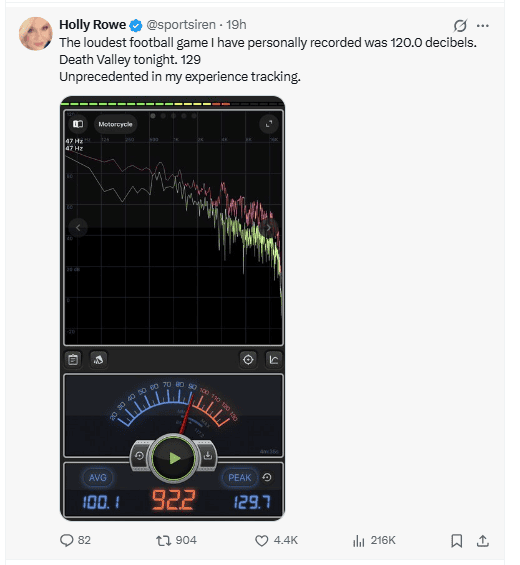
Especially the noise.
But noise aside, the rest is why an educated guess shouldn’t go into too much detail, because it is in exactly those details that I was completely wrong. What I missed was not the direction of the game, but the scale of everything. I greatly underestimated this new LSU program’s ability to make up for whatever went wrong.
I also never could have guessed how efficient, business-like, and in control the entire operation was. Did LSU call even one timeout the entire game?
The game was in fact close early, for like two minutes.
And LSU did pull away, to the tune of 51 unanswered points.
And Clemson did score late.
Offensively, the Tigers allowed no sacks and ran for 309 yards, piling up 644 total. The rebuilt roster set a school record with 38 first downs, converting 11 of 16 third downs, most of which seemed to be 3rd and 1, 3rd and 2.
I’d say they stayed ahead of the chains.
The line protected Sam Leavitt, whose 113 rushing yards looked like a weapon rather than the scrambling of a disoriented quarterback. He’ll probably lose a fumble or two with that style at some point this year, but last night it was fun to watch.
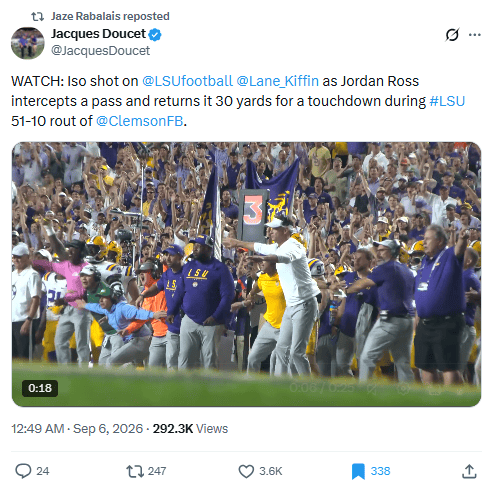
On defense, Blake Baker’s unit was an unequivocal monster, racking up four sacks, 11 tackles for loss and a pick-six while holding Clemson to 1 of 13 on third down conversions.
Before Clemson’s final touchdown drive—when the stands had cleared and the Tigers’ third string was on the field—it had managed 85 total yards. All 40 of its rushing yards came on that last possession.
That is about as compact a statistical nutshell as we can provide, but if you watched that game, you know it goes well beyond that. So while the shell of what we thought would happen did happen, it does nothing to express what truly took place Saturday night.
Twin Storms
One game is just one game, of course, and Clemson may prove to be as bad as some of the cupcakes the Top-10 gorged on Saturday. Still, some other early games in past years may come to mind as markers. In 2007, LSU followed a 45-0 Thursday-night win at Mississippi State by destroying No. 9 Virginia Tech 48-7, gaining 598 yards and allowing 149. Saturday night produced the same 41-point margin, with 644 yards gained and 145 allowed.
The 2011 opener against No. 3 Oregon, which we revisited last week, likewise revealed a team able to absorb early-game trouble that might have broken a lesser team. That “early-game,” of course, at least lasted a whole half. But 2011 ended as 2007 did—with a shot at the title. The difference between champion and runner-up has no bearing on the similarities between these early games—both markers of coming greatness.
The story went beyond even that this week. Everyone knows about the “pro players” who didn’t play Saturday night.
Dae’Quan Wright and Zxavian Harris were not on LSU’s roster, and LSU still led 31-3 at halftime. “Imagine if we had pro players,” Kiffin told ABC’s Holly Rowe as he left the field.
My planned salvo on Friday, concerning the screeds online, was shelved because Scott McKay had already handled the hypocrisy and absurdity surrounding the dispute, not to mention I was simply running out of time. I’m sort of glad now, as I’ll get to shortly. While he didn’t take the argument where I will, Scott’s central question was and is correct:
“So Kiffin is supposed to turn them down and watch them suit up against him? In a game he’s under enormous pressure to win?”
Talking about the game against Ole Miss in two weeks, that is.
You can read Scott’s full argument here. My plan was to touch on many of the same things, but to also bring in our unintentional role—as college football fans over the decades—in this entire circus.
So yes, mine was shelved, at least how it would have been framed on Friday. After Saturday’s developments, and the timely metaphor of the storm, I am more interested today than I would’ve been in spotlighting exactly what kind of personality Kiffin is for us, for me, for the entire college football world—both participants and fans.
But just for fun, besides your typical copy-and-paste posts on X and everywhere else, you had the occasional b-eaut like this one:

Hence my insistence on fans maybe looking in the mirror and their own insanity before they start looking around for it elsewhere. I’ll raise my hand first.
As an aside, I wrote a similar thing for my Master’s thesis years ago, exploring the despicable yet necessary nature of Heathcliff in the novel Wuthering Heights. Read the novel and not just the movie and you’ll understand.
Many of you likely see Donald Trump in the same light. I did once upon a time to a great degree, and still do to a different one.
Sometimes storms are necessary. And no one likes a storm.
Lane Kiffin is not especially likable in the ordinary sense. If his coaching prowess benefits your team, you are likelier to accept the warts. If he has left your school, beaten your team, or helped exploit a loophole in a rule you keep trying to hide under the the flower pot, you see arrogance.
I should admit that when I went to the LSU-Ole Miss game in 2022 and saw the poster “LANE KIFFIN PUTS TOMATOES IN HIS GUMBO,” I loved it. I loved the fact that LSU didn’t have that prick as a head coach.
Now he’s not so much of a prick I don’t like as he is a necessary one, at least for certain higher values I hold a little better now.
Kiffin, simply put, is a storm personality. The type is unique, baffling, and infuriating, but strangely, also correct in much of what they expose, even if how they expose it is what makes it infuriating. He is a “wuthering” force of nature, and that is no hyperbole. You don’t have to be a literary guy to see it.
Kiffin didn’t create NIL, the portal, or the new non-existent line between college players and professionals. He blows through structures and forces into the open what everybody stuck under the flower pot for decades. Through the process of fighting this type of personality, institutions are forced to reveal their contradictions, TV analysts their selective principles, and fans how quickly their own moral compass changes with every new story hook.
That is why Scott’s article is excellent. Many of the same fans who secretly damn Kiffin for those two “professionals” would have excoriated him in turn had those two players gone to Ole Miss and had any impact whatsoever on that game, particularly if the Rebels had won.
We do this as fallen humans. We are inconsistent in our values because we don’t understand where the true anchor lies.
Advertisement
Kiffin did that to me just this past Friday, actually, in relation to that article that went unpublished. Angry at the lazy headlines, arrogant generalizations about Louisiana people, and instant keyboard warriorhood, I was ready to answer fire with more fire. Yet strangely, the spectacle became so excessive that it calmed me. I couldn’t keep up with the feed I was planning to show in my article, the morning got away from me, and in the end I was forced just to clip most of it and post only the Death Valley/prediction part you saw on Friday.
By the time I woke up Saturday morning—and even more so Sunday, as I went through my prayer routine—everything began to congeal in a different way. Once I saw the archetypal narrative roles—Kiffin the villain, LSU the corrupt institutional scapegoat, the SEC the false guardian of order—the script lost its power.
Saturday night, that Tiger squad gave me a better answer than anything I’d been preparing to write.
Final Words
Nine months ago when he was hired, I wrote about Kiffin and the idea of virtue inside the college football world as a whole, much as I am doing here today. Near the end of July, I started a series called “The Right Lane” with what the coach himself called growth through subtraction: removing alcohol, destructive relationships, bad habits, and social media while becoming less impacted by public opinion.
That is good, but there is a catch too, and that is why the freedom from an unhealthy dependence on human respect must be grounded in God. It is not freedom from the prudence required to know when to move and when not to move, spiritually speaking.
After the 51-10 beatdown, for instance, ABC’s Laura Rutledge asked Kiffin how Clemson compared with LSU’s mock game. Kiffin answered, “Our mock team scored more points against us than them.”
I mean, did she not walk herself right into that one?
That mock game was the subject of our latest installment of “The Right Lane” last week, by the way.
Was it true, the thing he said that I couldn’t really understand at first and made Rutledge’s face go really awkward? Apparently. Funny? Yes, very, if I were a prick too (and a part of me is). Necessary? Probably not, based on the part that isn’t a prick anymore. We won’t drum up another scandal here or judge Kiffin for it, but we also won’t play off everything Kiffin does just because he’s the coach for our team now. Perhaps his next growth through subtraction is removing the need to land that one more blow, after the scoreboard has already won the fight for him.
That is not a lecture from above, Coach Kiffin. I know the same appetite as a writer, when exposing dishonesty can become a crusade that perhaps trickles into extremity.
Today’s Mass lesson could hardly be timed better. St Paul warns in Galatians 5:25-26, “Let us not be made desirous of vainglory, provoking one another, envying one another,” then instructs anyone correcting a man blinded by a fault, as Galatians 6:1 says, “in the spirit of meekness, considering thyself, lest thou also be tempted.”
The Gospel places all of us under judgment: Kiffin, the moralizers, LSU fans, and me as writer tempted to answer a spectacle with a hotter spectacle this past Friday. I was seriously angry at the folks drumming up Waterboy references, and for what? Why? “What things a man shall sow, those also shall he reap.” If we sow provocation and vainglory, even in defense of something true, we should not be surprised when the circus gives the same thing back. It is what I almost fell into Friday and what Scott’s article reminds us of, particularly in its conclusion.
“Because Kiffin didn’t create any of this. LSU didn’t create any of this. To the extent that it’s the ruination of college sports, that actually happened some time ago.”
Kiffin burns bridges because he is a human storm. There must be souls like that in this life to expose the hidden, and most times those souls are unsavory. Some of those bridges, he’ll regret losing. But some of those bridges…
Did the entire “hidden” debacle that is “college” football not need to come crashing down?
Saturday night revealed that LSU may have found a football team capable of surviving both storms and circuses, because they are now led by a coach who embodies both, for better and worse.
I dislike this college-football landscape, but my measly rage will never restore what was lost a long time ago—well beyond NIL in 2021, well beyond SMU in the 1980s, probably well beyond whatever amateur golden age we thought stood most of the 1900s. Perhaps we can just accept the entertainment on Saturdays for what it is and leave it there, and remain outside the circus—outside the cave—the rest of the week, peeking in to enjoy the show every so often without mistaking its shadows for reality, without getting sucked in to the degree that we lose our own sanity entirely.
Then maybe we can use sports to discuss more important and virtuous things without making winning, losing, and Lane Kiffin the question of virtue in itself.
Because no, he is not a role model. Nor did he ever say he wanted to be.
Thank you for reading The Hayride!
Advertisement
Advertisement
