
Yesterday afternoon I got sucked into following the judicial hearing at the 19th Judicial District Court in downtown Baton Rouge where a host of college athletes, most notably former Ole Miss defensive tackle Zxavian Harris and former Ole Miss tight end Dae’Quon Wright, both of whom will play for LSU this year if they’re allowed to, are the plaintiffs in a lawsuit against the NCAA – and in the case of seven of them, the SEC.
There was a poster – a lawyer, I gathered – on TigerDroppings who was surreptitiously posting updates from his phone, which he wasn’t supposed to be doing according to the court’s rules. Nobody follows the rules much anymore in any venue, I guess.
Anyway, from following that thread I got a blow-by-blow description of the hearing, and I knew before seeing any media reports what had transpired and what the outcome was.
Which was fairly predictable. Judge William Jorden did what judges around the country have been doing, granting an injunction on behalf of the players and against the NCAA and the leagues, and in this case Jorden went so far as to essentially mandate that LSU put Wright and Harris on the roster for Saturday’s game against Clemson.
Which means that LSU is under a greater authority than the SEC rules in adding those two former All-SEC players.
The SEC filed suit against LSU, its Board of Supervisors, athletic director Verge Ausberry and head football coach Lane Kiffin yesterday. The suit had actually hit the court the night before but it was announced in the middle of the hearing, and in fact during the testimony of SEC commissioner Greg Sankey – who had a very bad day in court. Sankey couldn’t define a professional athlete, which was humiliating for somebody supposedly in charge of an amateur athletic association. But then again, nobody in college sports administration can do that anymore, at least not in a way they’ll want to.
Because any such definition would either include modern college athletes, or it would be absurd.
The national media sensationalized the events in the Baton Rouge courtroom, but it wasn’t the defining moment surrounding this supposedly-unwelcome change, whereby college teams can suddenly recruit pro athletes. No, that moment came far earlier.
In truth, it came a couple of years ago when the NCAA began allowing European professional players to be eligible to play college basketball. Once that Rubicon was crossed, everything else was just the aftermath.
And of course, when the NCAA brought in the transfer portal and Name, Image and Likeness (NIL) payments to college athletes, there was nothing left of this amateur status to save.
Let’s be honest here – college athletes have been pro athletes for some time now. Arguably, this goes all the way back to the beginning of college sports. Teams have been buying players under the table for decades. Probably more than a century, if we’re going to be truly honest. The inception of NIL simply brought all this extracurricular economic activity above board.
But if you want a real defining moment, I’ll tell you what it was. It came in a courtroom not in Baton Rouge but in Oxford, Mississippi, when Ole Miss’ excellent quarterback Trinidad Chambliss got a friendly local judge to give him an injunction granting him a sixth year of college eligibility on the most paper-thin justification possible. Neither the NCAA nor the SEC agreed that Chambliss was eligible but they declared they’d abide by the injunction.
You can’t blame Chambliss for going to court and seeking another year. Why? Because he’s reportedly going to make some $6 million in NIL payments as Ole Miss’ quarterback this year. That’s more money than he would have made had he accepted his college eligibility was up and gone into the NFL draft. Chambliss would have been a late-first round pick at best and a third round pick at worst; either way, he’s richer for staying in school. And not in an academic sense; I’m talking about filthy lucre.
When Trinidad Chambliss went to court and got a local-yokel judge to give him an extra year of eligibility based on a sore throat he’d had while a younger player at Ferris State so that he could make more money as an “amateur” than a “pro” athlete, there was no longer any justification for pretending college sports aren’t pro sports. Everything past that point is flavors of absurdity.
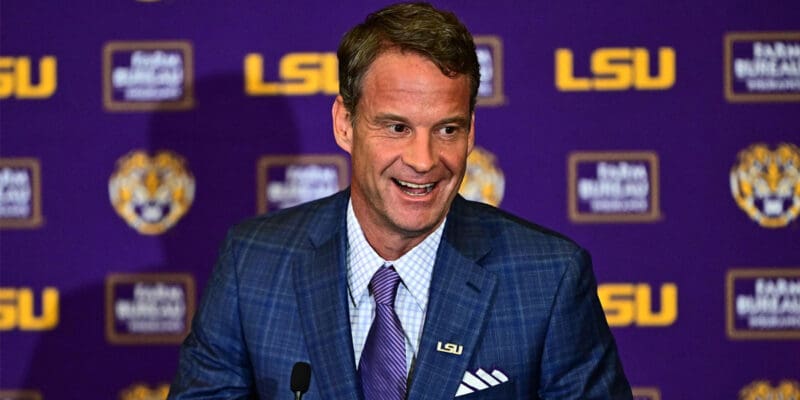
And that’s the world LSU and Kiffin are living in.
So what’s asked of Kiffin, by the SEC and the national media and all of the sanctimonious moralizers on social media, is that he should sit by and not participate in this new world.
Well, OK, let’s game this out.
Zxavian Harris testified yesterday that his “pro” experience with the New Orleans Saints consisted of a few days rehabbing a foot he’d had surgery on in the spring, never actually putting on pads or a jersey or taking part in a practice in a minicamp or training camp, and getting paid a grand total of $190 in reimbursements for gas. But he signed a piece of paper, we’re told, so he’s now a pro athlete.
Meanwhile the University of Texas has an offensive lineman named Cole Hutson who went to two different NFL minicamps, signed all the waiver forms the league allows, and then returned to campus. But Hutson isn’t a pro.
Believe there’s a meaningful distinction between the two if you want – there isn’t – but you’ll have to recognize you’re choosing between flavors of absurdity.
You’ll also have to recognize that what brought all of this on was the NCAA’s utterly incompetent implementation of the new 5-for-5 rule. Which was supposed to eliminate the absurdity of situations like the Chambliss mess at Ole Miss and, for another example, the University of Virginia’s offensive line which is chiefly made up of 6th and 7th (!) year players. The 5-for-5 rule says that once a player enrolls in college, or passes his 19th birthday, whichever comes first, he’s got five years of eligibility. No redshirts, no waivers, no exceptions.
That’s actually a pretty good rule. The problem is that once it’s passed, you have to make accommodations for the 5th year players.
The way to do that is to pass the rule at a point where nobody is left hanging. For example, if they’d passed 5-for-5 in October of this year, none of these kids would be enrolled in college (perhaps a few would still be around finishing up their degrees, but they’d have missed half a season in the fall sports; they’d be eligible for the winter and spring sports, though) and the lawsuits would have been minimal.
And what came out of Jorden’s order, which has come out of other injunctions as well, was that when those 5th year players who matriculated in 2022 were told they didn’t have an extra year of eligibility, they didn’t have a choice but to pursue professional options. Punishing them for that according to some red line, when the difference between Harris and Hutson is so thin, was never going to fly.
So let me present it to you this way: Lane Kiffin’s team will play its SEC conference opener two weeks from Saturday. Against Ole Miss. In Oxford. In what will be one of the most hyped-up matchups in college sports in years. Given the lawsuits surrounding the 5-for-5 rule change, and given the injunction-out-of-a-clear-blue-sky that Chambliss received, what makes you think, had Kiffin turned down Harris and Wright, that they wouldn’t have returned to Ole Miss and gotten an injunction from that same judge? Both players testified at yesterday’s hearing that they’d been pursued by multiple programs before deciding to follow Kiffin to LSU from Ole Miss.
So Kiffin is supposed to turn them down and watch them suit up against him? In a game he’s under enormous pressure to win?
Remember, we’re picking flavors of absurdity here. But the most bizarre flavor is the one where Lane Kiffin agrees to take one on the chin from his old team when they’ve got a 6th year quarterback who’s getting more money from Ole Miss than the 2nd round of the NFL draft would have yielded to him and two All-SEC senior players fresh out of NFL training camps.
That’s the course you think Lane Kiffin should have agreed to follow.
Perhaps you’ll forgive him for saying no. Probably not.
But maybe you should.
Because Kiffin didn’t create any of this. LSU didn’t create any of this. To the extent that it’s the ruination of college sports, that actually happened some time ago.
Advertisement
Advertisement
