
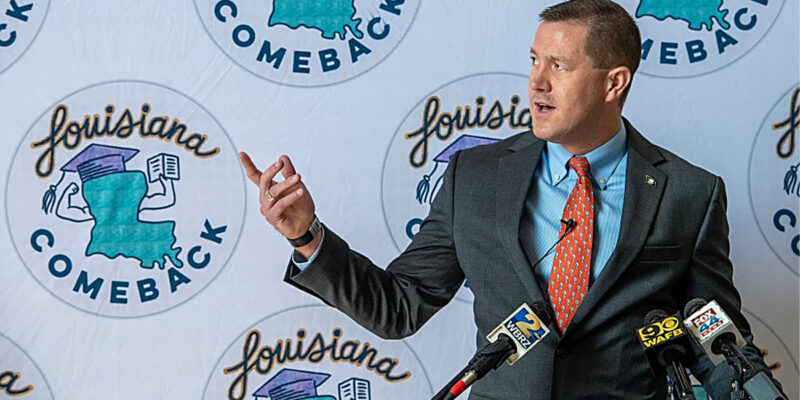
(Charles A. Owen, LtCol (ret), USAF, Ph.D.) — About six years ago, Louisiana was looking for a new Superintendent of Education. The State’s rankings were not good at the time, and things had not gone in the right direction for a long time. How we got to that low point is the topic of another article, and we might need to go down that path some time, but not right now. What is salient at this point is to tell what has happened since the Board of Elementary and Secondary Education (BESE) decided to place Dr. Cade Brumley at the helm of K-12 Education in Louisiana.
In the past six years, we’ve seen improvements and success that we’ve never experienced in Louisiana, and I sincerely think it’s time to review the record. This is my input on the Report Card for the State Superintendent of Education. I sit on the House Committee on Education and I have paid careful attention to these matters for 6.5 years now. I am also a Louisiana native and am the son, husband and father of teachers. I’ve been in this world for most of life as a very interested observer and tax payer.
I think it’s important that we talk about where we are as a state—in the context of how our students are doing, which is THE point of public education as I see it.
Student outcomes form the heart of any honest evaluation. On the Nation’s Report Card, Louisiana’s average ranking improved from 49th in 2019 to 32nd in 2024—the highest average national placement the state has ever recorded. Ever.
During Brumley’s tenure, fourth-grade reading scores rose from 50th to 16th, and Louisiana led the nation in reading growth across two consecutive cycles. Fourth-grade math climbed from 50th to 38th. Independent scorecards place Louisiana first among the states in reading recovery and second in math, while ranking us first in overall growth from 2022 through 2026. U.S. News & World Report’s Pre-K–12 ranking moved from 46th to 38th.
On the state’s own LEAP assessments, the percentage of students achieving Mastery and above reached an all-time high of 36 percent in 2026, up from 30 percent in 2021. Advanced Placement results are equally striking: the share of exams earning a qualifying score of 3 or higher rose from 38.2 percent in 2021 to 62.7 percent in 2025, and the number of students earning at least one qualifying score increased 77 percent. Seventy-six percent of the Class of 2025 graduated with either college credit or an industry-based credential—a twelve-point gain over six years. These are not marginal improvements. They represent measurable, sustained progress.
The academic standards Brumley has delivered reinforce that progress. The Freedom Framework for social studies, rewritten between 2021 and 2022 and implemented in 2023–24, is built on primary source documents, the founding principles of the American republic, and a clear affirmation of American exceptionalism. Critical race theory and action civics were explicitly excluded. The standards have been widely praised as among the strongest in the country. Updated English language arts standards, approved in 2026, strengthen the Science of Reading, grammar, and cursive writing. Mathematics standards approved the same year emphasize foundational skills and logical reasoning. Louisiana adopted its first-ever statewide K–12 computer science standards in 2024, and physical education standards are being revised to restore emphasis on lifelong fitness and personal fitness plans in alignment with the Presidential Physical Fitness Test.
Workforce readiness has received equal and timely attention. The Fast Forward initiative, launched in 2021, redesigned the high school experience around associate-degree pathways, career-technical education, and high-demand apprenticeships that connect secondary schools, higher education, and regional employers. Work-based learning opportunities—including paid internships, cooperative education, and registered apprenticeships—have expanded, supported by direct $1,000 payments to school systems for each approved internship enrollment. The result is a clearer pipeline from classroom to career.
A series of important statutes has undergirded this work. Act 108 of 2021 required Science of Reading training for K–3 teachers and administrators. Act 438 of 2021 established a comprehensive early literacy framework. Act 267 of 2023 made financial literacy a high school graduation requirement. Act 219 of 2023 guaranteed elementary students at least fifteen minutes of daily recess. Act 771 of 2024 mandated high-dosage tutoring for struggling K–5 students. Act 686 of 2024 repealed unnecessary teacher-training mandates and restored flexibility to the Board of Elementary and Secondary Education. Most significantly, Act 1 of 2024 created LA GATOR, Louisiana’s first statewide education savings account program, putting parents more firmly in the driver’s seat of their children’s education. The Legislature did its part to empower Brumley, and the Superintendent has delivered results.
Inside the classroom, Brumley has worked to restore order and professional authority. The Let Teachers Teach Workgroup produced eighteen concrete recommendations to reduce bureaucracy. Suspension rates were decoupled from the criteria used to identify schools for intervention. Teachers’ ability to remove chronically disruptive students was strengthened. Formal letters to school system leaders in 2024 and 2026 called for a renewed commitment to assertive discipline so that teaching and learning can occur without constant interruption. Testing burdens have been reduced: grades 3–8 ELA and math testing time was cut by 20 percent, and social studies testing will be limited to grades 3, 5, and 8 beginning in 2027–28.
Advertisement
Support for local school districts has expanded through new leadership development programs, a menu of customized services, and the state’s first differentiated compensation model that allows systems to pay based on performance and market conditions. Millions of dollars in federal grants have been secured to advance Louisiana priorities.
The context of Brumley’s tenure also matters. He assumed office in the midst of the COVID-19 pandemic and statewide school closures. Louisiana pursued one of the more aggressive returns to in-person instruction in the nation. In September 2021, he implemented a parent-choice quarantine policy that allowed asymptomatic students to remain in school despite strong public opposition from the then-governor and others. In fact, as I appreciate the account, Brumley refused to take part in a long-term shutdown of schools in direct opposition to the seated Governor—standing up for what was right, regardless of the political consequence.
On contested social questions he has been consistent: in 2022 he publicly committed that critical race theory and action civics would not appear in the social studies standards; in 2024 he advised school systems not to alter policies in response to the Biden administration’s expansive Title IX rule, correctly describing it as an unprecedented and reckless expansion of federal authority. This Title IX rule was not innocuous—it dealt with allowing boys to use the bathrooms of girls. He stood up to the federal giant and did not bat an eye. He also oversaw implementation of the Ten Commandments classroom display law and served as lead defendant in the resulting federal litigation.
National observers have taken note. Education Week identified Brumley as a leading contender for U.S. Secretary of Education during the 2024 transition. Max Eden of the American Enterprise Institute described him as “the most administratively effective and politically talented state superintendent on the right.” U.S. Secretary of Education Linda McMahon made Louisiana her first stop on a national tour and called the state a rare bright spot and a model for others. Governor Jeff Landry appointed him to chair the Task Force on Public Higher Education Accreditation Reform.
The cumulative record is clear. Student achievement is rising. Standards are rigorous and grounded in primary sources and founding principles. Teachers have greater authority and less bureaucratic interference. Parents have more educational choice. Career pathways are more coherent. Louisiana is no longer content to linger near the bottom of national rankings. There is still work to be done, and Cade Brumley is leading the way.
Critics will continue to find fault. That is their right and, in some cases, their profession. But the data do not lie. The Report Card for the Superintendent is straightforward and earned: A+.
—
Charles A. Owen, LtCol (ret), USAF, Ph.D.
State Representative, District 30
Member, House Committee on Education
Advertisement
Advertisement
