
Rome wanted an audit of the Catholic man, or its third-century equivalent.
Or it just wanted to steal.
And Saint Laurence, deacon and eventual martyr, had a response to the treachery that has provided both dark humor and a courageous example for the Catholic who has remembered him this week.
According to accounts recorded by Saint Ambrose and Father Francis Xavier Weninger, the earthen treasures of the Church—its money and sacred vessels—were demanded from Laurence (my preferred spelling of the name, steeped in the traditional spirit) by pagan Rome. Here is a pull from the latter writer:
The Saint assembled all the poor he could find, and leading them to the tyrant, said: “Behold, these are the treasures of our church.” The emperor, regarding this as an insult, was greatly enraged, and swore by the gods to be revenged. He gave Lawrence over to the prefect with the command to torture him in the most painful manner if he refused to worship the idols. The prefect, who was as cruel as the emperor himself, ordered his lictors to tear off the Saint’s clothes and to lash him, like a vile slave, till his whole body was a mass of blood and wounds. After this, he displayed a great many instruments of torture, with the menace that they would be used upon him, if he longer refused to worship the gods. Lawrence looked unconcernedly upon them, and said: “They cannot frighten me. I have long desired to suffer for the sake of Christ. Your idols are not worthy to be worshipped; they are no gods, and I will never sacrifice to them.” Hardly had these words passed his lips, when the holy man was stretched upon the rack, then raised high in the air and his whole body whipped with scourges on the ends of which were fastened iron stars or spurs. After this, they applied lighted torches to his mangled body. The martyr’s constancy could not be shaken. Turning his eyes heavenward, he only asked for strength to endure.
As always, we should avoid the easy binary. Civil authority is not intrinsically evil, and certainly the man-governed aspect of the Catholic Church has provided its share of monetary treachery. The point and the trouble start when “Caesar” confuses earthen and heavenly treasures, imagining that whatever lies within his reach must belong to him in the here and now, ignoring the eternal reward or punishment awaiting him for the choice.
Laurence was pressed first with a demand, and he asked for some time to satisfy it. Having distributed what the emperor had demanded among the needy, he returned to him with the poor and pointed toward them. Saint Ambrose records it:
140. Such gold the holy martyr Lawrence preserved for the Lord. For when the treasures of the Church were demanded from him, he promised that he would show them. On the following day he brought the poor together. When asked where the treasures were which he had promised, he pointed to the poor, saying:
These are the treasures of the Church.And truly they were treasures, in whom Christ lives, in whom there is faith in Him. So, too, the Apostle says:We have this treasure in earthen vessels.2 Corinthians 4:7 What greater treasures has Christ than those in whom He says He Himself lives? For thus it is written:I was hungry and you gave Me to eat, I was thirsty and you gave Me to drink, I was a stranger and you took Me in.Matthew 25:35 And again:What you did to one of these, you did it unto Me.Matthew 25:40 What better treasures has Jesus than those in which He loves to be seen?
Pagan Rome had offered Laurence a binary of choices: surrender the Church’s earthen vessels or become an enemy of public order. Laurence declined the trap altogether and chose God.
The State, of course, was not amused. Governments don’t enjoy the satire when it’s directed at them, particularly when it is done in person, and with such holy rascality.
Laurence, as it would turn out, was not done being pressed by Rome, nor was he done with the jokes. And now centuries later, he and his gridiron have full command of the kitchen for anyone daring enough to seek his unique intercession.
One and Eight
Today, August 17, the older Roman Catholic Martyrology remembers plainly “The Octave of St. Lawrence, martyr,” language that may be foreign to the modern Catholic, no disrespect intended.
The same entry remembers others, but the Octave of Laurence takes precedence. In the traditional calendar, August 9 was the Vigil of Saint Laurence. His feast followed on August 10, and the octave concluded on August 17.
Did you know that, before not that long ago, the “vigil” was not simply the Sunday Mass obligation satisfied the day before, but was a completely separate liturgy and spirit? The vigil was—and still is, in the Traditional Mass—penitential, observed with fasting or abstinence according to the discipline of the day. The old Catholic Encyclopedia’s treatment of abstinence explains that vigils originated as periods of watching and prayer, whilst specifically naming the vigil of Saint Laurence:
In former times the clergy assembled in church, on the eves of great festivals, and chanted the divine office. In like manner the laity also repaired to their churches and passed the time in watching and praying. Hence the term vigil. Innocent III (op. cit., i) mentions the vigils of Christmas, the Assumption, and the Apostles (28 June). It is likely that the obligation of abstaining on the vigils of Pentecost, St. John Baptist, St. Lawrence, and All Saints was introduced by custom (cf. Azor., op. cit., VII, xiii), for, according to Duchesne (op. cit., 287), the element of antiquity is not the fasting, but the vigil. Formerly, the obligation of abstaining on vigils was anticipated as often as a vigil fell on Sunday. This practice is still in vogue.
The vigil belongs to this side on Earth—the fasting, the waiting, the struggling side. The octave offers a small figure of what follows after this life. When this side is done, the faithful don’t pass into nothing. They pass, one hopes, into the feast for which the vigil was preparing them.
Thus, the number eight carries its own Catholic instruction. Saint John Chrysostom interpreted the eighth day as the “day of rest” and “day of eternity,” while Saint Ambrose associated it with the Beatitudes and the fulfillment of Christian hope. The ordinary seven-day cycle of six days of work and one of rest belongs to our temporal life. The eighth points beyond it, illustrated most powerfully by the Resurrection on Sunday, taking away all work and suffering and nestling us with God in eternal rest.
One day of earthly mortification to teach how short this life is. That’s what a vigil used to mean. Now it means something else entirely.
Then an eight-day liturgical celebration to teach how long life in either heaven or hell is, much like what you see in the story of the Wedding at Cana. The modern church celebrates for one day now. The intended instruction has been eliminated, and now I ask us to consider how often the average person sits there and contemplates heaven and hell, versus what “forever” really and truly means.
“Feasting,” of course, doesn’t require eight consecutive days of drinking and gorging on food. It does mean that the Church once prolonged the solemnity, returning to the saint’s triumph over and over again, rather than consuming his or her story in one big binge and moving on.
Political and cultural life likely played its role in the change decades ago. A life lived there demands immediate reactions and simplified scheduling. It is based more on efficiency.
On the other hand, the Catholic calendar was once less frantic, and still is for those who follow the Old Way. By making the faithful prepare first, then celebrate, and then remain in it for a time, it resists the impulse to reduce every event to the superficiality of bare bones. Because the calendar is expected to educate and train Catholics, it teaches through such order, through such a cycle of anticipation, fasting, celebration, and repetition, anticipation, fasting, celebration, and repetition. We as Americans say we want law and order, but nothing about our lives moves us in that direction inherently. It seems to me, as one great coach once said, that we want to win the championship without having to first practice like a champion.
Go another round. Do another rep. Practice for just ten more minutes.
Stay.
Traditional Catholics who really dig will tell you these issues didn’t suddenly arise in the 1960s, no, even though the events of that time period would certainly be a culmination of sorts, not to mention a convenient conversation starting point now. But here, with this singular development, one may point specifically to 1955 and Pius XII. When the Sacred Congregation of Rites issued Cum Nostra Hac Aetate in 1955, the decree retained only the octaves of Easter, Christmas, and Pentecost, suppressing all the others.
Advertisement
And now, so have Easter, Christmas, and Pentecost in the open instruction to the faithful.
It is interesting to consider, that the very law, order, and peace that so many Americans want were already embedded intrinsically in older liturgical calendars, with changes being made only gently and over time. Now that those older disciplines are lost, one might wonder if we’ve done all of this to ourselves.
Back to Laurence…
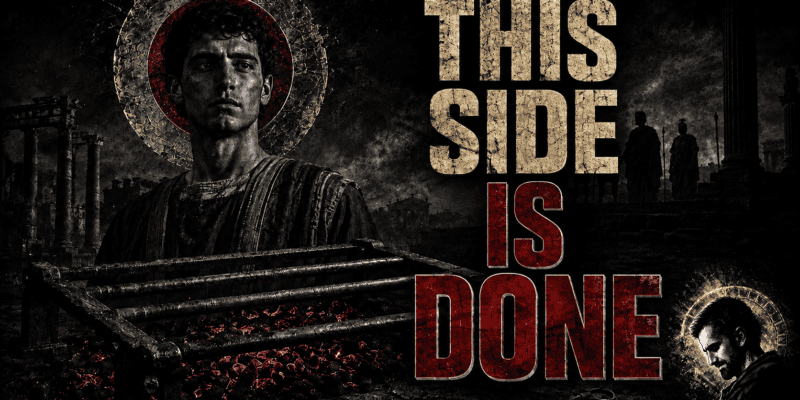
This Side Is Done
The ancient tradition preserved by Saint Ambrose and Prudentius holds that Laurence was burned on a gridiron. The 1910 Catholic Encyclopedia identifies those fourth-century witnesses while explaining that the particulars reached them through early oral tradition rather than a wholly reliable written record:
The meeting between St. Lawrence and Pope Sixtus II, when the latter was being led to execution, related by St. Ambrose, is not compatible with the contemporaneous reports about the persecution of Valerian. The manner of his execution–burning on a red-hot gridiron–also gives rise to grave doubts. The narrations of Ambrose and Prudentius are founded rather on oral tradition than on written accounts. It is quite possible that between the year 258 and the end of the fourth century popular legends may have grown up about this highly venerated Roman deacon, and some of these legends have been preserved by these two authors. We have, in any case, no means of verifying from earlier sources the details derived from St. Ambrose and Prudentius, or of ascertaining to what extent such details are supported by earlier historical tradition. Fuller accounts of the martyrdom of St. Lawrence were composed, probably, early in the sixth century, and in these narratives a number of the martyrs of the Via Tiburtina and of the two Catacombs of St. Cyriaca in agro Verano and St. Hippolytius were connected in a romantic and wholly legendary fashion. The details given in these Acts concerning the martyrdom of St. Lawrence and his activity before his death cannot claim any credibility. However, in spite of this criticism of the later accounts of the martyrdom, there can be no question that St. Lawrence was a real historical personage, nor any doubt as to the martyrdom of that venerated Roman deacon, the place of its occurrence, and the date of his burial. Pope Damasus built a basilica in Rome which he dedicated to St. Lawrence; this is the church now known as that of San Lorenzo in Damaso. The church of San Lorenzo in Lucina, also dedicated to this saint, still exists. The feast day of St. Lawrence is kept on 10 August. He is pictured in art with the gridiron on which he is supposed to have been roasted to death.
According to the legend, after suffering on one side, Laurence looked toward his executioner and said, “See, this side is well roasted; turn me on the other and eat.”
The quip contains more than gallows humor. This side is done. For Laurence, one side of the gridiron had finished its work. For the Catholic, this side of existence must eventually finish its work as well. Another side—the eternal one—awaits.
And that is where the stuff of legend meets the substance of reality. It is a story to inspire all to look to the other side, similar in nature, at least, to Christ’s instructional parables. See the video I put together on it here for his feast day:
To extend the dark morbidity, perhaps unnecessarily for this piece (but we cannot help ourselves), let us note that his association with the gridiron and fire explains why Catholic custom invokes Laurence as a patron of cooks, chefs, and restaurateurs.
There’s more:
The battle took place on the Feast Day of St. Lawrence 10 August.[5] Philibert, with his 7,000 English allies,[a][b] had placed St. Quentin under siege. Montmorency with a force of around 26,000 men marched to St. Quentin to relieve the city.[5] Facing a force twice their size, Montmorency attempted to gain access to St. Quentin through a marsh, but a delayed French withdrawal allowed the Spanish to defeat the French and capture Montmorency.[5]
…Being extremely pious, Philip II was aware that 10 August is the Feast of Saint Lawrence, a Roman deacon who was roasted on a gridiron for his Christian beliefs. Hence, in commemoration of the great victory on St Lawrence’s Day, Philip sent orders to Spain that a great palace in the shape of a gridiron should be built in the Guadarrama Mountains northwest of Madrid. Known as El Escorial, it was finally completed in 1584.[12]
Yes, some of this is strangely morbid. That is also what makes it wonderfully and unapologetically Catholic, something the modern version of the Faith has lost through its insistence on this life and not the next. It’s not as much a turn to seriousness as it is to that most unfortunate imbalance.
The front end of this decade proved where “home” is for most of us.
Moreover, Catholic humor around the martyrs isn’t intended to ridicule their suffering, as a cynic formed by today’s standards might assume. The humor is intended to ridicule death’s claim to possess the soul. Laurence could joke because the gridiron was not his final destination. It was only the final cruelty, the final vanity of his enemies, on this side. If Catholics were still trained to think regularly about this vale of tears—as we call it every time we pray the Hail, Holy Queen—and the eternal glory beyond it, the joke wouldn’t require nearly so much explaining. We’d appreciate a good double-entendre for what it is, and maybe even chuckle along.
True faith can’t remain in the “feels” all the time. It must be lucid enough to recognize when this world has fallen out of order and courageous enough to refuse its terms. Laurence’s joke did both. Caesar controlled the fire. Laurence controlled what that fire would come to mean, even in Catholic kitchens centuries later.
Rome declared this side done for the man who would not render God’s things to Caesar. But Laurence had declared it first—and meant something Rome was not equipped to understand.
The State got its blood and its day.
And Laurence has been feasting on the other side ever since.
Thank you for reading The Hayride!
Advertisement
Advertisement
