
It’s possible that a taxing economic development district might be a good thing for the old part of Bossier City. But the plans presented for a pair of these that the City Council will vet this week make that impossible.
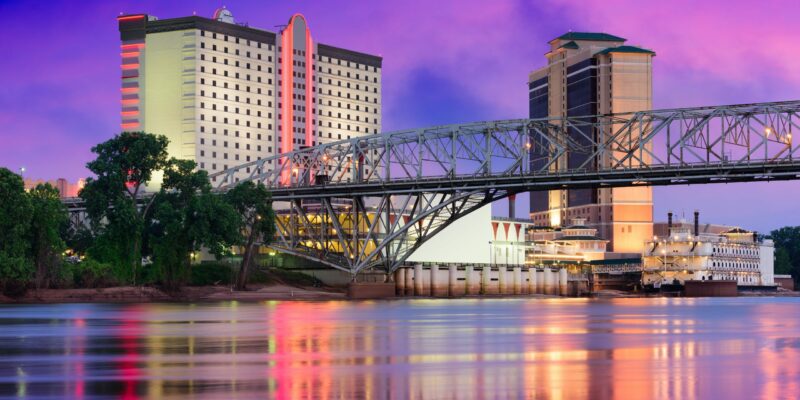
The Council will consider in its first September meeting creating two such districts, with one taking in most of the commercial establishments in the East Bank District and to the north, east, and south, plus the Louisiana Boardwalk, while the four casinos comprise the other. All residences, some businesses and nonprofits, and government buildings are excluded.
Each will have the power to levy up to a two percent sales and/or two percent occupancy tax on businesses included, with revenues going into a trust fund whose proceeds may be spent on transportation, street, right-of-way, and utility infrastructure, grants to new or existing businesses, and security measures, with no more than 30 percent annually spent in any one area unless three-quarters of the management board (below) votes to override, plus a unanimous vote needed to spend on grants. The City Council will govern each, and as there will be no residents in them, the Council unilaterally can decide whether to enact taxation and issue debt within them.
Daily management will be contracted to a nonprofit board with administration provided by the Greater Bossier Economic Development Foundation, with the board of nine members headed by that organization’s chief executive officer, Rocky Rockett. The mayor, Republican Tommy Chandler, will select three others at-large and, from a list of three from the East Bank businesses and three from the Boardwalk businesses, select one from each. The remaining three selections are to come from the casinos, but the ordinance is unclear as to whether that means one each from three lists or accepting only three total proffered by the casinos. All will face confirmation by the Council, and all must have requisite experiential qualifications.
The initial deal lasts for 25 years, although district management by GBEDF initially lasts two years. Further, district revenues generated in one can be spent on purposes in the other.
While suspect because these call for tax increases in a portion of the city, there is a scenario where they would be acceptable. If the firms being asked to pass along extra taxes agree – knowing this may cost them business through higher prices but thinking benefits from a tax exclusively going to their needs offset that – then such a regime is acceptable. After all, nobody is putting a gun to people’s heads and making them pay more to patronize these places; they can conduct commerce elsewhere if they think prices have gotten too high.
But many of the businesses affected, concentrated among East Bank establishments, don’t think this is a good idea. And the fault lies in numerous shortcomings in the existing deal.
The notion to separate them into two districts seems sensible until viewing the details. The casino one with those four puts together huge revenue-collectors who operate hotels, retail stores, and restaurants owned by large national corporations. Yet two operating national chain hotels are lumped into the other, plus the Boardwalk, which also has a number of national retail chains operating there and also operates in a different open container district than the East Bank, whose entertainment and retail establishments are owned locally and operate at a much smaller scale (the rather dissimilar Chasing Aces golfing range also is in the East Bank EDD). The Boardwalk merchants probably have more in common with the casinos, flanked as the Boardwalk is by them, than with the distant (in terms of actual operating businesses, except for Chasing Aces) East Bank.
District governance structures do the East Bank no favors, giving it just a single guaranteed representative. The Boardwalk also has just one, but may have more in common with the casinos, which have three. In other words, unless the mayor, with his at-large appointments and Council forbearance toward all three of his selections, appoints representatives sympathetic to the East Bank merchants and the dissimilar Boardwalk’s representative also goes along, East Bank merchants cannot prevent getting the short end of the stick if the casino representatives in particular want to have things their way. Keep in mind, the casinos and East Bank compete for the same business; casinos want patrons sucked into their gambling dens to stay in their hotels, eat in their restaurants, and buy their retail offerings, not wander down the street to the East Bank’s.
Even had the design featured two distinct boards, one for each district controlling disbursements collected within its boundaries – which might be unwieldy, as spending for one often might overlap with the other, such as for security – unless these boards featured only representation from their covered entities, as set up, casinos still would have the upper hand in representation. Nor would this solve the free-rider problem presented by a smattering of excluded professional and industrial firms in the East Bank, a church and a mosque, a public school, and the largest employer, revenue generator, and landholder outside of the casinos, Red River Chevrolet, all of which would pay nothing but reap the benefits of, for example, increased police presence paid by the trust fund.
Still, even this alteration is subverted by the provision that all revenues are pooled across districts. In the proposed arrangement, simply no checks exist against the large entities, casinos in particular, from shaping planned spending to their will at the expense of the smaller East Bank entities whose patrons forcibly would pay into the fund and who see the lost business as greater than whatever crumbs are thrown their way from the controlling parties.
Then there’s the taxation level. The casinos, just to name one kind, do an enormous amount of business that, at the highest level, could send the funds quickly into the tens of millions of dollars. Does the area really need that? At a higher level, it will become a great temptation to raid that fund (except for debt service requirements) for general city purposes, which is as simple as passing an ordinance to rig it.
Finally, is it that compelling to make GBEDF the manager without bidding out the business? Many companies across the country manage districts like this that have the requisite expertise. GBEDF does not.
The planned ordinances simply have way too many holes for this not to devolve into a gravy train for the largest entities or even into a backdoor tax increase that spends revenues throughout the city. Far better would be moving the Boardwalk, the hotels, and Chasing Aces into one discrete district with separate governance, taxation, collection sequestration, and proceeds usage, with the casinos entirely separate from another one containing only the East Bank entertainment venues, except for allowing money from the much larger district in dollar terms to go toward purposes that benefit both districts, with part of the creation ordinances forbidding transfers out of the trust funds. Then bid out the professional management and set any tax at a low level.
These changes might make the idea acceptable and workable. Otherwise, it will end up a money grab that favors a few at the expense of many.
Thank you for reading The Hayride!
Advertisement
Advertisement
