
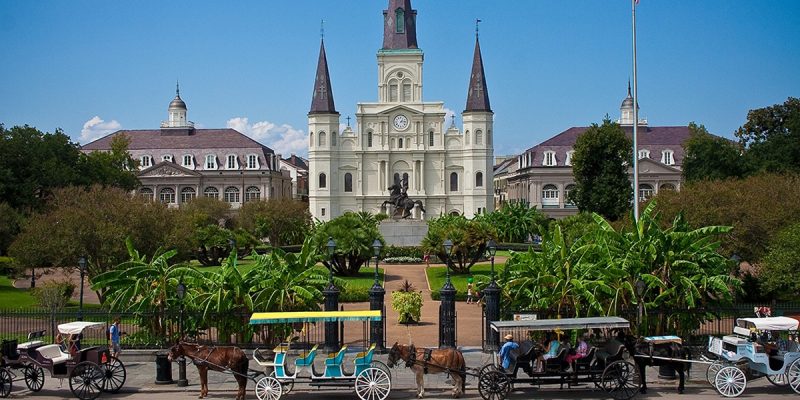
Most folks know how horrendous a place New Orleans has become. For those who don’t, Scott McKay’s summary will give them an accurate description:
Frequent Hayride readers are aware of my theory of Weaponized Governmental Failure, which holds that urban Democrat politicians will intentionally refuse to satisfactorily perform the basic functions of governance in a city, because that failure leads to an exodus of middle class voters – and when they go, the accountability they demand goes with them.
Middle class voters usually vote Republican. They want smaller, economical government, low taxes, efficient basic services, law and order, quality schools.
They want the potholes filled promptly. Drainage. A working fire department. Obvious things.
A city with too many middle class voters will bounce local politicians out of office if they catch them stealing the pothole money.
So what you want to do is to get rid of as many of those people as you can. You want a city with a small skim of rich people, who can pay for city services a la carte (they’ll have private security in their neighborhoods and their kids will go to private schools, plus they’ll buy access to politicians with campaign donations and bribes so as to secure whatever other things from the city that they need), and a vast swath of easily duped poor people who can be bought off with stupid woke pieties and policy baubles like midnight basketball and cashless bail.
Weaponized governmental failure is why Democrat politicians want to defund the police or take the side of street criminals over lawful citizens they prey on. It’s about subjugating the people and making them easy to govern, because all the rebels will soon live in the suburbs.
And weaponized governmental failure has held sway in New Orleans for better than a half-century at this point’ (‘There Is Really Only One Positive We’ll Take From The NOLA Mayor’s Race…,’ thehayride.com).
The recent election of Helena Moreno as mayor of New Orleans hasn’t brought much hope for major improvements (see, e.g., Bayham or Sadow).
But history – in particular, the history of New Orleans’s namesake in France, the city of Orleans – does offer a source of hope for those who would like to see a brighter future for New Orleans. One of the greatest French historians, St Gregory of Tours (+6th century), supplies us with the details.
The first event we will look at recounts the deliverance of Orleans from an attack by Attila and his barbaric Huns in the 5th century:
‘But Attila, king of the Huns, going forth from Metz, subdued many cities of Gaul; and he came to Orleans, and battered it with rams, striving so to take the city. At that time the most blessed Anianus was bishop in this city, a man eminent in wisdom and renowned for holiness, the record of whose virtuous deeds are faithfully preserved among us. When the beleaguered people cried out to their bishop to know what they should do, he, trusting in God, enjoined them all to prostrate themselves in prayer, and with tears to implore the help of God, ever present in time of need. And while they prayed according to his bidding, the bishop cried: “Look forth from the city wall, if haply the pity of God succour us.” For he deemed that by the mercy of the Lord Aétius should come, whom before he had visited in Arles, foreseeing that which might come to pass. So they looked out from the wall, but saw no man. Then he said: “Pray in faith; for this day shall the Lord deliver you.” And while they continued praying he said: “Look once more.” And when they looked they saw none that might succour them. He said to them a third time: “If ye seek Him in faith, the Lord cometh among us right soon.” Again with many tears and lamentations they besought the compassion of the Lord. But when their prayer was done, they looked forth from the wall a third time as the old man bade them, and behold they saw afar off as it might be a cloud rising from the earth. And they brought the bishop the news, and he said: “It is the succour of the Lord.” And now the walls were already shaking under the shock of the rams, and on the point of falling, when behold Aétius came; and Theo-doric, king of the Goths, and Thorismond, his son, with their armies swiftly advanced upon the town, and cast forth and flung back the enemy. The city thus freed by the intercession of the blessed bishop, they put Attila to flight . . .’ (History of the Franks, p. 46, archive.org)
The key to the salvation of Orleans from Attila was the prayers of a holy man, St Anianus (sometimes spelled Aignan), the bishop of Orleans, and the faith and prayers of the others in the city.
The second event is closely related to that one: the fall of Metz to Attila because of the sinfulness of the city:
‘The Huns, therefore, issuing from Pannonia, reached the town of Metz, as some say, on the vigil of the feast of Easter, devastating all the country. They gave the city to the flames, and slew the people with the edge of the sword, and did to death the priests of the Lord before the holy altars; no spot in the town remained unburned save the oratory of the blessed Stephen, protomartyr and deacon. The story of this oratory, as I heard it from certain persons, I will now relate. They say that before the coming of this enemy, one of the faithful in a vision saw the blessed deacon Stephen conferring with the holy apostles Peter and Paul about this destruction, and heard him say: “I beseech you, O my lords, that by your intercession ye suffer not the city of Metz to be burned to the ground by the enemy, for there is in it a place in which relics of this your humble petitioner are preserved; but rather let the people per-ceive that my power somewhat availeth with the Lord. But if the evil-doing of the people is waxed so great that the city must needs be given to the flames, at least suffer not this oratory to be burned.” They answered: “Go in peace, most beloved brother, this oratory of thine shall alone be spared in the fire. For the city we shall not obtain this grace, seeing that the sentence of divine judgement is already gone forth upon it. For the sin of the people is grown great, and the sound of their wickedness is gone up before the Lord. For this cause shall this city be burned with fire.” It is therefore beyond doubt that by their intercession the oratory remained unharmed’ (Ibid., pgs. 45-6).
At this point, we may conclude the following from the foregoing:
- New Orleans has a potential powerful guardian in St Anianus of Orleans, the protector of her Mother City of Orleans, France. The protector of the mother will also protect her child;
- We make guardians/patron saints like St Anianus nearly powerless by our disobedience of God. That is the lesson of Metz, which was sacked despite the presence of the holy relics of St Stephen the First Martyr within that city.
How does New Orleans stand in this regard, i.e., her obedience or disobedience of Christ?
When it comes to sex? Disobedient. Pro-LGBT, pro-abortion, etc.
When it comes to controlling the other appetites? Disobedient. Lots of obesity, drunkenness, etc.
When it comes to magic, witchcraft, and the like? Disobedient. Many in New Orleans delight in the city’s reputation for the demonic practices of voodoo (for one example).
We have focused on these sins for a particular reason: Most of them are those that recent saints have mentioned as being the cause of coming catastrophes in the world:
‘Metropolitan Neophytos of Morphou, Cyprus: “Three saints told me that the next World War will take place because of the sexual sins, the abortions, and the witchcraft that are taking place, for which people do not repent. The sexual sins are not only those committed by the youth, but especially of married couples because they defile the Holy Mystery of their Marriage”’ (Priest-monk Kosmas, ‘Who Should We Listen to Regarding Contraceptives and the Avoidance of Having Children?’, orthodoxtalks.com, p. 77.)
But sinfulness in general will leave destruction in its wake, as another writer recently pointed out:
‘Their [Adam and Eve’s—W.G.] fear and struggle for survival outside the Garden of Eden introduced enmity with the natural world. The fear of death in Mankind also instilled anxiety, materialism, greed, hatred and despair. This eventually resulted in economic exploitation, racial oppression, social inequalities, wars, genocides, and so on. These collective signs of death are all consequences of the fear of death.10
‘By yielding to sin and Satan, Man eventually allowed Satan to become the “ruler of the world” (John 14:30), resulting in the suffering of all creatures. “For we know that the whole creation groans and suffers together until now” (Romans 8:22), for “the whole world lies in the power of the evil one” (1 John 5:19). This is because our master becomes the one who we follow. Some may say that they follow no-one except themselves, but this is a trap, for it is a form of self-worship (pride), which is exactly how Satan lost Paradise.2
‘Sin also distorted the role of headship and the responsible ruler. As a result, instead of being good stewards, sinful men (and women) became despots and some even tyrants.2 In addition, a man’s godly headship, which was meant to be only in relation to his wife, became distorted and was generalized across womankind. This resulted in many abuses of women, and even children, even by modern “Christians” who ignored or forgot that the “…first of all the commandments is … you shall love the Lord your God with all your heart, with all your soul, with all your mind, and with all your strength…’ And the second, like it, is … ‘You shall love your neighbor as yourself” (Mark 12:29-31). Treating all women, children and men as our neighbour and loving them as ourselves would have prevented many atrocities like the slave trade and the need for societal constructs like the various human rights organizations … Many social movements continuously arise to mitigate the wages of sin. Why do they continuously arise? Because they don’t do nearly as good a job as obeying the commandment to love’ (Dr Irene Polidoulis, ‘Falling for the Fruit of Spiritual Adultery,’ orthodoxreflections.com).
Greed, hatred, bad stewardship, despotic governance? Sounds a lot like modern New Orleans.
More police officers, judges and district attorneys interested in actual justice rather than fluffy ‘social justice’, economic opportunity, good schools – these are some of the usual cures proposed for New Orleans. There is little doubt they would benefit her and any other city, whether big or small, given the right circumstances. But in themselves they cannot compensate for the spiritual sickness of a city’s population; the latter will overwhelm those other solutions in the end.
That is what the historians like St Gregory and most others of past ages understood: The health of the soul is central to man’s well-being. Yet we consider ourselves wiser – more advanced – than them. But Metz, Orleans, etc., stand as witnesses testifying in favor of the older view and against the newer one.
The tragedy of New Orleans continues to unfold like one of Shakespeare’s or Jean Racine’s plays. But a hero who can bring about a happy ending for her instead waits just out of reach in the person St Anianus. He rescued Mother Orleans from a powerful marauding army; with repentance, he can do the same for Daughter Orleans, rescuing her from predators in the halls of government and roaming upon the streets. What will be the answer of New Orleans to him? To Christ? Those are the critical questions going forward.
Advertisement
Advertisement
