
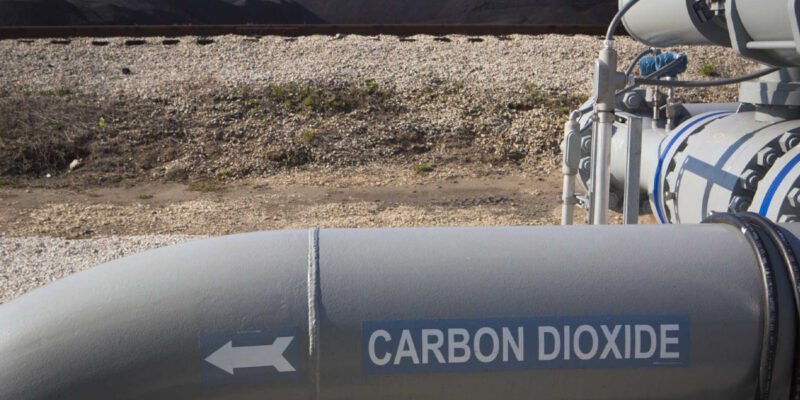
Long before “carbon capture and sequestration” (CCS) became a flashpoint and buzzword, politicians and oil companies were quietly building the legal, technical, and political foundation for today’s massive CO₂ storage push—starting in the 1970s. The technology, the pipelines, and even the power of eminent domain to seize private land for carbon infrastructure were all pioneered here, decades before our state was volunteered as a hub for the nation’s captured carbon dioxide.
The story begins not with climate urgency, but with oil. In 1976, the Weeks Island Field in Iberia Parish became one of the first Gulf Coast sites to inject CO₂ for enhanced oil recovery (EOR). Around the same time, the U.S. Department of Energy and a major oil company ran a pilot blending CO₂ with natural gas—proving that large volumes could be pumped underground and stay there. As the folks in the oil and gas industry will quickly tell you, they’ve been injecting carbon in the ground here for a long time—and it has been tied to getting a useful and critical product out of the ground.
A few years later, in 1981, Representative Frank Simoneaux proposed, and the legislature passed, Act 760, which granted the state jurisdiction over CO₂ pipeline construction and operations and—crucially—authorizing eminent domain for their construction. And this authority included foreign and domestic corporations.
The 1980s and 1990s saw steady legislative expansion. Bills refined pipeline routing, tax incentives for EOR, and regulatory oversight of injection wells. Each step normalized CO₂ as a commodity—like natural gas or crude—with private entities being empowered to seize land if industry needed it. And this CO2 was a commodity. It was used in commerce. These were not climate laws; they were energy laws, designed to keep Louisiana’s oil fields producing a great Louisiana resource. But they laid the tracks for what would come.
The turning point—and the most problematic milestone—was Representative Jim Morris’ Act 517 in 2009, signed into law under Governor Bobby Jindal. This sweeping legislation created the modern CCS framework: it authorized eminent domain powers for underground storage facilities, expanded powers for CO₂ pipelines, granted liability exemptions to operators after site closure, and fast-tracked Class VI well permits. It shifted oversight from strict environmental review to economic development priorities, allowing storage projects to proceed with minimal public input. This legislation was ushered through quietly, without comment.
In the intervening years, a number of things happened that provided for the taking of private property through eminent domain—and they were things DONE in the legislature. HB 274 (Act 702, 2012), sponsored by then-Rep. Franklin Foil and recommended by the Louisiana State Law Institute, explicitly authorized domestic or foreign entities to expropriate property for CO₂ pipelines and underground storage. It strengthened eminent domain for energy infrastructure and adjusted cost/fee rules to penalize lowball offers. The bill passed unanimously (93-0 House, 38-0 Senate), reinforcing a long-standing State framework for CO₂ projects with a modicum of added landowner safeguards.
Today, those laws underpin every major sequestration project in Louisiana. An up-charging of the framework was passed in 2020 with the now infamous Senate Bill 353. The BIG thing Senator Sharon Hewitt’s bill did was place CO₂ pipelines in a category that would have made an eminent domain land grab easier, and it underscored an already existing right to use eminent domain for what we now refer to as a Class VI Carbon Well.
In 2024, the right to take subsurface space for a carbon well via expropriation was ended by HB 492 by Rep Brett Geymann. Prior to 2024, the pipeline and well companies had the upper hand; they could take land and subsurface space (called pore space) and were enabled to do this by the laws passed since 1981. Geymann maneuvered to protect the pore space from a private sector seizure via eminent domain. He was outnumbered on this and had to negotiate to get it done. The trade in the negotiation was to allow for what is called “unitization.”
In the unitization paradigm, a big area is considered—thousands of acres. 492 made it where a company wanting to inject and or build a well must get 75% of the landowners in the big circle to proceed. In 2025, that number was moved to 85%, thanks to legislation by Vernon Parish Senator Michael Reese–providing MORE protection for landowners. The unitization paradigm is not perfect, but it is a massive improvement over what was created in 2009. The unitization situation is in place in case landowners cannot be located or if a small number don’t want to participate in the project. The KEY POINT: Geymann’s law guaranteed any disputes would be handled by the State, not private entities. A carbon company cannot sue for expropriation of property in a unit; they must go to the state to get a unitization ruling.
In 2025, Senate Bill 244—a colossal and byzantine reorganization bill—had an amendment inserted in it that placed the carriers of CO₂ into a category that is on par with public utilities and goods that are produced for a common benefit—something known as “common carrier.” The bill also removed some strange language from 2009 about how removal of greenhouse gases would be of public benefit—-eliminating a critical path that CO₂ pipeline operators could legally hang their hat on if they tried to take someone to court in an eminent domain case.
Hewitt’s SB 353 keeps being discussed as the thing that created this moment for carbon sequestration but it, in fact, was NOT the foundation nor even the linchpin. Where we stand today is that most of its effects are now undone—thanks to Brett Geymann’s amendments to SB 244 and his maneuvering with HB 492. In lawmaking, negotiations often take place to get partial wins. That’s how the legislature has mostly rolled back the effect of SB 353.
Still Louisiana stands at the precipice of something many people in the state don’t understand and probably just as many don’t want. The movement to inject billions of tons of condensed, toxic CO₂ beneath Louisiana homes, farms, and in one case a federal military installation is at the doorsteps of the citizens of the State.
But it is NOT NEW.
It is the culmination of fifty years of policy, engineering, and legal precedent—much of it written to benefit the oil and gas industry which has been a major employer in the state. It is still being trumpeted as something to benefit the oil and gas world, but there are nefarious parts to it that turn it from a public good to a potential ecological problem. The people who want this are seemingly hell bent on making it happen. The people who don’t want it are coalescing.
The wide scale or forced injection of carbon is NOT inevitable. Louisiana can still avoid the sequestration abyss. Citizens should demand and hopefully legislators will support:
- Full repeal of 2009’s liability shield for operators
- Ban on eminent domain for private CO₂ pipelines
- An absolute END to foreign entities being able to use eminent domain in the state
- Mandatory independent risk assessments before any injection
- Revenue from storage fees directed to affected communities, not general funds
- Moratorium on new Class VI wells until state-sanctioned and approved seismic and groundwater baselines are complete
- Full vetting and State analytical approval of the tools used to analyze the behavior of injected caron
- Above and below ground toxicity models—made public and produced by government entities. I’ve had some of these created for my home area and they are STARTLING and we are failing our citizens if we don’t have these done for both pipelines and well sites
There’s much more. In Part Two of this article, I will address what our state’s deficiencies in our structural preparation for or management of the grand vision and the “hub” that has planned for us. We are completely unprepared as a state to manage what is being proposed and envisioned. What I will share in the next article will startle you. Stand by.
For now, please let it suffice to say this one more time: The foundation for where we are was laid long ago and it has been created and shored up for decades. It all needs to be reviewed and it all needs to be confronted—-NOW.
Advertisement
Advertisement
