
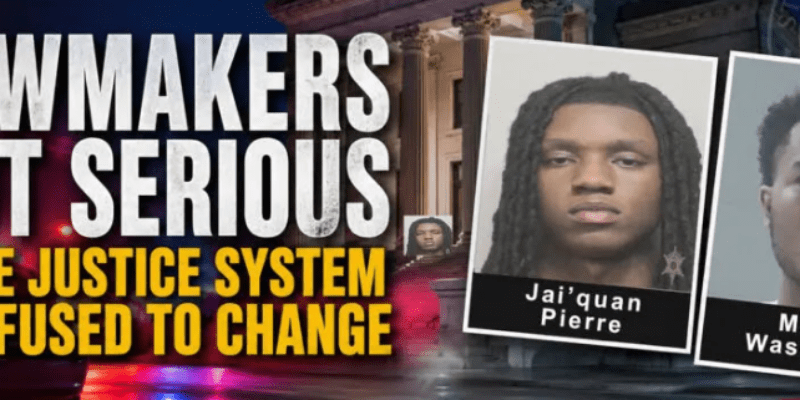
(Citizens for a New Louisiana) — During Louisiana’s 2024 crime session, the Legislature — at the direction of Governor Jeff Landry — presented a sweeping set of criminal justice reforms. Lawmakers passed bills, promised accountability, and told the public help was on the way. Two years later, a harder truth is emerging: the laws changed, but much of the courtroom culture did not.
But reform is not defined by what is passed by the state legislature. It is defined by what happens in the justice system afterward. And that raises a simple question.
What Has Changed?
There is a growing tendency to assume that because laws have changed, outcomes will follow automatically. Recent analysis has highlighted a deeper issue — Louisiana’s courts are not addressing crime promptly. Cases move slowly. Charges are delayed. Outcomes are inconsistent.
District Attorneys point the finger at lenient judges and a lack of satisfactory police work necessary to obtain a conviction. Law enforcement leaders voice frustration with lazy prosecutors who work scarce hours and are unwilling to try cases unless they are slam dunks. They also have concerns with light sentences, if they ever finally do arrive after long delays and repeat offenses. Judges, for the most part, prefer to speak through their rulings rather than engage publicly on crime.
This is not a marginal problem. It goes to the core function of the system and whether timely justice exists at all in Louisiana.
A System in Motion
Criminal justice reform is often framed as a debate between “tough” and “lenient.” That framing misses the real issue. A system can be harsh or lenient and still ineffective. Consider a recent case out of Lafayette Parish. Nineteen-year-old Jai’quan Pierre was arrested own April 26, 2026, over an incident around Festival International in Lafayette, Louisiana. Pierre is presently incarcerated for negligent carrying of a handgun, terrorizing, and aggravated assault with a firearm. Commissioner Andre Doguet has set bond on all charges at $110,000.00. Pierre was also booked on an outstanding bench warrant issued by Commissioner Doguet in October of 2025, which carries a $50.00 contempt fee.
Local news stations quickly reported that Pierre had been previously arrested by the Lafayette Parish Sheriff’s Office in November of 2025 on a charge of video voyeurism in relation to the death of Gabreilla Sharp. Commissioner Doguet set bond in this case at $15,000.00, which Pierre posted and was released the same day. Apparently, the October 2025 warrant went unaddressed at that time.
What hasn’t been widely discussed is that, prior to these two incidents, Pierre was also arrested on July 7, 2025, by the Lafayette Parish Sheriff’s Office for two counts of aggravated flight from an officer and possession with the intent to distribute marijuana and possession of drug paraphernalia. Commissioner Doguet set bond on those offenses at $45,000.00. Pierre again posted bond and was released the same day. The 15th Judicial District Attorney’s Office formally filed charges in this matter in October of 2025.
A Conviction with No Consequences
Pierre also made a splash in Jefferson Davis Parish. According to court records, he was arrested in January of this year for aggravated flight from an officer, illegal possession of a stolen firearm, and illegal carrying of a weapon. Bond was set at $70,000.00. Pierre appeared in court on March 23, 2026, where he changed his plea from not guilty to guilty on the first two offenses, and the District Attorney agreed to dismiss the third offense. The judge then sentenced Pierre to five years’ hard labor.
At first glance, that might appear to be a meaningful consequence, but it doesn’t end there. The judge suspended the entire sentence and placed Pierre on probation for three years. Pierre was released from jail the same day — only to be re-arrested this weekend, just a month after his release from Jefferson Davis Parish.
Here Lies the Problem
A single individual was arrested multiple times across 2025 and 2026 for a progression of offenses, including:
- Aggravated flight from an officer
- Drug distribution charges
- Weapons-related offenses
Each time, the pattern repeated:
- Arrest
- Bond
- Release
- Re-arrest
This reflects something larger — a system that struggles to intervene before escalation occurs.
When Patterns Don’t Meet Consequences
There is also a recent and far more serious example. Public reporting surrounding the recent Mall of Louisiana shooting, which tragically took one life and multiple injuries, indicates that at least one individual detained (Marcus Washington) in connection with the incident had previously been arrested for a firearm-related offense, released on bond, and had supervision conditions reduced just prior to the shooting.
The broader pattern is difficult to ignore. When repeated contact with the system fails to yield meaningful intervention, the public is put at risk.
The Promise
Louisiana’s 2024 Second Extraordinary Session was presented as a turning point. Lawmakers gathered, legislation was passed, and the public was told that meaningful reform had arrived. The message was clear: the system would be strengthened, accountability restored, and public safety improved.
Press releases are not results. Bill numbers are not results. Outcomes are.
And the question now is unavoidable: Has anything really changed? Because when we step outside of the legislative narrative and look at actual case patterns — delayed charges, repeat arrests, rapid release, and escalating conduct — the answer is far less certain.
If the system were functioning differently, we would expect to see it in the results. We would expect faster movement from arrest to prosecution, more consistent intervention before escalation, and fewer repeat cycles of arrest and release. Yet the patterns emerging in recent cases suggest continuity of the same broken system legislators tried to address two years ago.
The People Blocking Reform
The very people you would expect to want to fix things are the ones obstructing change. We saw this plainly when Tony Bacala put forth the Timely Delivery of Justice Act. The bills simply sought to adopt standards of timeliness by which our justice systems should operate. These are the same standards already used in other criminal systems across the United States operating under the same constitutional safeguards. The proposal was ultimately reduced to a simple reporting requirement after opposition from the District Judges Association and the District Attorney’s Association.
What these cases illustrate is not simply crime but friction within the system — delayed charging decisions, repeated releases without effective supervision, and outcomes that fail to interrupt escalating behavior. This is where reform must now focus. Not just on statutes — but on function.
The real questions are simpler — and more difficult:
- Does it work?
- Does it move cases efficiently?
- Does it intervene at the right moment?
- Does it prevent escalation?
Right now, for many Louisianans, the answer to all four questions is NO!
Louisiana Wants Real Accountability
Louisiana has already taken legislative action. But legislative action alone is not the same as structural and cultural change. The right things to do are harder—and more important:
- Ensuring timely prosecution
- Aligning supervision with actual risk
- Closing the gap between arrest, charging, and disposition
- Measuring outcomes, not just activity
Because reform is not measured in sessions. It is measured in results. The question is not whether it exists but whether it is producing the results the public expects — and deserves.
Right now, the evidence suggests Louisiana changed its laws, but the justice system refused to change with them. Louisiana already held a crime session. It may be time for a justice session — one focused not on passing new laws, but on making the existing system work. Because right now, the public sees motion in Baton Rouge and stagnation in the courtroom.
Advertisement
Advertisement
