
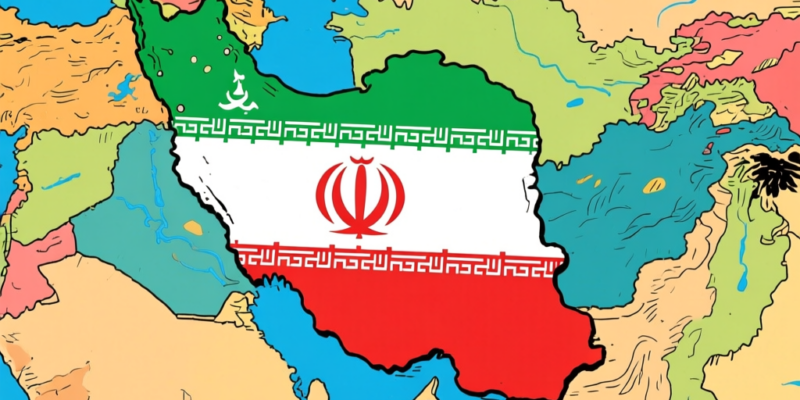
One of the clearest signs of this condition is the regime’s attempt to redefine its aggressive and destructive actions through legal and economic language. Maritime extortion in the Strait of Hormuz is rebranded as “maritime insurance” or a “security fee” in an effort to normalize Tehran’s control over one of the world’s most critical energy corridors. This follows the classic pattern of mafia-style systems: create insecurity, then sell security. Without formally declaring war or announcing a blockade, the Islamic Republic uses intimidation, threats, and psychological pressure against shipping and Gulf trade in order to increase the cost of confronting Tehran for governments and corporations, while avoiding direct responsibility for a major military conflict.
At the same time, the regime is under pressure from the United States at sea and therefore has expanded overland routes through China, Pakistan, and Iraq in order to bypass sanctions and maritime pressure. This demonstrates that Tehran is shifting part of its “survival economy” away from the Persian Gulf toward Asian logistical networks. An economy dependent on sanctions evasion, opaque financial structures, smuggling networks, and regional black-market operations is not a sign of strength; it is a sign of weakness and isolation. The regime’s growing dependence on China, Russia, and the anti-Western axis is also not evidence of strategic success but rather proof of political and economic failure. A regime that once promoted the slogan “Neither East nor West” now relies heavily on Beijing and Moscow simply to sustain itself. Tactical support from China and Russia may prolong the regime’s survival, but it cannot reverse the deeper structural erosion consuming the Islamic Republic.
The continued support for terrorist proxy organizations across the so-called Shiite Crescent — including Hezbollah, Hamas, and the Houthis — is not merely ideological. It is a mechanism for preserving strategic depth and exporting crises beyond Iran’s borders. Tehran understands that if it loses influence in the region, pressure will rapidly shift inward toward the regime itself. This is why the Islamic Republic simultaneously advances two contradictory narratives: on one hand, it claims to be the “guardian of Persian Gulf security,” while on the other hand it actively undermines regional stability through proxy warfare, tanker threats, destabilization campaigns, and intimidation. This contradiction is central to the regime’s strategy of fear and coercive control.
Domestically, the regime also attempts to repackage economic collapse and structural corruption under the rhetoric of “resistance” and “steadfastness” in order to suppress public anger and redirect blame toward the West. Economically, politically, and socially, the Islamic Republic faces severe pressure and declining legitimacy. However, this does not necessarily mean the regime will collapse tomorrow. Even weakened systems can survive for extended periods, particularly when external crises or regional conflicts provide them with security justification and emergency conditions. Yet history shows that the most dangerous phase for such governments often comes precisely when they feel weak, surrounded, and threatened. Under those conditions, they frequently become more aggressive, unpredictable, and repressive. There is no meaningful sign of flexibility, reform, or moderation within this rogue regime.
As a result, internal repression and information control have intensified dramatically. The government understands that its social legitimacy has eroded severely, and therefore censorship, internet restrictions, organized intimidation, and hidden executions continue. The gap between the Iranian people and the ruling establishment grows deeper every day. Many inside Iran increasingly view Crown Prince Reza Pahlavi as a more organized and coherent alternative to the current system. At the same time, the ruling establishment still believes that the Islamic Revolutionary Guard Corps (IRGC), the security apparatus, ideological propaganda, and the machinery of repression remain its essential tools of survival and control. In reality, nearly all the regime’s energy is now devoted to “crisis management” and buying time.
Overall, the current image of the Islamic Republic is the image of a “surrounded but dangerous regime” — a system that no longer possesses the capacity for natural expansion of power and instead relies on geopolitical extortion, proxy networks, domestic repression, and dependence on Eastern powers simply to preserve itself. The Islamic Republic has entered a stage of “structural erosion,” and its behavior increasingly resembles that of a weak, exhausted, survival-driven government rather than a confident regional power. The regime came to power through terrorism, sustained itself through terrorism, and ultimately it will be pushed toward the graveyard of history through a multilayered confrontation shaped by both domestic resistance and regional pressures.
Erfan Fard is a Middle East Analyst focused on Iran, terrorism, and regional security affairs. My work has appeared in Fox News, The Hill, The Dallas Morning News, The Jerusalem Post, and Israel Hayom.
Advertisement
Advertisement
