
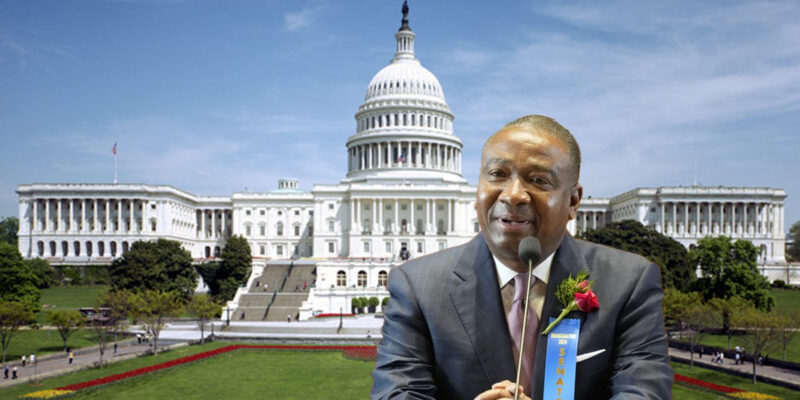
Cleo Fields is likely going to get to occupy Congress for two more years, even though the district he represents was illegally drawn according to the Supreme Court.
That’s the short-term upshot of the final disposition of the Louisiana v. Callais case, the Congressional redistricting lawsuit filed by conservatives after the current Louisiana congressional map was redrawn in early 2024. That redrawn map came courtesy of a different lawsuit, one filed by the “civil rights” mob, which alleged that the previous congressional map put Louisiana afoul of Section 2 of the Voting Rights Act.
At the time, Baton Rouge federal judge Shelley Dick, an Obama appointee whose rulings are usually more like partisan Democrat policy offensives, had gone so far as to threaten to hold Louisiana’s legislative leadership in contempt of her court if they didn’t redraw the map. When Jeff Landry took office as governor in January 2024, he called a special session and created the current map, which switched the 6th congressional district, then represented by Garret Graves, to a majority-black district. Fields was elected to that seat later in 2024.
The Callais case was filed shortly thereafter and it’s been at the Supreme Court for a long time. The case was originally heard at the Court in its previous term, but the question of Section 2 of the Voting Rights act was not debated then; last year the Supreme Court set up a rehearing for arguments on Section 2.
And now, with the ruling handed down today, it looks like Section 2 is at least mostly gone from the law.
Section 2 of the Voting Rights Act is the one which essentially sets up a requirement for DEI congressional districts to favor black Democrats like Fields. Section 2 was used to make the argument that because Louisiana’s population is one-third black, a third of its six congressional districts have to be drawn to have a black majority. But institutionalizing racial gerrymandering like this is very problematic with respect to the 14th Amendment’s Equal Protection Clause, and that conflict has created chaos for decades.
Which the Supreme Court seems to have decided to resolve by telling the states they can draw congressional districts however the hell they please.
This is the outcome Landry has been predicting all along. Interestingly enough, he’s right for reasons different from his assumption about what was going to happen.
The governor and his people had expected the Court would uphold the congressional map but with the caveat that states can draw whatever maps they want, and so if Louisiana wants a 4-2 map it can have one – or if it wants a 6-0 map it can have that. But that isn’t what happened. The opposite did.
Liz Murrill, Louisiana’s Attorney General, technically “lost” this case. But she’s not taking it that way. Murrill’s argument, that Louisiana’s atrocious state media said amounted to a flip-flop, was that the state legislature drew the map it was told to draw and wasn’t wrong in doing so given the interpretation of Section 2 it was given to work with – but that interpretation was utterly unworkable, so if the Supreme Court wanted to have another look at Section 2 she had lots of things to say about that.
Here was Murrill’s quote after the decision came down…
“We win in Louisiana v. Callais! The Supreme Court has ended Louisiana’s long-running nightmare of federal courts coercing the state to draw a racially discriminatory map. That was always unconstitutional—and this is a seismic decision reaffirming equal protection under our nation’s laws.
I vigorously defended our first map and said then that the only way to draw a second majority-minority district was to expressly take race into account. We raised our objections at that time to racial gerrymandering, but the district court and the Fifth Circuit directed us to draw the map anyway. It is gratifying that the Supreme Court has finally vindicated our original position and, in doing so, clarified that only under very narrow circumstances—where there is proof of intentional discrimination—may race be used as a remedy under Section 2. It is frustrating that this has taken five years, millions of dollars, and many lost hours to get here. I will continue to work with the Governor and the Legislature to provide guidance as we move forward to adopt a constitutionally compliant map.”
The decision, which is 92 pages – begins like this: “Held: Because the Voting Rights Act did not require Louisiana to create an additional majority-minority district, no compelling interest justified the State’s use of race in creating SB8, and that map is an unconstitutional racial gerrymander. Pp. 17–36.”
It doesn’t look like it explicitly struck down Section 2. But it essentially, if I’m reading this correctly, took all the teeth out of it and said it doesn’t mean what it’s been interpreted to mean.
And now it’s open season for red states to redraw their maps however they want to.
Does this mean blowing out all of the majority-majority districts throughout the South, for example? Probably not. In Louisiana’s case, if you’re a conservative you’re probably more comfortable with a 5-1 map drawn in such a way as to maximize the conservative leanings of the five Republican/white districts, rather than go for a 6-0 map. A 6-0 map gives an opening to a “moderate” white Democrat to bank the third of the vote in a hypothetical district which is black, then try to get to 50 percent by sounding like a Republican. That does work once in a while, you know – John Bel Edwards pulled it off statewide twice, and Foster Campbell managed to do it for years on the Public Service Commission in a district which has no business being represented by a Democrat.
It’s better to just make that impossible. Make a heavy majority-minority “ghetto” (ghetto in the sense that everybody is crammed into a little area, not in the sense that it’s a slum) district that, say, Fields and Troy Carter would have to slug it out for, and then have the rest of the state voting in blood-red districts where Democrat politicians are more likely to be hunted with dogs than get elected.
So Louisiana would still have a black congressman. So would Mississippi and Alabama and the other Southern states.
But there would be 30 members of the Congressional Black Caucus when this is over. Not 70 like there are now. And there would be more Byron Donalds and less Jasmine Crocketts – meaning, if you’re black and you want to get elected to Congress you’re going to have to hold some appeal among non-black voters. Only one in eight Americans is black, after all. This idea that almost 20 percent of Congress would be people whose sole qualification is that they’re of a particular race and they got an affirmative-action path to Congress is moronic, and it turns out not to produce very good representation.
Cleo Fields is among the most morally compromised individuals in American politics. He’s a disgrace. And Troy Carter is a buffoon who makes the state look bad every time he opens his mouth.
We don’t even have it all that badly. We could have Bennie Thompson, Frederica Wilson, Hank Johnson or Jasmine Crockett as a member of our congressional delegation.
Or Al Green.
Ohhh, the Democrats are hot about this. Ken Martin, who runs the DNC, spat the contents of his aneurysm onto a printed page and distributed it to the media…
“Today is a dark day for America — the Supreme Court just rolled back the clock on the Civil Rights Movement. The GOP-captured Supreme Court just effectively killed Section 2 of the Voting Rights Act, a major step back in the fight for racial justice and fair representation. While today’s decision is a gut punch, make no mistake: Democrats will fight tooth and nail to ensure the voices of all Americans will be heard in November and in every election that follows.”
“Tooth and nail” probably means sending another would-be assassin after the President. Or something.
The problem is, because of the Supreme Court’s Purcell doctrine it’s unlikely anything will change until 2028, unless we have this all wrong. Purcell is a rule which says that court decisions can’t disrupt elections when they come down too close to Election Day. Seeing as though we’ve got party primaries in less than a month, and the candidates all qualified under the current map, there is no way to return to a 5-1 map until the 2028 election.
We wanted to see the state legislature draw up and pass a conditional map last fall that would have gone into effect in the event of a decision like this. Had the Supreme Court handed down the Callais decision in January, when a lot of people thought it might, we would have had a point. But an end-of-April ruling makes all of that moot anyway.
So yes, this is a gigantic decision. Its import will be felt in a major way. In Texas and Florida, where they’re redrawing maps and just got a green light to do it as aggressively as they want, this decision will bolster GOP efforts.
But Callais won’t turn any gears in Louisiana for a couple of years, we don’t think. Cleo can rest easy for another term thanks to the timing. And that’s a dark lining to an otherwise excellent gift from the high court today.
Advertisement
Advertisement
