
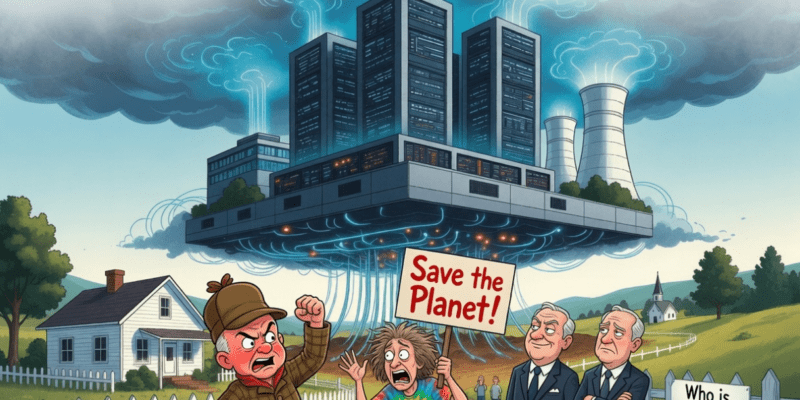
As AI infrastructure spreads across local communities, the question may not be only about the multiplication of data centers across the country. It may very well be whether citizens are finally noticing the physical regime behind the digital world.
From a silly little show I was watching on television the other day to the local news, Mockingbird media is busy about the business of setting the public abuzz with the debate over the seeming takeover of data centers across the country. Questions of land usage, electricity, water, cooling, taxes, zoning, transmission lines, and everyday citizens not wanting enormous server facilities in their backyards are just a few of the reasons why this is such a contentious topic, one we should all recognize now will never reach a satisfying compromise.
To even think it might do that tragically underestimates the power of the elites that run everything behind all of our cute little facades posing as government and the voting booth. Infrastructure politics goes infinitely and frightfully deeper than the little local town hall meeting I was watching on that silly little show a week or two ago.
There are one or two questions I would like to offer, especially to the conservatives that obviously read this site: Does the resistance actually go well beyond liberal pushback and into a portion of the citizenry we would most likely agree with on many issues? Are many dissenters actually conservatives themselves, who hold more strongly this conservative value or that conservative value over another’s, finally deciding to fight something they’ve seen brewing for a long time now—the first visible pieces of something much larger and much more spiritual?
The Cloud Was Never Invisible
A long time ago, well-meaning Americans were sold that the digital world was abstract and harmless. Not that it needed our permission, but its inevitability in controlling our lives was marketed through the filter of its innocence. And with each passing decade, as technology releases grow increasingly sharp and invasive, including both the physical objects and the algorithm of social media, the people paying attention have grown more and more suspicious of where all of this is going. The problem, however, has always lain in the “invisibility” of the adversary, the inability to actually name what was irking their souls every time they had a conversation and an ad on that very topic popped up five minutes later on their phones.
This is where data centers perhaps change things. Their expansion is large enough, physical enough, and disruptive enough to give citizens something to argue against in a way the latest iPhone release never could.
The invisible “somewhere out there” is becoming suddenly and stingingly local. Data centers are revealing, perhaps, the teleology that was present all along: The digital world was never going to remain merely digital. It would eventually consume real land, real water, real power, real communities, real space.
That physicality, one might guess, provides the tangible thing some have always needed to express a growing apprehension—perhaps a soul-level, cosmic one—previously impossible and even embarrassing to bring up. It is providing a confirmation signal—either correctly or incorrectly—for those who have stewed on this issue for many, many years.
Advertisement
MORE CONTEXT
Trump, Palantir, and the Surveillance Machine We Already Built
ON CLOUDS, CAMPFIRES & CAVES: Texas and the Infrastructure Beneath America’s Digital World
Who Is This Future For?
The brief illustration presented here, in addition to the more unpacked content of the above related links, is why even the best of conservatives should be careful not to dismiss every data center objection as reflexive left-wing environmental hysterics or even the NIMBYism that screams “stay off my lawn.”
Some of it is exactly that, of course, and more than that too when you take into account the manufactured fractures injected into a society, preying on presumably organic emotion, by the powers in the shadows.
But some of it may also be a normal human instinct toward the very traditions so many conservatives value concerning other topics. Questions of property, place, memory, stewardship, and self-government all involve limits that provide the very mental physics of what “conservatism” inherently is. Conservatives pride themselves on being the more reasonable of the camps, so perhaps there is something to learn from our like-minded, reasonable friends and their angst.
A people do not need a fully intellectual or philosophical vocabulary to know when something enormous is being built around them, above them, beneath them, seemingly inside their very souls. Particularly for a religious person, this will be true. The seeming invasiveness of it all can absolutely parallel and perhaps even mimic the incessant diabolical forces encroaching on us everywhere else in society, and it seems to me that perhaps there is prime opportunity for a little grace to be extended here. Grace, and perhaps a little reason that extends beyond blue and red and donkeys and elephants.
Maybe the data center pushback isn’t really about data centers at all.
Maybe it’s about, in one terrifyingly prescient metaphor, the cloud finally touching earth.
And now that it is, conservatives would do well to listen to the concerns of their fellows and at least allow the question to be asked: For whom exactly is this future being built?
Advertisement
Advertisement
