
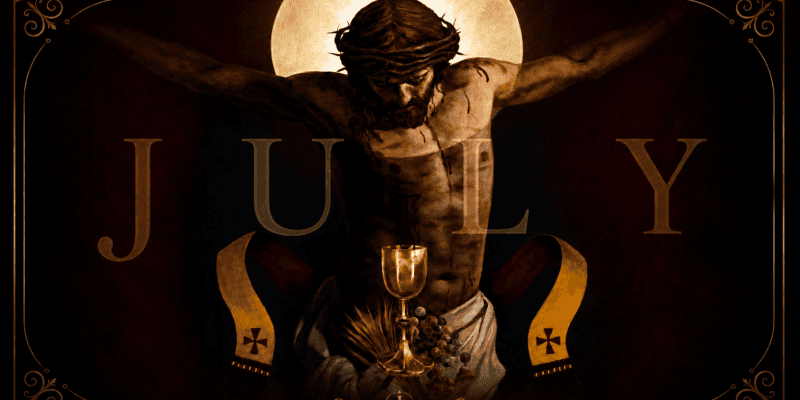
Today is not first a day for argument or for my self-admitted “stream of dissonance” writing. It is a day to adore, with whatever sliver of love I have, the price of our salvation.
On July 1, and throughout this month devoted to the Precious Blood, the Catholic Church turns her eyes to the Most Precious Blood of Our Lord Jesus Christ. For those familiar with the great Divine Office devotion, the traditional Matins for this feast gives Catholics something far richer than the typical pious theme or slogan we place on the marquee and then pass over too quickly. It gives us a structured, ordered meditation that teaches, inspires, and moves.
This first piece will not attempt to walk through all of Matins at once. It will stay where the Office itself begins, with the Invitatory and the hymn before the first Psalm, because if we do not begin in adoration, we will not read the rest rightly.
Nor will we feel the tug to begin the rigorous devotion ourselves, which is ultimately my only aim here.
In general, the spine of the whole Office is clear. Reverent worship comes before the prayer even begins. Then Scripture speaks first, as it always does in the Catholic Church. The antiphons then walk us through the Blood of Christ across the whole Passion, including a reminder of the saving name of Jesus and His Circumcision—who can resist bemoaning here the Vatican II sect’s removal of this feast from the calendar? Church Father Saint John Chrysostom then teaches the terror and power of that Blood against the enemy. St Augustine shows us the opened Side of Christ as the entrance unto life eternal. Even the historical note concerning Pius XI, who raised the feast in connection with the 1900-year anniversary of the Redemption, places the devotion inside the great march of Catholic memory.
One cannot help but ponder, then, the significance of the 2000-year anniversary, which we rapidly approach here in 2026.
The Office teaches cleanly, most solemnly, and with far more authority than any writer could. If Catholics want to know what the Precious Blood means, we should let the Church teach us how to pray it before we try to explain it or meme it away, as solid as those actions may be.
No Catholic devotion remains merely private in the shallow modern sense. The Blood of Christ purchased souls, founded the Church, illustrated the sacraments, and revealed the revolting, eternal cost of sin. In the Passion, Judas, Pilate, the crowd, the Jews, the soldiers, Roman governance, Jerusalem’s harlotry, and political and spiritual cowardice all stand beneath the same Blood—judged for then and all eternity. The Precious Blood is therefore not only consolation for the penitent soul; that is where too many a Christian stops today. It is, on a much broader scale, judgment upon every false order that tries to wash its hands like Pilate of the rigorous demands of the cross and the true Christian life.
With this in mind, I hope you can forgive me for not extending this article any longer than it is. It’s simply too big for one sitting.
So let us begin where the Church begins. It begins with the Invitatory and worship: “Christ, the Son of God, hath redeemed us by His Own Blood, O come, let us worship Him.”
The Invitatory
Before the lessons, before the antiphons, before Chrysostom and Augustine, before the great doctrinal meaning of Blood and Water flowing from the Side of Our Lord, the Church commands adoration—and she does it by what she provides us to pray. She does not begin by asking us what we think or with the feelings of the moment or with a vote or even with an explanation. She begins by placing the Catholic soul where every Catholic soul belongs in perpetuity: beneath the Blood of Christ in worship.
Is there any wonder why we, well, wonder, at Mary? She did this for His entire life. She gazed on Him with adoration His entire life and even after when He was dead in her arms. How impoverished a soul must be to mock her, or even to treat her adoration of her Son as some obstacle to Christ rather than the purest and most salutary of all creaturely responses to Him.
Modern Catholics, even self-styled traditional ones, forget the importance of this first principle. We analyze before we adore. We argue before we listen in silence. We search the latest YouTube podcast before we pray. We forward articles, watch videos, absorb clips, chase controversies, build private systems of explanation that others confirm, but this is not the order of love God wants from us. Devotion to the Divine Office, in a more sustained and demanding way than many familiar devotions, does something entirely different. It doesn’t say not to do all of those things in defense of Christ, but it puts those things in their proper place. And now that I am writing it, I see the reminder for myself: Information gathered for any purpose other than the love and defense of Christ is vain, perhaps even sinful, depending on the extent.
Worship comes first—true worship with silence, reverence, and adoration. Awe. Only then can the knowledge of the intellect be enlightened according to God’s good design.
“Come, let us adore and fall down; and weep before the Lord that made us: For he is the Lord our God: and we are the people of his pasture and the sheep of his hand.”
Come, let us fall down. And weep. Compare this now to the vanity and self-exaltation we are inundated by on social media and the entertainment world.
This is why, incidentally, I hesitate with Hildebrand, even though the intellect is being satisfied at every turn. Do I really love God enough to have merited this incredibly daunting responsibility, if in fact it is true? Even though it is plain to see that nothing about the conciliar Church is Catholic, and God often works in the most mysterious of ways?
Really, do I? Perhaps the next prayer, one that frequents every Matins even beyond today’s, is why I insist on working out my salvation not with brains only but with the accompanying “fear and trembling” Saints Paul and Peter preach:
“Forty years long was I offended with that generation, and I said: These always err in heart. And these men have not known my ways: so I swore in my wrath that they shall not enter into my rest.”
Terrifying. In a good way, of course. But terrifying.
The Hymn
Thus properly aligned in soul even before the pray-er begins, the faithful Catholic dives into Scripture as a reminder of the story of our salvation. It begins with the memory of God’s righteous judgment in the Flood and moves toward the greater mystery of cleansing through the Blood of Christ. The old world was once washed beneath the waters of judgment. Now the world is offered cleansing through the Blood of the Redeemer. It is beautiful poetry, yet it does not flower into silly ambiguities nor does it flatten into only rhythmic words. What it does do, with the beauty of the poet, is hold judgment and mercy together. The Precious Blood is the price. It is the cost. It is the answer to sin, the purchase of our souls, the terror of every demon who wishes our harm, the founding of the Catholic Church’s sacramental life.
Here are two parts of it:
“He who once, in righteous vengeance,
Whelmed the world beneath the flood,
Once again in mercy cleansed it
With the stream of his own blood,
Coming from his throne on high
On the painful cross to die….
When before the Judge we tremble,
Conscious of his broken laws,
May this blood, in that dread hour,
Cry aloud, and plead our cause….”
This marriage of judgment and mercy is precisely what modern religious language so often refuses to do. Today it is just about mercy, and mercy only for ourselves and our own sinful behaviors at that.
That is why this feast, as was the Sacred Heart of Jesus in June, is so necessary. Souls are simply not trained in the way of merciful judgment. Any hint of judgment is automatically excommunicated from the mind, deemed too harsh to truly be of God.
If the modern world wants that mercy without justice, or even forgiveness without repentance, peace without sacrifice, and Christianity without the Cross, the Office of the Precious Blood today counters such vain and diabolical effeminacy with clarity and literary momentum.
Final Thoughts on Today
I first intended to move through the entirety of Matins today, but the Office is too rich to be rushed and too ordered to be flattened into one long litany of brief paragraphs. So I am going to let this become a series, partly to maximize readership, yes, but more importantly to maximize sincere reading, prayer, and perhaps even the desire in some souls to begin praying the Divine Office themselves.
I began it after Lent this year, with absolutely no inclination to do so and no prayer for the will to do it before. I admittedly have been negligent in completing every prayer throughout each day, although Matins is indeed my favorite. I will continue to strive to be better, for myself and for you.
Today we stayed at the threshold: the Invitatory and the hymn. Worship before reflection or even the prayer-proper itself. Adoration before any words whatsoever. Judgment and mercy held together in the Blood of Christ.
Tomorrow we move beyond the hymn and into the first antiphon and Psalm, which makes the next piece different by nature, not merely a second version of this one. So please, do come back. The Office places before us the Circumcision and the saving Name of Jesus, then pairs that mystery with Psalm II, where the nations rage, rulers gather against the Lord and against His Christ, and the Son receives the nations as His inheritance. In other words, the Precious Blood immediately begins to move from the private devotion to which it is too often reduced today and into the public Kingship very few Catholics are even aware is the command.
That is where we go next.
“…And when eight days were accomplished for the circumcising of the child, His Name was called Jesus…”
Most Precious Blood of Jesus Christ, save us.
Most Sacred Heart of Jesus, have mercy on us.
—
***I read the Divine Office from the Sanctifica app.
Advertisement
Advertisement
