
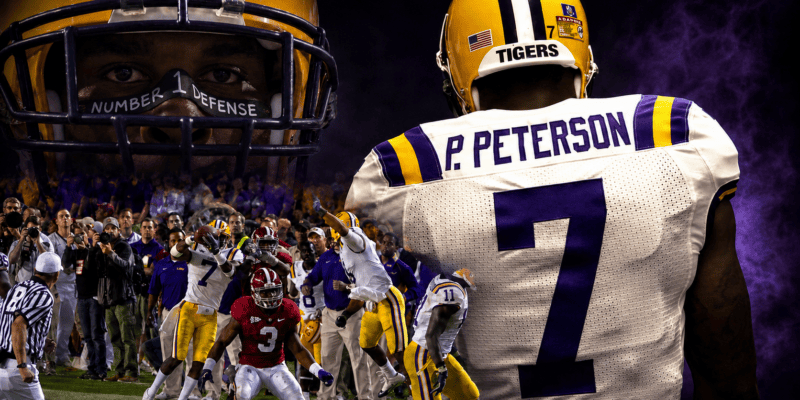
(First published on Saturday, July 11) — On July 11, 1990, Patrick Peterson was born in Fort Lauderdale, Florida.
That makes July 11 a meaningful date in LSU football history, because Peterson is not simply one of the best defensive backs LSU has ever had. He is one of the players who gave the traditional LSU defense its confidence, its nastiness, and one of its most visible symbols—
The No. 7 jersey tradition.
Many LSU fans might not realize that the No. 7 tradition began with Peterson, who wore it from 2008-10, then continued with “Honey Badger” Tyrann Mathieu in 2011 and hasn’t stopped since. Some have lived up to the star billing while some have been duds, but the topic has become one of those midsummer curiosities that keep the bed warm until opening kickoff.
For Peterson, who was drafted fifth overall in 2011 and enjoyed a stellar All-Pro career before retiring in 2025, that is quite a thing to start.
Peterson arrived in Baton Rouge as one of the most decorated high school players the LSU program had ever signed. By the time he left, he had become a trophy case with feet, winning the Thorpe Award as the nation’s best defensive back, the Bednarik Award as the nation’s top defender, first-team All-American honors, SEC Defensive Player of the Year, and SEC Special Teams Player of the Year in 2010. LSU’s bio also notes that he played in 39 games, started 30, finished with 135 tackles, 22 pass breakups and seven interceptions, and scored touchdowns three different ways: punt return, interception return, and blocked field-goal return.
Here is a more comprehensive list from LSUSports.net:
2010 Bednarik Award Winner (Nation’s Top Defender)
2010 Thorpe Award Winner (Nation’s Top Defensive Back)
2010 First-Team All-American (AP, AFCA Coaches, Walter Camp, Football Writers Association of America, CBSsports.com, Rivals.com, CollegeFootballNews.com)
2010 Southeastern Conference Defensive Player of the Year (Coaches)
2010 Southeastern Conference Special Teams Player of the Year (Coaches)
2010 First-Team All-Southeastern Conference Defense (AP, Coaches)
2010 First-Team All-Southeastern Conference Special Teams (Coaches)
2010 Second-Team All-Southeastern Conference All-Purpose (AP)
2010 SEC Special Teams Player of the Week (vs. North Carolina, vs. West Virginia)
2010 Lott IMPACT Player of the Week (vs. North Carolina, vs. Alabama)
2010 Hornung Award Versatile Performance (vs. North Carolina)
2010 Jim Thorpe Award Player of the Week (vs. Mississippi State)
2009 Second-Team All-America (Sporting News)
2009 First-Team All-SEC (ESPN)
2009 Second-Team All-SEC (AP, Coaches)
That is not merely a cornerback resume.
That is a case for an all-time great college football player.
That is probably the part most worth remembering now, especially after Tyrann Mathieu’s recent conversation with Whit Weeks on “In the Bayou.” Mathieu, who became the next great No. 7 after Peterson, was recently sitting across from a current LSU stalwart trying to help restore the very thing Peterson and Mathieu once made so visible.
Weeks said it plainly.
“I wanna bring back that nasty defensive mentality down to the Bayou,” Weeks told Mathieu. He said he grew up watching Mathieu, Devin White and Patrick Queen, remembering a time when teams feared LSU defenses. “That’s what I wanna bring back to this place. Teams turn on the film and they’re like, ‘Oh, shoot, we gotta go play these dudes on Saturday.’”
READ MORE: JULY 9, 2022: Whit Weeks Once Was and Still Is ‘Committed to the Boot’
It is worth noting that Peterson and Mathieu played together for the Arizona Cardinals and would earn NFL All-Decade honors for the 2010s.
Is everything Weeks said just nostalgia for nostalgia’s sake? Only this football season and time will tell. But what time is not needed for is to identify Peterson as a part of that standard.
Who can forget the “NUMBER 1 DEFENSE” painted in white on his eye black in the 2009 Alabama game when he went toe to toe with Julio Jones?
Toe to toe is key—and that takes us to the Alabama play.
LSU fans know the one.
Here is a piece of one SI.com write-up after the game by Andy Staples:
I wish I could have written Saturday about how Alabama receiver Julio Jones, who has struggled to break free all season, caught a 2-yard pass in the fourth quarter and turned it into a 73-yard touchdown. I wish I could have written about the grin on Alabama quarterback Greg McElroy’s face when he said “I’ve never seen anybody run that fast.”
I wish I could have written about how LSU cornerback Patrick Peterson fought off cramps for most of the game, or about how he just missed getting back on the field before that Jones touchdown play began. I should have written about how LSU soldiered on in spite of injuries to starting quarterback Jordan Jefferson (ankle) and tailback Charles Scott (broken collarbone).
Instead, I have to write about the SEC officials. Again.
Because when officials went to the video with 5:54 remaining in Alabama’s 24-15 win to determine whether Peterson intercepted McElroy along the right sideline, the replay official didn’t see what most impartial eyes watching at home saw: Peterson got his left foot down with possession. He may have even gotten his right foot down. Officials on the field ruled Patterson caught the ball out of bounds. After a few minutes, replay official Gerald Hodges upheld that call, even though numerous replays shown on the CBS telecast seemed to show Peterson getting that left foot down with possession. Later, LSU players would say Peterson’s left shoe left an obvious gash in the grass. (After interviews, I even took a photo of said gash.)
It was the interception that should have been.
It remains one of the worst calls LSU fans have ever had to swallow, partly because of the opponent, partly because of the circumstances, partly because of Saban, partly because it helped open the door for his first title in Tuscaloosa, and partly because the video looked so obvious—all perhaps in degree by that very order. Years later, Peterson himself referenced the blown call while reacting to another controversial sports decision, and NBC Sports revisited the moment, writing that McElroy “appeared to be picked off” by Peterson with an effort that looked as though it kept not one, but two feet in play. Alabama retained possession and added a field goal to seal LSU’s fate that day.
Of course one play did not create the Saban dynasty, even though it may sting that way to Tiger fans. LSU’s offense still had problems. They still would have had to move the ball and put the ball in the endzone. Alabama still had a defense capable of choking the life out of any hope that Peterson interception could have set up.
But that call has stayed in the LSU bloodstream because it felt like Peterson had done something extraordinary on a day and a moment in the fourth quarter when LSU needed it—a career defining play regardless of what the offense did with the gift—and had it taken away from him. Perhaps that’s why he is still talking about it years later. Great players do that sometimes. They make a play so sudden and improbable that the people responsible for judging it become the fans, angry that such a moment was stolen from both him and the team.
Still, the play was an interception and a career defining play, regardless of the refs. Then, one year later, he became the most decorated defensive back in college football history.
And then came Mathieu.
The No. 7 tradition passed from Peterson to Mathieu in 2011, and the connection between them was not just symbolic. The Arizona Cardinals’ own site later described Peterson as training Mathieu after Mathieu’s college career had busted at the seams, noting that Peterson had been in his third year at LSU when Mathieu arrived as a pesky and talented freshman. The same piece said Mathieu was becoming what he had set out to be: “The next Patrick Peterson.”
From a 2013 story on the Arizona Cardinals superstar tandem:
“Ever since that moment [they shook hands at LSU] we just clicked like big brother and little brother,” Peterson said. “We talked periodically throughout his recruiting process. Once he finally got to LSU in June (2010) we just jelled from the first day.”
Mathieu knew who he was meeting. He watched Peterson tear up Death Valley in his No. 7 uniform. But, at the same time, he didn’t know who he was meeting.
Peterson was quiet and laid back. His humble personality struck Mathieu. As Peterson hosted Mathieu throughout the weekend, the high school star kept noticing the same thing.
“He got along with all of his teammates,” Mathieu said. “They loved and respected him for what he did on and off the field. He didn’t talk a lot. He didn’t preach a lot.”
When Mathieu joined the Tigers in June before his freshman year, their bond strengthened. Peterson and Mathieu were together every day, watching film, talking football and becoming friends. They started working out together and it was then, under the sweltering sun in the blistering humidity of the bayou that Peterson saw glimpses of Mathieu’s talent.
Some may have a hard time understanding what made Peterson and Mathieu different than most players on the defensive side of the ball. Sure, talent, disruption, turnovers, return ability, and confidence were a part of it, but they are a part of many a college football player. But with Peterson and Mathieu, and with their numerous spectacular highlights as witness, fans were treated to that rare characteristic where, on any given play, a defense could do something truly timeless.
It is one thing that made the 2011 loss in the title game to Alabama so maddening, now that I think about it. You kept expecting Mathieu to do make a play, to turn the tide, to spark the comeback. And that never happened, and that is not even remotely an insult. It is the compliment of all compliments, because such an expectation shows how great that man was on the football field that year.
So when a now-retired Mathieu tells Whit Weeks that his passion, intensity, want-to and will remind him of LSU football, the words carry more weight than many might understand.
Advertisement
That is where Patrick Peterson’s birthday becomes a 2026 story.
The No. 7 tradition is expected to continue under Lane Kiffin, even if the next player to wear it has not yet been named. That makes the question feel a little more interesting than a normal midsummer jersey curiosity, because No. 7 is not just a number at LSU anymore. Peterson made it a standard. Mathieu only enhanced it. Others carried it in different ways, including Leonard Fournette and Grant Delpit. Ja’Marr Chase would have worn it but the Covid sham changed all that.
7-UP: LSU’s Chase Will Look to Stay No. 1 While Wearing New Number (March 2020)
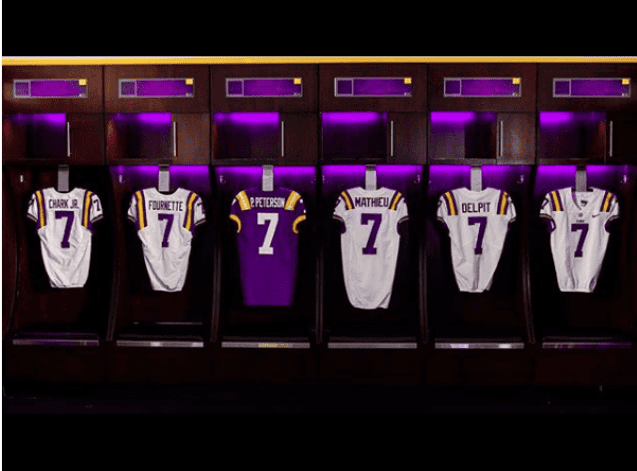
None perhaps, then, has worn it like those very first two. Maybe that’s why tradition is what it is—you can never quite replicate the original story, the original hand-off.
Now Kiffin inherits it.
The natural expectation, at least if the jersey stays on defense, may be DJ Pickett. He is a 6-5 cornerback, is a former five-star recruit, and made an immediate impact in 2025 as a true freshman, earning Freshman All-America and Freshman All-SEC honors while leading the team with three interceptions. That sounds like a No. 7 candidate if LSU wants the number back in the secondary, where Peterson first made it… just different.
But if LSU wanted to make the choice less about measurables and the eyes and more about what the number is supposed to represent as an every-down game-changer, Whit Weeks and his ferocious intensity in the middle of the field would be an intriguing darkhorse.
Of course, he would be a candidate for the No. 18 as well, since he skipped the draft, skipped the portal, and has proven what true loyalty to The Boot really means.
Weeks is a great candidate because, after four years in Baton Rouge, he is one of the players most determined to make LSU’s defense feel like LSU’s defense again. On Mathieu’s podcast, Weeks said he never once considered entering the transfer portal, saying, “I knew when I signed the papers to come here out of high school this was where I was gonna be.” He also said he wants to “bring back that nasty defensive mentality down to the Bayou,” the one he grew up watching in players like Mathieu, Devin White and Patrick Queen.
So yes, Weeks would look tough in the No. 7. And so would Pickett.
The larger point is that if both play at their highest level, especially alongside what should be one of LSU’s most fearsome defensive lines in years, the Tigers may have the defensive pieces to make Kiffin’s first season more than an offensive showcase.
Patrick Peterson, the original modern No. 7. He was born on July 11, 1990, came to LSU, wore the number, and helped turn that jersey into something larger than itself. He passed it to Mathieu, Mathieu carried it into LSU legend, and now Mathieu is the one asking Weeks whether that kind of LSU defense can return.
That is why July 11, through three Tiger greats, points back to the same question for 2026.
If LSU is going to recover what Peterson and Mathieu made visible almost an unfathomable 20 years ago now, the next No. 7 cannot be only a summer announcement swirled in fan curiosity.
It has to go to a man that will wear it as armor, and belong to a defense opponents fear again.
Advertisement
Advertisement
