
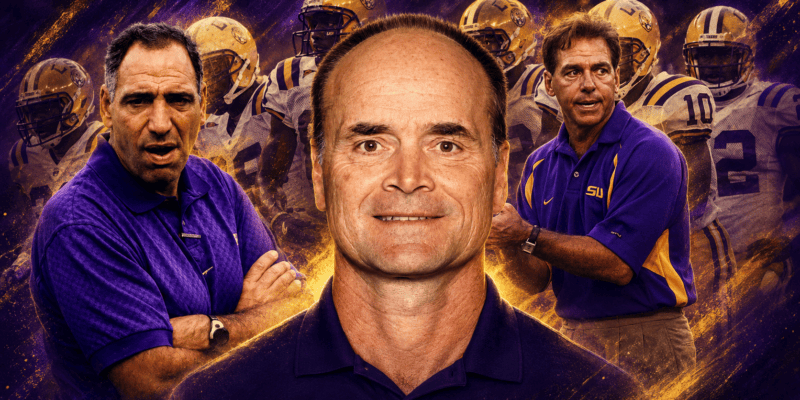
Admittedly we had to go pretty deep into the woods for this day in LSU football history. And when we got there, we found, however small, an interesting little quarry.
On July 8, 1959, Hal Hunter was born in Canonsburg, Pennsylvania.
That is not, of course, on the surface, a major LSU football date. The Tigers were just coming off the 1958 national championship season, and were about to enter the 1959 season as the near-unanimous favorite to repeat, but nothing from that day itself belongs in a history book. In the strange little batcaves of history, however, Hunter’s birthday opens a door worth walking through.
Big Game Hunter
Hal Hunter was head coach for LSU for one game, and he won it.
Hunter had been LSU’s offensive line coach under Gerry DiNardo and was promoted to assistant head coach in 1999. When DiNardo was fired before the final game of that miserable season, LSU turned to Hunter as interim coach.
Then came the odd part, if not infuriating. LSU, 2-8 and winless in the SEC, destroyed No. 17 Arkansas, 35-10. Hunter’s head coaching record at LSU: 1-0.
Perfect. We’d crack a joke about “printing the shirts,” as users on TigerDroppings like to do, but it wouldn’t be as much of a joke after Brian Kelly actually leaned into the bit last year before the Clemson game.
The jokes usually write themselves, of course. Hal Hunter is the only unbeaten and untied head coach in LSU football history, the sort of trivia answer you know is obscure but won’t for the life of you be able to remember when a free beer at the bar is on the line.
But after that single victorious game…
Nick Saban arrived.
There does not appear to be some famous Hunter-Saban conversation or dramatic handoff of the football. In fact, the DiNardo staff was gone with Saban’s arrival. But that may make the hinge even cleaner. Hunter did not build the Saban era. He simply coached the final game before the era of inconsistency and mediocrity would finally end.
Saban came to Baton Rouge with a wrecking ball. Everything changed. In five seasons from 2000-04, he went 48-16, won two SEC titles, and gave LSU its first national championship since that 1958 season.
And that, national prominence, overnight, after “Bring Back the Magic” had been the lowly standard, was the new one.
And it hasn’t gone away since.
Hunter was apparently not seriously considered for the permanent job, but forgive me if I’m wrong on that. The search ran through Joe Dean and Mark Emmert, more the latter if I remember correctly, and the public language, from what I have gathered, was clear enough: Hunter was the logical interim choice, not the future of the program.
Thus Hunter was not the almost-Saban. He was the one-game bridge before LSU went hunting for bigger hides.
There it is, the strange little thread I had to go hunting for.
The Hunt Continues in 2026
Yes, Hal Hunter coached the last LSU game before Saban, who built the LSU that made every future coach’s job a tiger cage. Then Saban, nearly three decades later, after all the Alabama bitterness and all the years LSU fans spent trying to hate their jilted lover, helped push Lane Kiffin toward Baton Rouge.
As Billy Beane says about baseball in the movie Moneyball, how can you not be romantic about that?
Advertisement
For that is where this little July 8 story bends toward 2026, and even more specifically toward our article from yesterday.
Kiffin was 24 years old when Hunter coached that one game against Arkansas. He was at the beginning of his own coaching life then, still a generation away from becoming the man LSU would hire to revive its Saban (and Miles, to be fair) pedigree in a sport that doesn’t much resemble what 1999 was.
I’d forgotten about “Recruiting Bashes” until I stumbled across it about a year ago.
But Kiffin’s LSU story, like almost every modern LSU football story, for better or worse, still runs through Saban. Kiffin has said on several occasions that Saban helped make the LSU decision for him, calling it the best job in America.
Football history is laden with full circle stories like this.
Before Saban, LSU was a program that remembered glory from a seemingly ancient past.
After Saban, LSU was a program that expected it—and that is what Kiffin inherits now, what Urban Meyer was referring to when he called LSU fans “nut jobs,” the standard Tiger fans were only dreaming of while watching Florida- and Florida State-type fans go wacky for their own teams in the ’90s, a standard which Saban made real.
Now Kiffin gets his own version of the handoff.
What the Hunt Left Behind
Nobody is asking Lane Kiffin to be Nick Saban, because even that road leads to another type of madness and probably a few broken remotes. Fans tend to glorify the past beyond reality.
But LSU as a university and as a fan base are asking him to understand what came after Hunter and what Saban made possible.
The abyss was indeed bleak in 1999.
But what followed was not just a coaching hire. It was a program deciding, finally, that remembering old glory was not enough. LSU did not merely want to talk about Billy Cannon, 1958, and what the Tigers used to be. It wanted to become dangerous, a reckoning for opponents no matter what stadium the game was played in. Saban made that real. Miles extended it, even if he did it clumsily at times, even shamelessly in the end. Orgeron, for one impossible season, caught the whole thing on fire and gave LSU perhaps the best single team in the history of the sport.
That is the inheritance now.
Hunter went 1-0 and disappeared into unknown LSU trivia.
Saban arrived and changed the meaning of the job.
Now Kiffin has to live with that meaning, because the standard and madness are real.
Advertisement
Advertisement
