
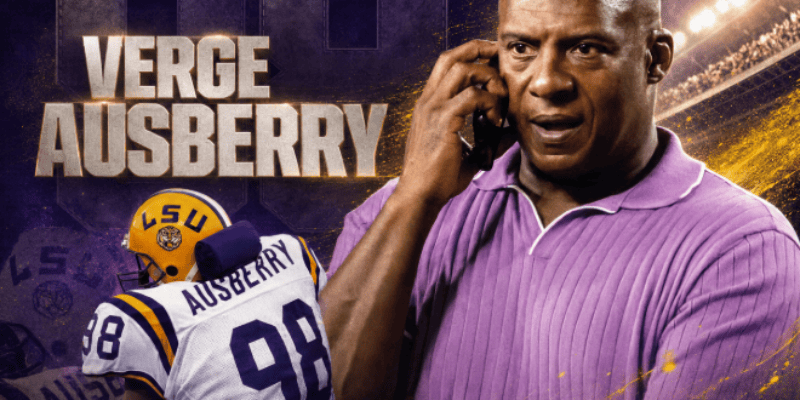
Over the last forty years, LSU Athletic Director Verge Ausberry has worked his way from a reluctant recruit from small town New Iberia to the top of the athletic department. After a miserable year 2025-26 across the three major men’s sports, his first decisions will determine whether all that patience produces championship pedigree again in Baton Rouge.
Ausberry was a standout linebacker for LSU (1986–89) and joined the athletic department as a compliance intern in 1991. He became the university’s 11th Director of Athletics in November 2025 and also serves as LSU’s Vice President.
“I arrived at LSU as a freshman student-athlete in 1985,” Ausberry said back in October, “and from that point forward, this institution has impacted my life and my family in ways I never could have imagined. It’s my responsibility to move this athletic department forward, including hiring the best football coach in America to lead our program. Our coaches and staff will continue to work every day to give our student-athletes the best experience possible and set a championship-level standard.”
But it all was very close to never even happening.
In his pre-LSU days, he was raised by career educators for whom discipline and grades came first. At New Iberia Senior High, he played football and competed in track, earning All-State recognition as a senior linebacker in 1984 along with All-District and All-Acadiana honors in the shot put. He did not attend his first LSU football game until that senior season, when Arnsparger and LSU assistant Jesse Daigle were recruiting him.
Our piece on Friday was not an exercise in unmitigated praise for the great LSU head coach Bill Arnsparger, no, but at the same time we meant no disrespect. In fact, late in the piece we directly pointed out that had Arnsparger stayed beyond three years at LSU, his championship dreams might well have come to fruition.
Certainly one of Arnsparger’s greatest selling acts has proven, after four decades, to be one of his most important gifts to LSU. He didn’t remain long enough to build modern LSU football himself, but one of the young men he landed came back and never left again, and has now inherited the responsibility of making the Tigers a monster again.
And running contrary to all of that? Ausberry admitted in a 2015 interview with Tiger Rag that he didn’t grow up an LSU fan.
“I really grew up an Oklahoma fan,” he said. “I loved OU. My parents were OU grads, and I used to watch all those great OU teams, the Barry Switzer teams. I could tell you the history of all that, because I grew up watching Oklahoma football. It was a big attraction to me.”
Ausberry didn’t see LSU as a final destination point because it simply hadn’t become the automatic path yet.
“I didn’t know much about LSU. It was foreign to a lot of kids in the state. There was a cycle going on then. Black players got here in ’72. It was kind of new. In every state, the blacks at that time didn’t have much affiliation for their state schools. They thought going out of state was the best thing.”
We’ll let Cody Worsham’s storytelling finish this part of our piece today:
BILL ARNSPARGER CHANGED ALL OF THAT. An ex-Marine and World War II vet and architect of the undefeated 1972 Miami Dolphins’ famous “No Name Defense,” Arnsparger spoke Ausberry’s language. He preached discipline and toughness, and convinced Ausberry to come to LSU as a preferred walk-on in 1985.
“Coach Arnsparger was a real selling point to me,” Ausberry says. “He was a man of great integrity. … I thought he could help me not only with football, but with life and a career. … I like discipline. I like structure, and he was that type of person.”
Ausberry earned a scholarship as a redshirt freshman, winning a letter as the Tigers won the 1986 conference title. …
The 1987 team, sandwiched between the ’86 and ’88 conference champs, is often overlooked, but the Tigers finished 10-1-1 that year. …
“I think ’87 was our best team,” he says. “… I think we could’ve won that one, and we should’ve beaten Ohio State here. That could’ve been, and should’ve been, an undefeated season. That was a good team.”
Ausberry is saying here everything we conjectured about Arnsparger on Friday. There was a national championship team tucked away in that program, just waiting to explode.
There is symmetry here that only the tantalizing ghosts of sports history can provide. The coach whose 1986 team ended LSU’s SEC title drought had recruited the one man who would one day, forty years later, choose coaches and distribute resources cunningly enough to restore the championship pedigree. The point is that Arnsparger’s LSU career ended too soon, yet his mark endures through the most durable piece he ever brought to the institution.
Ausberry became the part that stayed.
He played inside linebacker and lettered from 1986 through 1989, becoming a two-year defensive captain and LSU’s leading tackler in each of his final two seasons. He belonged to the 1986 SEC championship team under Arnsparger and the 1988 champions under Mike Archer, with the 10–1–1 team of 1987 between them. Among the postseason trips during his career were the 1987 Sugar Bowl, the 1987 Gator Bowl, and the 1988 Hall of Fame Bowl.
Ausberry left LSU only long enough to learn where he belonged. After NFL tryouts and a brief period in the World League, LSU Athletic Director Joe Dean encouraged him to return to Baton Rouge and finish his master’s degree. While doing so, he interned under Bo Bahnsen in the compliance office in 1991, then spent nearly seven years helping athletes earn their degrees in LSU’s Academic Center. He moved to the Tiger Athletic Foundation in July 1999, learning the fundraising side of the business by selling suites, club seating and stadium additions, before Skip Bertman named him Associate Athletic Director for operations in 2001. Ausberry became Senior Associate Athletic Director in 2006 and, working across seemingly every part of the department, was elevated to Executive Deputy Athletic Director and Executive Director of External Relations in 2019. He became Interim Athletic Director in October 2025; one month later, the landmark job became his.
Ausberry played on teams good enough to win two SEC titles but not a national championship, and he aims to change that here in 2026. His attraction to discipline was the reason he rose from the bottom of the depth chart after redshirting in 1985, and the reason there is hope that his work in the last several months will pay big dividends for LSU. In four decades of disappointments and resets, doldrums and celebrations, Ausberry has put himself in a position to know what it takes.
Ausberry’s hire did not come without criticism, although much of that criticism has faded amid his aggressive, no-nonsense work so far. That criticism did not prevent the university from entrusting him with the athletic department, and his first months have been marked by decisive, corrective action rather than hesitation.
The final result of the Ausberry hire, however, is now largely in the hands of Lane Kiffin, Will Wade, and Jay Johnson. An athletic director can choose coaches, provide them with resources, and allow them the space to cook, but those coaches must recruit the players and win the games. Whether LSU’s miserable 2025-26 becomes merely a passing low point and a necessary prelude to greater things will depend on what those three men do with the opportunities Ausberry has placed in front of them.
LSU hired Kiffin as its football coach on November 30, 2025. Kiffin had won at Ole Miss in the modern transfer-portal era, but Ausberry set the public standard for the appointment even higher than that. “We shared when we began this search that LSU would secure the best coach in the country and Lane Kiffin is just that,” he said.
Advertisement
We don’t have to declare that assertion as our own, not until Kiffin wins a title, but we should recognize it as the size of Ausberry’s bet, on both himself and the university. If the athletic director publicly identifies Kiffin as the best coach in the country, then playoff contention and championship relevance become the expected return—and sooner rather than later. The former Arnsparger recruit has chosen the coach charged with making good times at LSU feel trustable again, and he is now responsible for that choice.
It is a nice little loop back to the Friday article.
Kiffin was only the first major bet Ausberry made. On March 26, 2026, LSU pulled off another coup and brought Will Wade back for a second term as men’s basketball coach. Ausberry has described him as “a consistent winner, a diligent program-builder, and a charismatic leader.” And Ausberry’s support of baseball’s Jay Johnson has been expressed in dollars as well as words. In April, he said baseball would receive roughly five percent of LSU’s 2026-27 revenue-sharing pool, matching women’s basketball, along with additional NIL funding.
“Jay Johnson is one of the best. He has what it takes to win here. We’re going to make sure that at LSU, Johnson is always the No. 1 coach in the country,” Ausberry said.
Besides the big three men’s sports, Louisiana Radio Network reported that Ausberry said seven sports would receive revenue-sharing dollars. Sports like track and field and swimming will receive more scholarship money. And he’s reorganized the athletic department to put more of an emphasis on fundraising and securing NIL dollars.
“We have to be out there, and we have to be on the forefront. We have to be aggressive in that area. We’ve got to be raising funds and talking to our coaches daily,” he said.
Coach Johnson later said Ausberry had been instrumental in Johnson’s 2021 hiring and had played an important role in LSU’s 2023 and 2025 national championships.
While the basketball program is still finding its legs, Ausberry’s support of Johnson and the baseball program may be providing LSU’s earliest measurable reason for optimism. LSU entered the July 2026 Major League Baseball Draft with 22 high school signees in its 2027 class, and only a few appear headed to the majors. Unless surprises occur before the August 1 deadline for players to sign professional contracts, Johnson could retain enough of them to boast a remarkably deep incoming class and another strong foundation from which to build at Alex Box Stadium.
That outcome would belong first to Johnson, whose recruiting ability and history of player development persuaded those players to choose LSU and may now persuade many of them to stay. It would also suggest that the institutional backing Ausberry promised baseball is helping LSU compete in an era when keeping talent requires more than history and tradition. Kiffin’s early recruiting momentum, Wade’s rebuilding work, and Johnson’s success in navigating the draft offer genuine reasons for restrained optimism.
Ausberry has selected the coaches and committed the resources. What those decisions ultimately produce remains unwritten, leaving his own words as the promise against which LSU’s next chapter will be measured:
“I went to this school,” he said. “LSU is my school. I want to make sure when I’m here, it runs correctly and things go by right, and when I leave here, we set the next group on a path to be successful and continue to win.”
It has been an interesting path indeed for the reluctant recruit from small-town New Iberia who once didn’t even have LSU on his radar—and may now have the Tigers on the verge of a new gold standard.
Advertisement
Advertisement
