
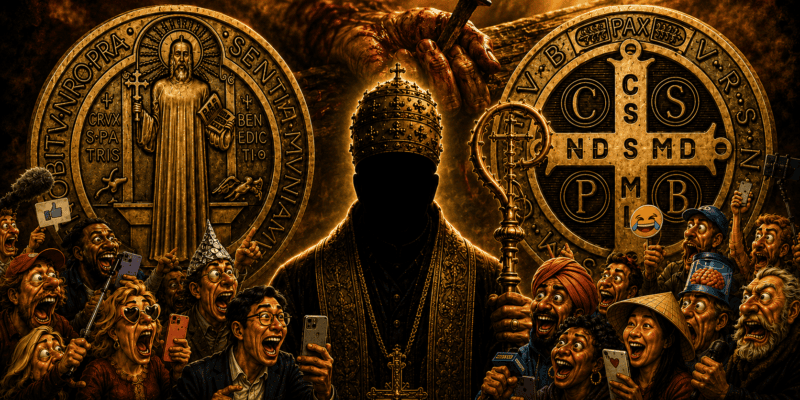
(First posted on RVIVR for Saint Benedict’s feast day)
The problem is not only that we have been lied to. The problem is that we have been formed to prefer the prince of this world through which lies arrive.
It is a political problem, sure. We see it in elections, wars, intelligence narratives, scandals, institutional coverups, and the daily manufacturing of public opinion. But for Catholics, it goes far beyond that. In addition to all the “public” Catholic tribes, some on the seeming fringe are being asked to judge grave questions concerning Leo, Hildebrand, Nicholas II, Paul IV, Universi Dominici Gregis, Benedict XVI’s Declaratio, the role of the SSPX and sedevacantism, universal acceptance of Leo, in addition to so many other contextual topics, while still receiving most of their cues from the same electronic spectacle that trained them not to think in the first place.
Souls have lied since Eden, so that’s not the problem by itself. The deeper problem is that modern man has been trained to accept the physics of presentation as though it were reality itself—and the prince of this world is in front of the classroom. If something appears on the screen, it is unquestionably real to us. If a question is not discussed by the approved personalities on YouTube, it seems tinfoil hat conspiratorial and certainly not of God. If the mob or even your good friend laughs or just hesitates against you, your own soul can hesitate as well.
That is why Saint Benedict, whose feast we celebrate today, may be the perfect intercessor in this time of crisis.
Saint Benedict: The Man After the Collapse
Today is one of Saint Benedict’s two feast days, the other falling on March 21. I have a special friendship with Saint Benedict, precisely because, unlike other saints I’ve gone to for an example over the years, he actually made his presence and assistance known to me, starting in 2017, a fascinating story that is ongoing but one that would be too far afield here.
Four Benedict medals rest respectively on the molding of the four corners of my home. There is one where I brush my teeth. I wear a Benedict pendant and ring. I am constantly asking for Christ’s protection through him.
I write this article today out of respect for such a saint who came before us. I write it for faithful Catholics who understand our religion and the encouragement it gives in placing before us models of true Christian worship. But I write it most importantly for Catholics trying to learn how to see again after years of spectacle, noise, mass societal manipulation, and public confusion over matters both political and Catholic.
The truth is hard. Christ said it would be. Saint Benedict, pray for us.
Benedict of Nursia was born in 480 AD, just four years after the Western Roman Empire collapsed, at least officially so. Rome had ruled for centuries as the center of civilization, law, and order. Then, seemingly overnight, it was gone—crushed under the weight of its own decadence, corruption, and arrogance.
And yet we know nothing like that happens that quickly. We don’t usually feel it all at once. We live—or exist—inside the erosion. We explain it all away or call the alarmists insane. God will always provide a number of souls sounding the alarm, bystander heroes, but getting mocked because no one ever thinks it will happen to them. Then, when the visible structure finally gives way, they speak as though the fall arrived suddenly. It didn’t. The ruin was already in motion long before and there were plenty of desperate voices trying to warn them.
Benedict was born into that world. He saw the ruins of what had been and knew that nothing could restore it. So he didn’t try. He didn’t waste his life attempting to revive a dead empire. Instead, he walked away and built something new—something that would outlast physical Rome itself.
Benedict’s approach—his Rule, if you want to research it—was radical. While the rest of the world fought for power, he sought discipline, order, and a life rooted in truth. He established monasteries, not just as places of prayer but as fortresses of Christian civilization. Within their walls, knowledge was preserved and the faith was kept alive. When the rest of the world slept into darkness, these communities shined like porch lights.
While the powers of this world fought over the remnants of Rome, Benedictine monks were prayerfully securing the future.
Catholics cannot misunderstand this saint as we do so many, relegating them to prayer cards. Benedict was not passive or hiding from reality and he wasn’t indifferent to the collapse around him. Holy detachment is not the same as indifference. He would not allow himself to mistake the old world for the kingdom that had to be lifted at all costs.
He understood that Christian order does not begin with the recovery of a dying and disobedient empire; in our time maybe it begins with the recovery of liturgical worship, the Mass, and, over the years, moves into full discipline, obedience, and truth inside the safe ark of the Catholic Church.
Advertisement
It is important to recognize that, one way or another, we are fighting the same war that has been waged for centuries: the war between truth and deception, between Christ and the forces that hate him. That is the hinge. That is the only true binary. The modern world does not tolerate truth, because truth threatens the entire system of false binaries and the maze of plausible deniability.
Our response is to rebuild the Catholic mind and the Catholic life from the inside out—and, for so many of us, it is in Hildebrand’s teaching and back story that we find hope.
He must become visible if more Catholics are to believe. And once visible, and if his claim is true under God, he must take on Rome, as the giants of the past once did.
See my work this past week for the challenge to the SSPX to help provide that visibility.
Final Thoughts
The recognition of that only true binary—the enmity between the seeds in Genesis III.15—help us with the questions in front of us now. The spectacle has brainwashed an entire people, including myself. A Catholic mind must be disciplined before it can judge Catholic questions with strength, and I admit, while intellectually not a single person has come forward to challenge the Hildebrand claim under the laws provided by past popes themselves, I cannot bring my soul to pledge allegiance to him publicly, not until he goes public himself. What I do in my own home and in the quiet of night or during the Canon of the Mass may be different, but I cannot bring myself to write it down for public consumption.
Too many souls read my work and I’d be on the hook with my Maker if I’m wrong on any point—main and secondary. And anyway, there is nothing I can do with my words here until either the people behind Hildebrand or the SSPX show him to the world. Some way, somehow, through that blasted electronic screen as a start if need be, we need to see him.
That is not even a doubting Thomas scenario. At least the Apostle lived with Christ for three years and was able to see him then.
Saint Benedict didn’t look behind him as Lot’s wife did. He built by moving forward from the ruins of Rome, by recovering order, and that is what I am attempting to do in challenging the SSPX to bring Hildebrand into view for us. They have the numbers and the strength to do it. They have the order.
Thus, order is where Part II will go. If Saint Benedict teaches us not to chase every rumor in the ruins, the Divine Office teaches us how to rebuild the Catholic mind in the first place–through psalm, antiphon, feast, discipline, and repetition. In the next piece, we move past the Hymn of Matins for the Feast of the Most Precious Blood and into the Office itself, where the Church begins to train us to see through the spectacle and judge according to God.
Saint Benedict, pray for us.
Most Precious Blood of Jesus Christ, salva nos.
Advertisement
Advertisement
