
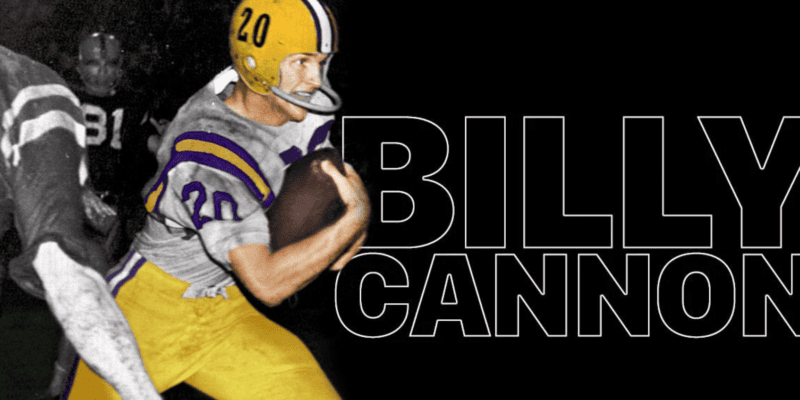
On August 3, 2017, one day after Billy Cannon’s 80th birthday, the LSU Athletic Hall of Fame Committee unanimously approved a statue honoring one of the greatest players in program history. The bronze would commemorate the 1959 Heisman Trophy winner, the Halloween Run, and the man who helped transform LSU into a national football power.
RELATED: SPOOKY: Billy Cannon Run is Just One Part of a Chilling Sports Story
Because LSU’s announcement also praised Cannon’s commitment to rebuild and dedicate his life in service, the university made clear that it was assessing an entire biography, which contained far more than an 89-yard punt return.
That biography included considerable public shame. In 1983, Cannon pleaded guilty for his role in a counterfeiting operation, receiving a five-year federal sentence and serving approximately half of it. The statue supplied no pardon. His guilt, punishment, and public disgrace remained permanent parts of his history.
After leaving federal prison and regaining his dental license, Cannon eventually accepted a position at Angola and worked to make amends for his past. Following his death in 2018, the LSU Alumni Association summarized what he had done there:
Cannon began working at the Louisiana State Penitentiary at Angola in 1995 and only retired in January of this year. When he was hired, Angola was facing a federal lawsuit over dreadful prison conditions. Newly appointed warden Burl Cain hired Cannon not only as a dentist but also to reform the medical and dental programs, which had fallen into disrepair. With Cannon’s hard work and leadership skills, order and efficiency were restored to both programs, and, by the end of the nineties, the federal suit was lifted. Cannon continued as director of the dental program for the nation’s largest prison.
“Billy is among the most heralded and identifiable college football players in NCAA history, and is largely responsible for the emergence of big-time football at LSU,” said then-vice chancellor and athletic director Joe Alleva. “I also believe his commitment to rebuild and dedicate his life in service to his family, the community and the university he loves is admirable. He’s a very human hero and LSU’s most renowned.”
While his football accomplishments established why LSU knew his name, those later decades demonstrated what he did after disgracing it, which is essential to any honest assessment of the man and, if we are willing to apply the same standard inward, of ourselves.
Cannon eventually became Angola’s director of dentistry, remaining there until his January 2018 retirement. His work did not expunge the counterfeiting conviction, but it supplied evidence of genuine rehabilitation, showing that a man could accept punishment and spend decades making himself useful again.
This is where we need to pray for the gifts of knowledge and understanding. Mercy can acknowledge guilt, while justice can leave room for a punished man to amend his life.
Sadly, although Cannon lived long enough to hear that LSU had approved the monument, he died on May 20, 2018, four months before the statue was dedicated outside Tiger Stadium, which gives the August 3 announcement additional poignancy.
Advertisement
In February 2026, President Donald Trump granted Cannon a posthumous pardon. That act of clemency arrived nearly nine years after LSU had already reached its own conclusion about Cannon: His crime belonged in the record, but so did what he chose to do afterward.
That judgment also helps us understand yesterday’s Gospel of the publican and the Pharisee. We stand with the publican when we recognize our guilt and ask for mercy, but we imitate the Pharisee when another person’s public disgrace allows us to forget how much of our own remains hidden. Cannon’s life does not ask us to judge his soul, nor is it a command of God to do so. It asks, even when judging the sin and not the sinner, whether later amendment of life is allowed to count in our personal courtrooms.
Does accepted amendment apply only to those inside our tribe, or does the charity extend to places it hurts?
I think LSU made the more demanding judgment. Public memory often becomes reductive, allowing one glorious moment or one shameful episode to consume an entire life. LSU allowed achievement, guilt, punishment, and amendment to remain visible at once—which is the old Christian way of understanding a fallen life: neither denying the sin nor denying the possibility of rising from it.
And so, the lesson is invaluable today, even for the most rabid of LSU football fans. The statue preserved the football player, sure. But the August 3 vote preserves something more consequential about the man, recognizing rehabilitation as a legitimate part of the same life, the same public biography. LSU left Cannon’s conviction where it belonged and still permitted his redemption to count, which may be the most honest way to remember him and the most difficult standard to apply to ourselves.
Thank you for reading The Hayride!
Advertisement
Advertisement
