
(Citizens for a New Louisiana) —

After we published our recent article on candidate responsiveness, several candidates pushed back. Some said they never saw our email. Others suggested it may have landed in a spam folder. Some accepted responsibility for overlooking it, while others offered explanations.
One candidate, however, deserves a correction from us. Carencro mayoral candidate Don Chauvin contacted CNLA after publication and told us he had responded before the deadline. We went back through the correspondence and found his August 25 response. The message was improperly sorted and overlooked during our review. Chauvin did respond before the deadline, and our original article was incorrect in stating otherwise. You can find his submission at the bottom of this page.
That mistake is ours, and we have corrected it. It also illustrates something from the original article: emails get filtered, messages get overlooked, and one unanswered — or seemingly unanswered — email can only tell you so much. When new information comes to light, the appropriate response is to acknowledge it and correct the record.
But what happens when public records remain outstanding for months—and even a direct promise of help from the mayor fails to prompt their release?
A Different Kind of Email
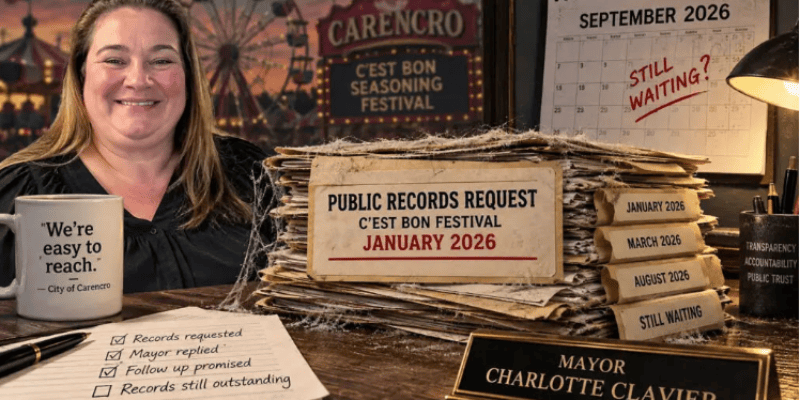
On August 18, 2026, Citizens for a New Louisiana (CNLA) sent an email to Carencro Mayor Charlotte Clavier. The email did not come out of nowhere. CNLA staff had recently seen Clavier at a Fleur De Lis Republican Women meeting. During that conversation, Clavier stated that if there were still public records CNLA was trying to obtain, we should reach out to her directly and she would send them over herself.
So we did. The August 18 email reminded Clavier of that conversation and identified four requests for records that had remained outstanding since January of this year. The records sought included financial records associated with Carencro C’est Bon Seasoning Festival: profit-and-loss reports, a complete general ledger, monthly bank statements, balance sheet information, and records of adjusting or correcting entries.
The message was not complicated. It essentially said, “You told us to contact you directly. Here is what we are still waiting for.” Clavier replied that afternoon and promised to follow up. Weeks later, the outstanding records still have not been produced.
The Missing Financial Records
These were not random accounting documents. Citizens for a New Louisiana has been examining the relationship between the City of Carencro and Carencro Pas Bon Grift Festival since early 2025. Records previously reviewed by CNLA showed that the City spent $3,000 in taxpayer money in 2023 to create the nonprofit, prepare its bylaws and obtain nonprofit status. Corporate records identified Clavier as the sole incorporator and later as a director.
Prior coverage reported that more than $40,000 in City funds had been advanced or spent on the nonprofit before a cooperative endeavor agreement was in place. Clavier’s involvement appears on both sides of the paperwork. As mayor, she signed the agreement governing the City’s financial relationship with the nonprofit. As a director of that nonprofit, she signed a sworn financial statement to the Louisiana Legislative Auditor.
But the agreement did not put the audit issue to rest. The latest City audit carries forward the unresolved finding. Finding 2025-003 identifies inadequate safeguards over public spending and the City’s failure to pass an ordinance specifying the nonprofit’s benefit to the City. The auditors warned that the loan may have violated Article VII, Section 14 of the Louisiana Constitution. The City’s own response acknowledged that the arrangement may not have fully complied.
Then there were the numbers.
This Doesn’t Add Up
The City initially produced a profit-and-loss statement showing approximately $123,903 in revenue, $151,212 in expenses, and a loss of about $27,309 for the 2024 festival. Later financial information filed with the Louisiana Legislative Auditor reflected approximately $139,115 in revenue, $170,942 in expenses, and a loss of approximately $31,827.
The later filing raises another basic question: its balance sheet does not balance. It lists $20,506.49 in assets but only $8,172.99 in liabilities and fund balance—a $12,333.50 discrepancy. That difference matches an unexplained entry labeled “Other.”
Those differing figures provided a clear reason to request the records beneath the summaries. After all, the Festival Corporation was now reporting numbers in a sworn financial statement that differed substantially from those previously reported to CNLA. If two reports concerning the same festival contain materially different totals, the logical next step is to review the general ledger, bank statements, transaction details, and adjusting entries. That is precisely what Citizens for a New Louisiana requested.
In March, the City’s response said the records were not in its possession but had been requested from the festival organization, which expected to gather them in approximately two weeks. Review for possible redactions would follow. That agreement expressly gives the City access to the nonprofit’s books and records upon request. Six months after that estimate, the records remain outstanding.
The Latest Audit Identifies More Accounting Problems
Carencro’s newest financial audit does not make those questions disappear. The independent auditors issued a qualified opinion on the City’s business-type activities and Culture & Recreation Fund because Carencro was unable to reconcile operating revenues to the individual point-of-sale systems. The auditors stated they could not satisfy themselves through other procedures as to the reasonableness of the revenues reported for the year.
The audit also identified inadequate controls over reconciling accounts as a material weakness. According to the auditors, the City did not have adequate procedures to reconcile the Culture & Recreation Fund general ledger accounts with supporting documentation.
For 2025, the Culture & Recreation Fund reported approximately $687,000 in operating revenue and $1.8 million in operating expenses, producing an operating loss of approximately $1.11 million. Carencro’s management attributed part of the reconciliation problem to construction and incomplete implementation of point-of-sale systems before May 2025. The City said it has since instituted regular reconciliations and intends to strengthen review procedures.
The records are being sought because questions about the use of public money, the relationship between the City and the mayor’s nonprofit, the accuracy of financial reporting, and the City’s own accounting controls remain unresolved.
“These Records Have Been Outstanding Since January”
This was not an unsolicited message sent into a generic government inbox. Mayor Charlotte Clavier herself had invited the follow-up. She had been told about outstanding records. She offered to help obtain them directly. CNLA took her up on the offer.
We again listed the records sought. We reminded her of the conversation. And we reminded her:
“These records have been outstanding since January.”
Clavier replied that afternoon. She said she understood the available records had already been sent, promised to check with Joy after returning from a short trip, and invited us to discuss the festival at City Hall. Weeks later, the outstanding records still have not been produced.
Responsiveness Is Not Agreement
One misconception about responsiveness is that answering someone means agreeing with them. It doesn’t. Mayor Clavier need not agree with Citizens for a New Louisiana’s characterization of the festival.
A public official does not have to agree with a citizen’s criticism. Nor does government have to give everyone the answer they want. But responsive government does at least provide an answer. That answer might be that the records do not exist. It might be that the City does not possess them, another official is the proper custodian, additional time is reasonably necessary to collect and review them, or that the government believes some or all of the records are legally exempt from disclosure.
The City relayed an estimate of two weeks to gather the records. Six months later, we are still asking for them. An estimate is not a substitute for producing the records.
Louisiana’s Public Records Law itself reflects that distinction. When requested records are not in the custody or control of the person receiving the request, state law requires that fact to be promptly certified in writing, along with information concerning the records’ absence and whereabouts. When a custodian questions whether requested material is a public record, the law likewise requires a written determination and legal basis within five days, excluding weekends and holidays.
The law also provides a mechanism for judicial relief when a requester receives neither a determination nor an estimate of the time reasonably necessary to process the request in that time period. The point is simple. The law itself assumes government should respond.
“We’re Easy to Reach”
There is an almost ironic contrast here. Governments routinely publish telephone numbers, email addresses, contact forms and directories designed to demonstrate accessibility. That is exactly what they should do. But publishing an email address is only the beginning of accessibility. The real test is what happens after someone uses it.
A government can have a beautiful website, a public records portal, multiple telephone numbers, and a directory full of email addresses. None of those things mean much if citizens repeatedly have to chase someone down after making contact. The City of Carencro’s own website tells visitors:
“We’re easy to reach.”
Responsiveness is not measured by how many ways government gives you to send a message. It is measured by whether anyone answers. Public officials will not always be able to fix your problem. They will not always agree with you, produce the records you request, or give you the answer you hoped to hear.
But when officials promise to obtain records, citizens should not have to spend months repeatedly asking for them. Answer the citizen. Then follow through.
Don Chauvin
Candidate for Carencro Mayor
After 37 years of public service, I am proud to announce my candidacy for Mayor of the City of Carencro.
I retired from the Lafayette Fire Department after 29 years to work for the City I love. As Carencro City Manager for six years, following three years as Fire Chief, I worked alongside the Mayor, City Council, and department leaders to advance more than $65 million in infrastructure improvements that are now underway. Those projects didn’t happen by chance—they required planning, discipline, and leadership.
As your next mayor, I will bring back steady, accountable leadership. I will work respectfully with the City Council to return to a conservative, responsible budget to ensure that taxpayer dollars are spent wisely—prioritizing infrastructure, public safety, and the quality of life our residents deserve.
Most importantly, I will bring people together—residents, businesses, community leaders, and public officials—to listen, collaborate, and move Carencro forward with a shared vision.
Advertisement
Advertisement
