
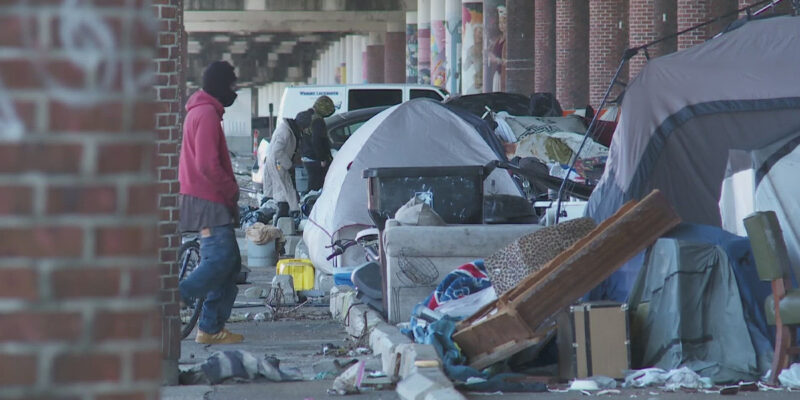
The Republican Gov. Jeff Landry Administration came up aces with its recently released plan to use federal housing funds in a way that actually mitigates homelessness in Louisiana.
Each year, the federal Department of Housing and Urban Development doles out grants for housing and homelessness programs. States and local governments have established panels to recommend to HUD proposals from various lead agencies willing to coordinate spending, in Louisiana’s case historically around $100 million combined annually. For many years until this year, these defaulted to a nonprofit agency called UNITY of Greater New Orleans and another outside of New Orleans, the Louisiana Balance of State Continuum of Care.
But those agencies followed a flawed worldview of optimal housing policy, and their distributional plans reflected that, where primarily the homeless were to be given permanent housing as a “solution” to homelessness, even as research has shown that approach is less effective than steering policy to make any housing most often transitional, as the large majority of homeless are that way because of behavioral issues they must solve to enable them to exit homelessness. The GOP Pres. Donald Trump Administration last year directed HUD to embrace the latter, a more effective strategy in how it distributed these grants.
Although a federal judge had blocked this redirection over a technical procedural matter, recently an appeals court gave the green light to the rebalancing. And Landry’s Louisiana Housing Corporation offered a plan built along those lines.
One of a pair of significant changes to state housing policy adds $20 million to the $80 million already allocated by other parts of state government to roof fortification programs. The previous versions would grant up to $10,000 for homeowners whose properties suffered wind damage to strengthen their roofs, a process that significantly reduces the possibility of damage. However, the typical stronger roof costs several thousand additional dollars. The new program pays for the entirety, with a design of enhancing the ability of these properties to become available as housing stock that, with less money needed for insurance premiums, ends up reducing rental or mortgage pricing. This helps the homeless who face bad fortune that causes them to lose shelter to regain it, which could include the physically disabled.
The other is building a transitional housing facility in Baton Rouge, with 200 beds and a requirement that clients participate in 20 to 40 hours of support services per week and purchase two out of three daily meals out of their own pocket, although that requirement could be waived for the elderly or physically disabled. It also appears that a similar facility in New Orleans would be operated, although there is confusion about that in the grant applications. With plans for each apparently rejected by the respective agencies overseeing those areas as of now, the state will appeal to HUD, which likely will decide whether to overrule these agencies and appoint LHC as the statewide overseer. If successful, this would facilitate individuals whose troubles that made them homeless, such as drug addiction, were self-inflicted, as well as those suffering from mental difficulties, by directing them toward treatment instead of allowing them to abjure it.
Naturally, the class invested in the previous policy has howled about this change. They focus their attacks on it in reference to the small minorities of homeless people who are not there by their own doing, when it’s clear the LHC policy advocated for shelters applies only to those who made themselves homeless by poor lifestyle choices and that policy will provide incentives for them to change their lifestyles, whether that behavior results from character flaws and/or deeper psychological problems. This upsets the establishment because its acolytes invest themselves in an ideology that holds that homelessness is not so much located within individual choices but somehow constitutes some systemic failure that relieves individuals of responsibility for themselves.
Fortunately, Landry has recognized that and is turning the rudder away from it. He can bring real hope to reducing homelessness with the policy his appointees back and seem likely to implement in the near future, which will benefit all Louisianans.
Advertisement
Advertisement
