
When discussing the impacts of Hurricane Katrina on the gulfsouth and New Orleans in particular, many people get stuck on what was lost without appreciating the other side of the story: an entire region that had the grit and determination to rise back up from the morass of mold and stagnant storm surge.
The remarkable recovery is as much part of the Katrina story as the destruction.
To repair buildings, infrastructure, schools, and residences is one thing but it’s another to salve the mind and soul.
And we needed that post-Katrina as much as anything.
For me one of the worst gut punches that was delivered came in the form of Ted Koppel’s infamous pronouncement on national television on the evening of September 6th that the Superdome would likely be torn down.
Sitting in my Arizona exile hearing such a seemingly authoritative statement broke my heart and dampened my spirit- which says a lot as I was certain I had lost everything that I did not cram in the two suitcases I brought with me.
Koppel’s declaration will go down for me as the most reckless and hyperbolic piece of what we would later classify “fake news” I had ever heard.
The 504 diaspora didn’t need to hear such a wild and farcical claim by a desk journalist no more qualified to make a structural assessment from looking at a photo of one of the largest covered stadiums in the world than he would to provide an estimate on a smashed in car door.
I wonder if Koppel said the same thing years later when the roof of Notre Dame in Paris went up in a blaze.
Fortunately New Orleans found a hero in the form of NFL Commissioner Paul Tagliabue.
Tagliabue leveraged the league’s resources and cut numerous deals with the Saints ownership and the state government to return the Black and Gold to New Orleans in the 2006 season.
And Tagliabue would spike the reopening of the Superdome on the national stage with a Monday Night Football game against the rival Atlanta Falcons.
But it wouldn’t be just any game as Green Day and U2 would perform to open the event covering the Scottish punk group Skids’ song The Saints Are Coming.
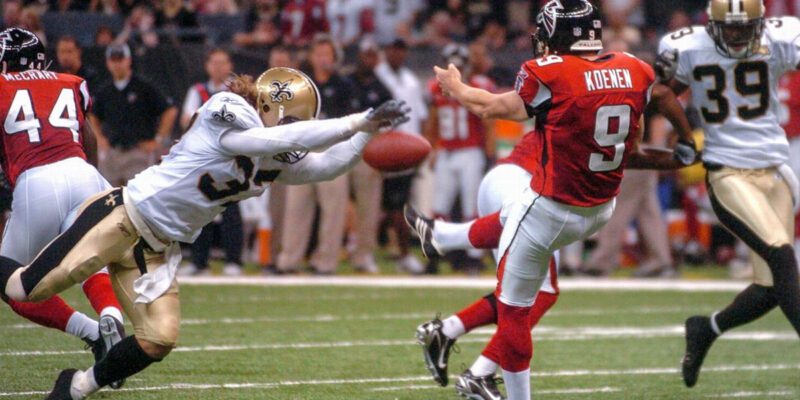
The contest would produce many incredible moments, particularly special teams player Steve Gleason’s flying block of Falcons punter Michael Koenen’s kick that would be recovered by Saints cornerback Curtis DeLoatch in the end zone for a touchdown.
Gleason’s play has been immortalized in bronze form as the catalyst for not only the rebirth of the franchise led by new head coach Sean Payton, quarterback Drew Brees (who was on the path to his own professional football career rebirth), and college sensation running back Reggie Bush but the city of New Orleans as a whole though there was still much more wirk to be done.
For me the unforgettable moment might seem mundane by comparison but was personally poignant: waiting in line to enter the Superdome for the game.
Tens of thousands of Saints players wearing different jerseys, hailing from various parts of the area, with different life and Katrina experiences yet united in one spirit all waiting together to shuffle inside the refurbished Superdome.
The Domecoming served as the de facto grand reopening of the city to the world.
As I walked through the entrance of the city’s second most recognizable architectural landmark (behind St. Louis Cathedral) I thought about Koppel’s erroneous claim from the year before and how Tagliabue and a host of state and city officials in addition to numerous workers who kept the faith and worked to transform what was a battered visual that was representative of a down and out city into a beacon of recovery.
Advertisement
Advertisement
