You can vote for a candidate and still betray your values.
If winning requires you to defend a lie, excuse cruelty, or silence your conscience, the compromise has already begun. The devil does not need you to renounce your faith. Convincing you to set it aside until after the election will do.
With early voting underway in states across the country and November 3 approaching, Christians must confront that danger. Our responsibility extends beyond choosing candidates. We must decide whether Jesus will govern how we pursue the victory we want.
An incident in New York offers a concrete example of what happens when a cause becomes an excuse for wrongdoing.
On October 19, vandals shattered a window and sprayed red graffiti at a Capital One branch on Manhattan’s Upper East Side. The messages included “Pal Action” and “Drop Elbit,” referring to an Israeli defense company. Palestine Action claimed responsibility, and the NYPD’s Hate Crimes Task Force began investigating.
Whatever grievance someone holds against a bank or government, breaking a window does not become righteous because a political message accompanies it.
The people who work there, the neighbors who use the bank, and those responsible for repairing the damage bear consequences that a slogan cannot erase.
Christians should defend peaceful protest and demand accountability for destruction. We must also insist on accuracy. An investigation into a possible hate crime must establish responsibility. A Palestinian flag does not establish someone’s religion or justify blaming an entire community.
We can condemn what the evidence establishes without adding accusations the evidence cannot support.
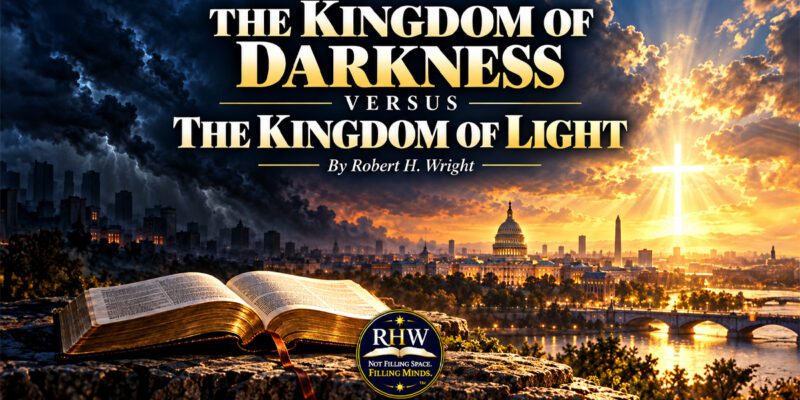
That discipline matters because the kingdom of light demands truthfulness from the people who claim to represent it.
Paul describes believers as people God has delivered from “the power of darkness” into “the kingdom of his dear Son” (Colossians 1:13, KJV).
Our citizenship in Christ’s kingdom establishes an allegiance that governs every other loyalty. His commands remain binding when obedience is inconvenient, unpopular, or politically costly.
The kingdom of darkness encourages rebellion against God’s authority. Its influence becomes especially deceptive when we convince ourselves that disobedience serves a righteous purpose.
We recognize that danger when others excuse vandalism. Recognizing it within our own political loyalties requires greater honesty.
Matthew 11:20–25 gives us a sobering reason to examine ourselves.
Chorazin, Bethsaida, and Capernaum had witnessed Jesus’ mighty works. They had received extraordinary opportunities to recognize Him.
Yet they would not repent.
“Then began he to upbraid the cities wherein most of his mighty works were done, because they repented not” (Matthew 11:20, KJV).
Jesus warned that judgment would be more tolerable for Tyre, Sidon, and Sodom. Greater exposure to truth had brought greater responsibility.
American Christians should take that warning seriously. We have Bibles, churches, and freedom to proclaim the gospel. We can explain biblical principles and identify violations of them in public life.
But knowing what Jesus commands does not establish that we are obeying Him.
We may demand honesty from officials while circulating an unverified accusation. We may insist on equal justice while defending special treatment for an ally. We may condemn hostility toward Christians while speaking with contempt about neighbors of another faith.
The offenses differ in seriousness and consequence. The spiritual problem begins whenever loyalty to our side determines which commands we are willing to obey.
An approaching election makes this temptation urgent.
Protecting unborn life, defending religious liberty, preserving public safety, and demanding honest government are serious responsibilities. Elections affect real people. Christians should study candidates’ records, compare policies, and vote with informed conviction.
We should examine whether candidates respect constitutional limits and whether their proposals protect the innocent and restrain wrongdoing.
We also need enough independence to acknowledge faults among those we support.
No candidate is flawless. Choosing between imperfect alternatives requires judgment. A vote does not obligate us to defend every statement, excuse every action, or treat every criticism as an enemy attack.
We can support a candidate and correct a false claim made on that candidate’s behalf. We can defend a policy and object to cruelty in its enforcement. We can seek victory without surrendering accountability.
Those choices demonstrate that Christ governs our political participation.
After warning the unrepentant cities, Jesus thanked the Father for revealing truth to “babes” (Matthew 11:25). His prayer challenges pride and self-sufficiency. We depend on God’s gracious revelation and must remain willing to be taught.
During an election season, that humility becomes concrete.
“I shared that story, but it was false.”
“I support your position, but I cannot defend what you did.”
“Our opponents deserve the same fair process we expect for ourselves.”
Such statements can cost us approval. They also give substance to our confession that Jesus is Lord.
America needs officials who protect the innocent, restrain lawlessness, and exercise power honestly. Christians should work and vote toward those ends.
But we cannot faithfully defend the kingdom of light by giving darkness permission to operate whenever it benefits us.
As ballots are cast, examine both the choices before us and the excuses within us.
Winning an election will never release us from obeying the King.
Robert H. Wright is a Christian writer, former pastor, and educator from Bossier Parish, Louisiana. An observer of conservative politics and Christian public life for more than 40 years, he serves as an elected constable and a member of the Louisiana Republican State Central Committee. His writing explores biblical faith, freedom, civic responsibility, and the America we leave to future generations. For past columns visit roberthwright.com.
Advertisement
Advertisement
