
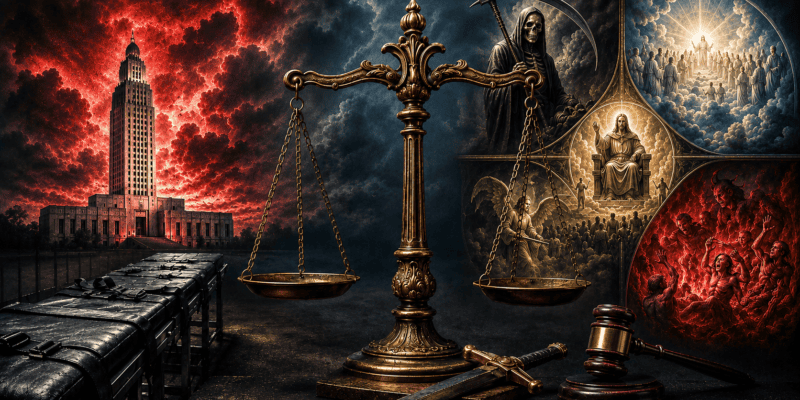
The death penalty debate always seems to find a way to avoid the thing itself.
When a condemned man’s final minutes become the entire moral universe and the victim, the victim’s family, the innocent public, and the divine meaning of justice are ignored entirely, something is fundamentally broken in a society.
That is why Jeff Sadow’s piece yesterday is worth reading. He is dealing with the practical Louisiana problem: If courts and activists are going to keep attacking every specific method of execution while leaving the death penalty itself constitutionally intact, then Louisiana has a practical problem to solve.
Sadow gives a solid political argument, which is of course what his space does, and admirably so.
But there is a deeper Catholic one that this space explores, one that does not replace the political argument so much as ground it.
The older Christian view of capital punishment was never merely about deterrence, though deterrence is of course of utmost importance. It was never merely about closure, though justice for victims is of utmost importance. It was about order, guilt, expiation, repentance, and the Four Last Things: Death, Judgment, Heaven, and Hell.
Modern, squishy sentimentality wants the punishment to come through rehabilitation, and the justice to come through unbalanced compassion and mercy.
Traditional Christianity through the centuries knew better.
Innocent I—fifth century pope and saint–in his letter Ad Exsuperium, Episcopum Tolosanum, made it clear:
It must be remembered that power was granted by God, and to avenge crime the sword was permitted; he who carries out this vengeance is God’s minister (Romans 13:1–4). What motive have we for condemning a practice that all hold to be permitted by God? We uphold, therefore, what has been observed until now, in order not to alter the discipline and so that we may not appear to act contrary to God’s authority.
Not “it is allowed under certain circumstances” as we see today. Not “it is regrettable but sometimes necessary” as we see today. No—Innocent I declared it fully in accord with divine law.
Advertisement
Pope Pius XII before the Second Vatican Council said this:
Even in the case of the death penalty, the State does not dispose of the individual’s right to life. It is up to the public authority to deprive the condemned of the benefit of life in expiation for his guilt, after he has himself deprived himself of the right to live.
St Thomas Aquinas in Summa Theologiae:
It is written: “Wizards thou shalt not suffer to live” (Exodus 22:18); and: “In the morning I put to death all the wicked of the land” (Psalms 100:8). …
Every part is directed to the whole, as imperfect to perfect, wherefore every part exists naturally for the sake of the whole. For this reason we see that if the health of the whole human body demands the excision of a member, because it became putrid or infectious to the other members, it would be both praiseworthy and healthful to have it cut away. Now every individual person is related to the entire society as a part to the whole. Therefore if a man be dangerous and infectious to the community, on account of some sin, it is praiseworthy and healthful that he be killed in order to safeguard the common good, since “a little leaven corrupteth the whole lump” (1 Corinthians 5:6). —Summa Theologiae, II, II, q. 64, art. 2
The fact that the evil ones, as long as they live, can be corrected from their errors does not prohibit that they may be justly executed, for the danger which threatens from their way of life is greater and more certain than the good which may be expected from their improvement.
They also have at that critical point of death the opportunity to be converted to God through repentance. And if they are so obstinate that even at the point of death their heart does not draw back from malice, it is possible to make a quite probable judgment that they would never come away from evil.” —Summa contra gentiles, Book III, chapter 146
St Augustine in The City of God:
The same divine authority that forbids the killing of a human being establishes certain exceptions, as when God authorizes killing by a general law or when He gives an explicit commission to an individual for a limited time.
The agent who executes the killing does not commit homicide; he is an instrument as is the sword with which he cuts. Therefore, it is in no way contrary to the commandment, ‘Thou shalt not kill’ to wage war at God’s bidding, or for the representatives of public authority to put criminals to death, according to the law, that is, the will of the most just reason.
Praiseworthy. Healthful. A positive good, not merely a tolerated necessity—because the execution of a criminal does not violate his dignity; it acknowledges it. A rational being, made in the image of God, is responsible for his actions and subject to just consequences. To deny that responsibility is to deny what Pius XII explained.
This is precisely why capital punishment requires moral seriousness, not bloodlust, however forcefully both Sadow’s argument and mine may read. Yes, the State must be restrained by evidence, due process, rightful authority, and a sober fear of abusing the sword God permits it to carry. But abuse of a power does not erase the power itself, and the modern allergy to final judgment and the afterlife does not overturn the old Christian understanding of public justice.
Of course none of that matters if the State doesn’t place itself squarely under God’s rule, and most certainly, it doesn’t. Thus every common sense argument will fail in this country until we rediscover the correct order of governance.
Given such complexities, which politics will never solve by itself, it becomes even more important that Christians not cheer every execution or trust every court. What it does mean is that Christians cannot pretend justice turned evil overnight because modern feelings started shouting in the megaphone. A lawful execution can protect the innocent, satisfy public justice, and, least discussed of all, force the guilty soul to confront eternity while there is still time to repent.
That is not cruelty.
That is the part of justice and mercy the modern world has excommunicated from the conscience.
READ MORE
The Four Last Things & the Old Faith: A View on the Death Penalty
Advertisement
Advertisement
